

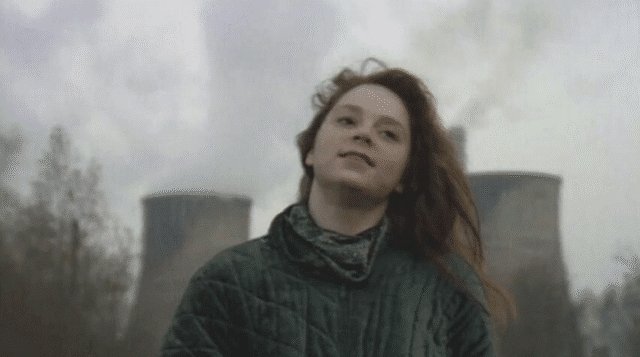
In their new film, Martin Gressmann and Peter Badel, both now in their early 70s, head east. White Smoke over Schwarze Pumpe (screening in German Competition) looks at working class life in an East German industrial town.
This is a project in two halves. The first section of the film was shot by Badel and another director, Dieter Chill, over thirty years ago, around the time of reunification, in 1990-1991, when factories and mines in the Spremberg municipality were closing down, and many of the local people suddenly found themselves unemployed. Maybe, some decided, capitalism wasn’t all it was cracked out to be.
For the second half of the film, Gressmann and Badel revisited the region between 2019 and 2025 to see how the locals were coping with the challenges of contemporary life.
“Badel and Chill are both from the East. They were doing their street interviews in 1991, just as the GDR collapsed. They worked for an East German TV station and made these films really quick, in three days,” Gressmann explains.
Many years later, he met Badel through the Film Academy Baden-Württemberg where they both taught. Gressmann admits they were like chalk and cheese.
“One [me] was from west Berlin and one was from east Berlin….but we always had the same opinion about the students, and so we became a little bit closer.”
Growing up in Brussels and living in west Berlin, Gressmann had certain preconceptions about the GDR, although he was also very curious about how life went on there.
“We had a lot of information about the east from let’s say artists who were freed and came to west Berlin or had been imprisoned there and had had problems,” he remembers.
After the Berlin Wall came down, Gressmann made “a lot of trips” to the east. Badel, though, still regarded him as being very ‘western.’
At a certain point, Badel showed Gressmann the material he had shot in the GDR. Gressmann was very impressed. That was then they decided to go back to the area to film again.
“A lot of the people they had interviewed in 1991 are not living anymore. Dieter Chill, who is a marvellous cameraman, stopped working, I don’t know why. Everything had changed…”
The co-directors were only able to track down one or two of the original subjects. They also noticed that the people were not as open as they had been in the early 90s. Now, they were much more wary about the media, and far less inclined to answer questions from strange men with cameras.
“We continued for five years, us two, without a sound man, trying to capture the mood of today,” Gressmann describes what turned into an epic venture.
Late on in the documentary, there is a disconcerting contemporary interview with a group of teenagers the filmmakers met on the streets. At first glance, the youngsters seem charming and perceptive, talking very frankly about their hopes for the future. But then they get on to the subject of migrants and the tone of the discussion very quickly darkens.
“I was shocked during the interview. I still wonder at how coolly I reacted. I didn’t believe my ears because they were so nice, naive and open,” Gressmann remembers the teenagers’ sudden expressions of xenophobia. “It’s interesting how natural this non-sympathy for foreigners [has become]. It’s with their parents but it is their own opinions too.”
He speculates that these suspicious and hostile attitudes date back generations. From the Kaiser to the Nazi era, communities have remained deeply distrustful of outsiders. It’s little surprise that the nationalist, right-wing Alternative for Germany AfD party is so strong in this part of Germany.
One of the paradoxes about Schwarze Pumpe is that the locals complain about the pollution caused by the factories – the white smoke of the title that is forever being belched out over the countryside – and yet they take a huge pride in the mines and factories.
“Peter Bader and I are close to Green Party thinking and we found it almost irritating how aggressively anti-Green the people there were. Lots of cars had stickers saying “F••k Greta” and so on.”
The two filmmakers had different approaches to their tasks. Bader was very direct and would often ask strangers intimate questions about their romantic lives and marriages. By contrast, Gressmann was more “theoretical” and wanted to address issues like working conditions and workers’ rights. Their camera styles were different too.
“During shooting, we may have been an odd couple but we were never really fighting. We often had the same interests,” Gressmann recalls.
Gressmann has been a DoP on several film and TV productions. During the making of the documentary, he played close attention to landscape, nuance and composition whereas Bader took a more “direct and tailored” approach.
Amid the interviews with workers, there are some action scenes featuring young, intrepid Motocross riders on their bikes, making prodigious leaps over muddy hills. “It was interesting because there were a lot of young girls also doing this Motocross. The moment they took their helmets off, you could see their long hair.”
This wasn’t an easy film to structure. The directors were struggling to find “new voices” and to work out the best way to end the documentary. Then just a few months ago, they met a couple finishing their night shifts. The man in his black t-shirt expresses his huge pride at working in the power station, providing affordable power, as if this is the greatest job that ever existed. Somehow, he seemed to embody all the contradictions the film had been trying to expose.
White Smoke over Schwarze Pumpe was made on a very modest budget. Alongside the two septuagenarian directors, a third collaborator was Anja Simon. The editor was Stefan Oliveira-Pita. Eventually, the filmmakers secured some funding from Medienboard BerlinBrandenburg, New Start Kultur and The Academy of Arts in Berlin.
Now, with the premiere at DOK Leipzig, the film should have the chance to travel. Gressmann has been receiving emails from sales agents keen to represent the movie, “even from London and from Israel,” he confides as if he himself can’t quite believe that such a local story can have such broad international appeal.





