

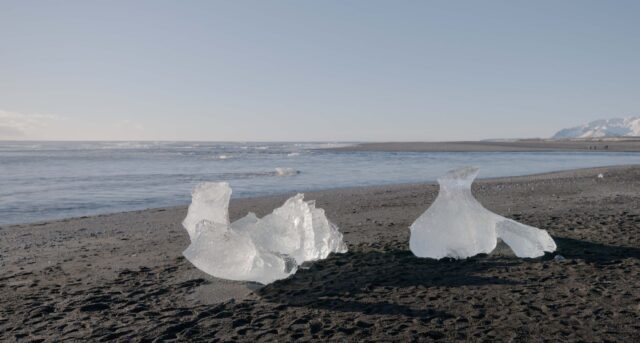
“You know, we want to sell the movie, and so we have cats and penguins,” documentary director Nikolaus Geyrhalter jokes about the animal cameos in his spectacular new feature documentary Melt (sold by Autlook and an International Premiere in DOK Leipzig) following its world premiere at the Viennale earlier this month.
This is a movie that intends to wrap its audience in a giant white shawl; to explore snow in all its manifestations and guises – and, yes, we do also see penguins traipsing across icy landscapes.
“Why should I not show them?” The director asks. “They [the penguins] are part of the last intact eco-system. You can walk close to them and they won’t run away because they are not used to the fact that humans could do any evil to them. Of course, they are sweet and they are nice but, in the film, it is important they are still there.”
The feline presence comes courtesy of a Japanese couple’s pet cat – but he is seen indoors as the blizzards rage outside.
Like most Austrians, Geyrhalter grew up around snow. He may have been living in Vienna but he still went on trips to the mountains with this parents or school.
“For me, it [snow] was just part of my childhood, let’s say. But now it is changing. Snow is getting less…”
Geyrhalter captures snow and ice in their full, mysterious beauty. The film includes many lovingly composed compositions of wintry landscapes, blizzards and Antarctic research stations, At the same time, he investigates reasons why glaciers are melting and even the swankiest ski resorts can no longer rely on natural snow to keep their downhill slopes running.
The film’s locations include the Tateyama Kurobe Alpine Route in Japan, the Val-d’Isère resort in France, and the frozen limits of Canada and Iceland as well. That’s a lot of air miles for the director and his crew. Geyrhalter is unapologetic about the travelling.
“For me, it is very simple. When you have a truck driver, you’ll never blame him for firing hundreds of litres of fuel every day just because he is doing a job that needs to be done. I do believe that a film like this is important.”
Geyrhalter could simply have abandoned the documentary to reduce its carbon footprint. He could have worked with remote teams as he did in his pandemic film, The Standstill (2023). “But that never worked because the way I am composing my images is so specific.”
The third option – the one he chose – was to go ahead with the film but to make it in as eco-conscious a way as possible. “If we had to travel, we had to travel as light as possible.”
Geryhalter tried to work with local crews. He also cut down on equipment. “If we go, say, to the Antarctic, there is nothing more than the usual two suitcases that you have with the airline. There is no aluminium case with camera and boxes. We packed as small as possible and used small cameras.”
Whenever possible, the filmmakers joined previously chartered flights that were going anyway to their destinations with scientists and researchers already aboard.
Filming in sub-zero temperatures poses obvious practical problems. Geyrhalter operates the camera himself. “Yes, of course, the camera doesn’t like it, the batteries don’t like it.”.
He learned some practical tricks. At the end of shooting, don’t ever let the camera get warm too quickly. Leave it in a cool place so it’s not exposed to sudden, big differences in temperature.
“Also, the lens has to be kept cold, especially if it’s snowing, because if snow is touching a warm lens, it would become water immediately.”
Even with Geyrhalter taking precautions, the equipment broke down several times. The film was shot between 2021 and 2025. The final parts, filmed earlier this year, were of bulldozers in Japan creating corridors through 16-metre-high walls of snow. When the camera went on the blink, Geyrhalter used an iPhone instead.
“We were trying to film this for several years. It took a lot of convincing people because nobody wanted a film crew there. They all said it was too dangerous.”
Geyrhalter was eventually able to convince the caterpillar drivers that he wouldn’t put himself or his crew at risk.
There are obvious contrasts in the documentary. For example, the atmosphere in Val-d’Isère, with thousands of tourists cramming the slopes, is very different from that in the Antarctic where there is sheer emptiness and isolation (apart from an occasional penguin).
“When we were shooting in Val-d’Isère, we were skiing with the camera. We wanted to have a ski resort. I preferred not to shoot in Austria.”
At the ski resort, they visit the “Atelier de Neige,” the workshop at which the experts go to extreme lengths to create artificial snow. As they discover from the engineers, “humans aren’t as good as nature.” Every real snowflake is unique and there are dozens of different types. Artificial ones are always the same, far less complex and far less beautiful.
Geyrhalter’s interviewees are generally shot in tableau fashion, in full frame, talking directly to the camera. It’s a technique which evokes memories of some of his fellow Austrian auteur Ulrich Seidl’s early documentaries.
“I was still a big kid when he came up with his movies and I liked them; I was fascinated,” Geryhalter says of Seidl. “He uses a wide-angle lens and so there are similarities [between us]. But what I like about his technique is that you see a lot of the environment where the people are living or working…it’s a question of being concentrated on what you see.”
The interviewees in Melt may talk in grim terms about melting glaciers and disappearing ice but they also express a sense of awe about the sheer splendour of the landscapes in which they work. Geyrhalter shares their sense of wonder.
“I did feel it, especially in the Antarctic and also in Japan. I never in my life experienced such a lot of snow before. It is really overwhelming. We are shooting and we are trying hard to come home with a good story but of course we are part of it. From the moment the camera is switched off, we are just people watching….I can’t see how not to be fascinated and sad at the same time.”
The director’s hope now is that audiences can bask in the beauty of the film’s images while also understanding that, as he puts it, “there is something wrong.” The snow is in retreat.
“If this film had had the title ‘Climate Change,’ nobody would have wanted to see it,” he reflects. “I’m not expecting a film like this to change the world, of course not, but consciousness is the beginning for any change…you can raise awareness!”





