

Moscow is growing much, much bigger. That is one of the early insights of Yulia Lokshina’s new feature documentary, Active Vocabulary, (produced through her company Oficina de Objetos Perdidos, and which premiered this week in DOK Leipzig’s German competition)
The film opens with satellite slides of the “New-Moscow Region.” Down at ground level, young workers are chopping down trees, ostensibly for the construction of a new school, but once the school is there, protesters know the property developers and carpetbaggers will soon follow. A 2012 government decree included the “New-Moscow” suburban woodland region, thereby more than doubling the city’s size.
Lokshina was originally planning to make a film about this land grab, but then came the Russian full-scale invasion of Ukraine in February 2022 and the scope of her movie expanded. The Russian-born director has lived in Germany since the 1990s. She had discovered the case of Maria, a Russian teacher denounced by her own teenage pupils for criticising the invasion. That teacher was forced into exile and is now based in Germany.
“We met in Berlin because she fled Russia and asked for political asylum in Germany. I read about her in German-speaking media, contacted her and told her I was working on this film and that I had an interest in what is happening to teachers [in Russia],” Lokshina explains.
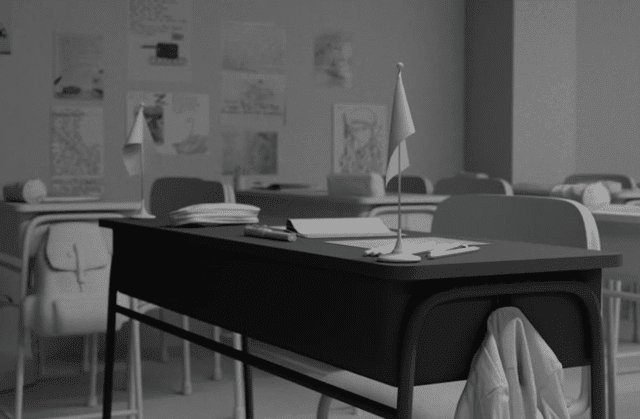
Maria becomes the main protagonist of the documentary as she stages an ingenious dramatic exercise in which her German students reconstruct the events that led to her being denounced back home in Russia.
Rather than conduct a conventional interview with her subject, Lokshina wanted “to put Maria’s story in a greater context and to bring it into her new German environment.”
At first glance, there isn’t an obvious connection between the state-sanctioned appropriation of the forests of New-Moscow and the experiences of the teacher. However, as the voice-over tells us, the school under construction has already been issued with strict new rules – and these are part of the often-sinister measures being introduced all over the country in the wake of the aggression in Ukraine.
“Speaking about the war was criminalised very fast. This is what the teacher Maria was experiencing also in her school,” Lokshina explains how, in the spider’s web of Putin’s Russia, everything is interconnected. She adds that “there is “an echo” between what the film refers to as “inner colonisation” in New-Moscow and what is happening in Ukraine.
“It’s obviously on a much more violent, dramatic and existential level [in Ukraine],” the director adds.
Born in Moscow in 1986, Lokshina studied documentary film at the Munich Academy for Television and Film. “I came to Germany as a kid. I went to school in Germany. You hear a brief reminiscence in the film of my school time in Germany. “
However, she was back in Russia to film the New-Moscow forest protests before leaving the country again after the full-scale invasion.
In the documentary, we learn that one of Maria’s fellow teachers, to whom she was previously close, turned against her after she was denounced. She thought they were friends but they ended up on opposite political sides.
“I can very much relate to this. A lot of is us maybe experience this. I don’t only have friends who have the same opinions as I do. I try not just to surround myself with people who think exactly the same. I am trying to stay in dialogue with people who are dear to me, to debate, discuss and challenge these differences…So I can relate to this, being close to a person, and then all of a sudden you realise there are dramatic differences between you that have severe, real-life consequences.”
An added complication, she speculates, may lie in some people’s desire to trust in the authorities. They find it very difficult to believe they are being fed false information. In “a certain terrifying political situation,” they are not sure how to respond.
“There are these greater political shifts and then, all of a sudden, the person starts transforming…certain people adapt to what surrounds them. We can’t say how certain people will behave if these tectonic shifts happen around them – and we can’t say how we ourselves will behave. I think this is also very scary.”
Another dimension of the film is the behaviour of the students. They’re the ones who secretly record the teacher’s comments in class.
“I find it very fascinating how Maria speaks about these kids. She had a relationship with them. She says they were smart and they were talented . I think they were very close. She still keeps speaking about them in this way after what happened to her, having to leave the country and not being able to go back,” Lokshina marvels at Maria’s generosity of spirit toward the youngsters whose actions have forced her into exile.
Then again, these are teenagers, not adults, and they’re under intense pressure to conform. “This village where Maria comes from is so remote from the front lines, so far away, and yet there is apparently this very strong ideological presence of the state that made them behave this way, or is setting the rules.”
It’s not clear that the students wanted to cause problems for Maria, or even realised they were doing so. They talked about the teacher to their parents – and then the parents had their own ideas about what was right and wrong.
In DOK Leipzig this week, Lokshina has been holding conversations with sales agents. Active Vocabulary isn’t the only film she has at the festival either. She is also close to completing another feature project, Around Paradise, produced by Trimafilm and which was presented in DOK Preview Germany, Leipzig’s event for works in progress and new films. This is billed as “a feature documentary on European settlement projects in Paraguay and their social and spacial architectures,” and is expected to be ready early next year.
“It’s a bit of a bigger scale project in terms of production,” the director says but doesn’t want to go into further detail at this stage. “It’s a complex and delicate story, so we will be happy to share more about it, when the film is completed“.
How did she make two full-blown feature docs back to back? “It’s intense! It was not intended that this happens at the same time. Some projects take years…some go faster unexpectedly.”





