

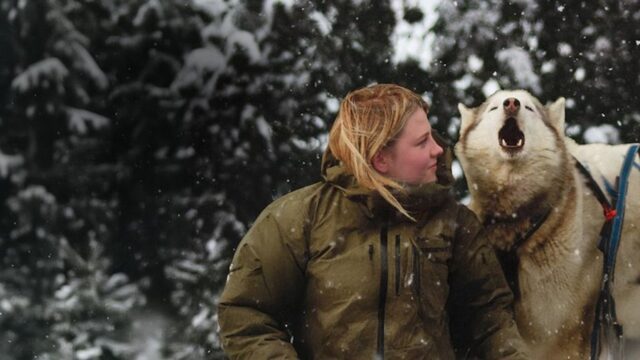
Within the Nordic countries exists the concept of the folk high school in which, over the course of a year, students can make the transition from teenager to adult through a programme of communal endeavour and self-reliance. The process also entails, at times, periods of isolation, albeit monitored at a distance by the school’s teachers.
In Heidi Ewing and Rachel Grady’s Folktales, we follow three such students – Hege and Bjørn Tore from Norway, and Romain from The Netherlands, as they embark upon a year away from their families and, by and large, from social media. The only companions they have in their new environment of Pasvik, located in Arctic Norway, are their fellow classmates…and a loyal pack of highly lovable sled dogs.
Each student is hopeful that the year ahead will be transformative. Romain is deeply lacking in confidence and finds it difficult to engage with the process. He performs poorly on a core assignment to go out into the woods, erect a tent and build a fire for the night, all the time accompanied by a sled dog that also needs protection from the cold. Romain eventually leaves after a term, but such has been the uniqueness of the experience he returns as the Nordic days begin to get longer again.
Bjørn Tore is without friends. He thinks he is “nice” but concedes that people find him “annoying.” At one point he remembers the sense of devastation he felt as a teenager when he was told by his father that the sun would one day die. But the business of self-reliance begins to have a profound effect on him, and little by little he discards his cloak of awkwardness as he builds friendships.
After a period of homesickness, Hege eventually takes to the folk high school experience like a duck to water. She misses desperately her dad, who was himself a keen outward bounder but who was killed in a brawl. She has natural survival skills and develops a very close relationship with the dogs who themselves seem to have an inherent sense of empathy for the students.
Everything is overseen by the inspirational teachers Iselin and Thor-Atle who, though kind and generous, are uncompromising in their insistence on tasks being performed correctly. They also have an equal sense of loyalty towards the dogs. “The dogs teach us to be more human, more patient,” says the older Thor-Atle, adding how it is “astonishing” that the dogs hold a key to liberating something inside each young person within the school. He further distils the essence of the solo nocturnal adventure in the woods, undertaken by each student. “A fire, a dog and a starry night above you,” is how he explains its simplicity.
A further layer of the film introduces us to the three Norns of Norse mythology who weave the threads of fate and shape the future of human beings. Their pronouncements serve as a chorus to events as they unfold in the film.
Directors Heidi Ewing and Rachel Grady were inspired to make the film after reading ‘Welcome to the Goddamn Ice Cube’ by Blair Braverman, an American dogsledder. “She had attended a folk high school and she talked about it being a transformative experience in her life,” Ewing tells BDE. “She described it as a ‘dog sledding high school’ and it altered the course of her life in so many ways.”
The filmmakers discovered that here are 400 folk high schools in Scandinavia, of which 80 are in Norway where the concentration is more on rural and outdoor pursuits. They investigated five Norwegian schools, eventually settling on Pasvik.
“This was the furthest away, the hardest to get to, the most impossible to photograph,” says Ewing. “And of course, that was the one that we decided on because of the teachers that we met there, Thor-Atle and Iselin. They were too good, too genuine, too special to walk away from.”
“They’re so capable and quiet about it,” Grady adds of the teachers. “You know, there’s so many people like that in the world. It’s good to be reminded and then just learn from them how to move in the world in a way that is just quiet and confident and grounded.”
The overall concept of the film was one very familiar to Ewing and Grady, and follows on from previous works of theirs such as Jesus Camp (2006), The Boys of Baraka (2005) and The Lord’s Boot Camp (2008).
“Heidi and I have made a lot of films on young people, on schools and camps, and we love that very straightforward framework of young people going to an institution and seeing what happens,” explains Grady. “And [in Folktales] these were amazing educators that were using dogs as their teaching tool. So it was like a bullseye for everything we like to explore.”
The canine aspect became a core component within the story as it unfolded.
“Dogs do have this amazing telepathic sense of empathy, when to be comforting or when to offer solace. They are the best thing that humans have, I think,” says Grady. “You know, humans and dogs have grown together as creatures on the earth over the last, you know, 10,000 years. So they bring out the very best in our humanity. So we couldn’t resist. That was catnip to us as storytellers, that dogs would be part of the growing experience.”
Ewing concurs, reminding as well that this was a film very much influenced by life during the pandemic. “We’re dealing with young people who are COVID kids, who have a lot of disadvantages because of living through COVID in their young lives. So there was a tenderness to the young people that we were filming…Because of COVID, I believe that the status of the dog on the planet was raised even higher.”
Ewing further muses on how the film they made exceeded, both in creative and emotional terms, the concept they had originally drawn up.
“This came out better than everything that we’d imagined. I went back recently and looked at our pitch deck, where you help raise financing. And all of the things I hoped that would happen, happened. And in spades, because of the tenderness and because of the transparency and the genuine nature of these young people. I didn’t imagine that,” she says.
“We’re in a very coarse moment in culture right now in the West – well, in the United States. I can’t say the West. So I guess I was very disarmed by how sweet and tender-hearted these students were,” Ewing adds. “I did not expect that. I expected a bit more hard-knocks, a bit more ‘jaded.’ I thought there’d be more jaded young people at the school. And that really threw me. I was so happy. But I didn’t really expect that. But in terms of transformation and hardship, and at least one character (Romain) chafing against what was being asked of him, I hoped for that. I imagined that. So I don’t think it’s a massive difference than what we had hoped for. It was just better.”
For Grady, the process of making Folktales was transformative. “I did not know I was going to come out of this experience so changed, so touched. I had this incredible life experience that is part of me now,” she says. “Of course, your experience doing something colours the art, so I think some of that ended up making it to the screen. But the stillness of the place just permanently rewired something for me. I think it was the ability for my nervous system to fully relax. It’s like a meditation that I’d never had. And then once you know it exists, you can keep doing it.”





