

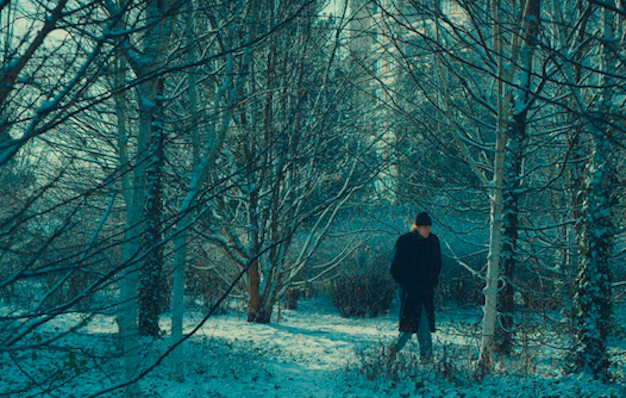
The protagonists of Patric Chiha’s new feature documentary A Russian Winter (showing in Berlinale Panorama and sold by Best Friend Forever) are young and charismatic. They’re the types you might expect to encounter in an early Richard Linklater or Jim Jarmusch movie, or even a Nouvelle Vague film. In fact, these are Russians in exile. They all left their homeland after Putin’s full-scale invasion of Ukraine in early 2022.
There’s an air of mystery about Margarita, Yuri and their friends. Austrian director Chiha came to know them very well and filmed them in many intimate and revealing situations. Nonetheless, certain aspects of their lives were hard to unravel. They don’t disclose too much about their personal circumstances – how they pay the bills and stay afloat. All we know is that they won’t be going home any time soon.
Chiha’s inspiration for the documentary came in September 2022 when he first saw images of young Russians crossing the border in Georgia, fleeing the Putin regime.
“They were facing a situation I could not imagine. Their faces seemed to say a lot about their fragility and the violence of our world,” reflects the director (whose previous credits include both fiction, such as The Beast in the Jungle, and documentaries).
He describes this as more a film “about friendship” than one analysing geo-politics.
Chiha’s first step was to travel to Istanbul to meet some of the young Russians who had fled their country. “At the beginning, I thought it would be a film about men – soldiers who do not want to do war. I met people from very different backgrounds, some very politically engaged, others less [so], some wanted by authorities, others not.”
Early on, Margarita, who eventually became the main character, was Chiha’s assistant. She translated interviews for him. “It was a job for her, [a way] to get some money. We talked a lot. We walked around. One day, it became very obvious to me I wanted to film her. It’s difficult to explain how you decide to make a film, but I would say her intelligence, her strength, her sensitivity touched me deeply.”
When Chiha and his team were working on the post-production, the editors nicknamed her “Brigitte Bardot” because she looked a little like the late French movie star. She was at the centre of a close-knit group of Russian friends in Istanbul.
One reason the characters are shot so often on the streets, in parks or on the beaches, is that it was very hard to film in their living quarters. This is a movie with a lot of chatting. Chiha catches his protagonists having very lengthy conversations about their predicament – but the camera never pries too close.
“The beauty of cinema lies in being able to see something that you cannot see otherwise – to have a window to the world. As a director, I think sometimes the best way to achieve this is to distance yourself from your immediate environment. I made a film about Russians. I am not Russian. I don’t live what they live,” Chiha continues. “For me, making a film is a way of opening up a space for reflection for myself and for others…”
The shooting period was lengthy and there was a lot of improvisation along the way. “We created moments where they [the subjects] could talk. Of course, at moments they were angry with me and said why do we have ‘’to talk so much?’”
In the end, though, they realised that their conversations were forcing them to ask probing questions about their lives and expectations.
Chiha adds that he films “without a goal. I don’t know what I am searching for.” When he started, he had no idea what direction the documentary would take but felt that these Russians were addressing subjects with which any audience could identify.
“And I feel there is conflict in their questions – loss and shame and guilt.”
The protagonists’ family stories are often heart-breaking. They have relatives who’ve died during the full-scale invasion. Some are estranged from their families.
Chiha refuses to make judgements. At times, when there weren’t translators on set, he didn’t even know what they were saying. “When I make a film, I’m very open. Of course, when you finance a film, you have to say what you will do but, in fact, I don’t know what I am going to do.”
Ask about the post-production and Chiha suggests this is also an intuitive process. He was working with editor, Anna Riche. “To speak about the editing is really the most mysterious thing. I am not sure I decide so much…the film decides! I try to be respectful to the characters. I try to make a film with ambiguous moments, a film that is complex and doesn’t give answers.”
He expects viewers’ feelings to oscillate as they watch the film. It’s important, though, that his subjects feel comfortable with the way they are portrayed. “It’s about respect…I don’t make films about people. I try to make them with them. The question for me is always what we can do together.”
He is adamant that this is “not a pro-Russian film at all.” Of course, he notes, “the Ukrainians are the victims.”
“I have friends in Ukraine. I admire their strength and extraordinary determination. I went to Kyiv for a festival in April 2024…it was a very, very strong moment for me,” he points out. “[But] I didn’t live what they live. I am not under the bombs. Who am I to film there?”
“Are the Russians in my film responsible for the situation or victims of the situation? This is a good question and I don’t have the answer…”
The documentary includes a poignant late shot of Margarita taking her possessions out of storage, presumably because is having to move yet again. We see her looking through old photographs, books and mementoes and suddenly becoming very emotional. She is a strong, resilient woman, but, for once, she is shown at her most vulnerable, sitting on a staircase, beginning to cry.
“We dig into very personal stuff. These people expose themselves…it was also nearly the end of the shooting,” he remembers. “I don’t know why she cries at this moment. We didn’t talk about it afterwards.”
Backing for A Russian Winter. came from the CNC. There was also some private finance but the budget remained relatively modest. Leopard Films will be handling the French distribution while Filmgarten has Austrian rights. The producers were Katia Khazak and Charlotte Vincent of Paris-based Aurora Films.





