

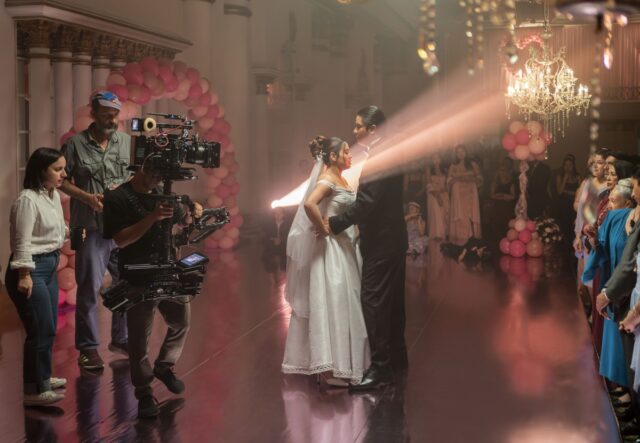
Oscar-nominated Chilean director Maite Alberdi (The Mole Hunter, The Eternal Memory) decamped to Mexico to make her new, Netflix-backed, feature doc A Child of My Own (Un Hijo Propio). She spent over three years working on the project, which received its world premiere this weekend as a Berlinale Special presentation.
Alberdi met her subject while researching another project inside Santa Martha prison in Mexico. Alejandra was one of the inmates. Alberdi was having lunch. They sat together and started to talk. It turned out that the prisoner had a quite astonishing story to tell. After two miscarriages and under huge pressure from her husband and relatives, she had successfully faked a pregnancy – and she had seemingly found another young, expectant mother ready to give away her baby.
“Okay, I always think reality is stranger than fiction,” Alberdi sighs as she remembers Alejandra’s account of how she simulated her own pregnancy. “I thought the events were extraordinary but, at the same time, quickly I connected with the questions about the depression of motherhood.”
In her usual hybrid fashion, the director uses both dramatic reconstructions and conventional documentary techniques to bring Alejandra’s experiences to life.
“To understand the present, I needed to tell the past,” she explains why she cast young actors to play Alejandra and her husband 13 years ago.
At first, Alberdi believed Alejandra’s story “100%.” Only gradually did she spot the cracks in her new friend’s narrative. “The structure of the film was completely my journey. I believed her testimony…and then I started to hear the other voices.”
It wasn’t exactly that Alejandra had been lying. It was just that she had her own version of events which didn’t fully accord with the facts. That was why she was now behind her bars, and why the young mother whose baby she had taken felt so aggrieved.
“Then I connect again with her because I understand the suffering, Alberdi tells BDE. “She made mistakes. Here are two women that suffer a lot.”
Alberdi sees the film as reflecting a system that is failing, When Alejandra suffered her miscarriages, there was no proper support for her, and certainly no mental care. “She has a family that puts so much pressure on her.”
Somehow, the doctor and her local hospital failed to notice that hers was a phantom pregnancy. Had they done, the story would have turned out very differently.
“Nobody was looking at her. For me, it’s a big tragedy because she was trying to make a big effort to be the good woman and to be what society was asking from her…and in the end, she is a woman in prison. It is very extreme.”
The cast includes professional actors, among them Ana Celeste, Armando Espitia, Ángeles Cruz, Mayra Sérbulo Cortés, Luisa Guzmán.
“The magic thing about documentary today is that you have the freedom to choose the best form for each character…in this case, I felt the usual way I shoot was not enough to understand that context.”
On one level, this is a dark story about oppressive patriarchy, Mexican machismo and the plight of childless mothers. However, Alberdi brings lightness and lyricism to potentially oppressive material. In real life, Alejandra loves the colour pink – and so the film is drenched in it. “It’s a big tragedy…but it has a lot of humour too.”
This is the director’s first documentary with Netflix (although her 2024 crime drama In Her Place was also backed by the streamer). “When I told them the story and said I wanted to make an hour of fiction [within it] they [Netflix] quickly took the risk. The documentary department worked with some people from the fiction department. All of us were experimenting and trying to find a way and they were very respectful – they fully financed and they gave me all the freedom to do the film I wanted to do.”
Nor does she sound concerned at not having a full-scale theatrical release for the film. She gets to premiere it at festivals (others are lined up for after Berlin) and then has the chance to reach a huge global audience. “It’s the best of both worlds.”
As for being a Chilean working in Mexico, that wasn’t a stretch either. She suggests both cultures are very similar, with the same cult of machismo. “Of course, there are some language things…but it is a country that I recognise easily.”
The real Alejandra passed as pregnant by eating vast amounts of food. Ana Celeste Montalvo Peña, the young actress playing her, was given a prosthetic stomach and so didn’t have to stuff herself. Armando Espitia, who plays her husband, seems a harsh and unsympathetic figure in the dramatised scenes – but when we see the real-life figure later in the documentary, he seems likeable and self-deprecating.
Alberdi explains that the fiction part of the film is giving Alejandra’s view as it was all those years ago. “We were not reconstructing reality. We were making a representation of her testimony,” is how she describes the process.
When she first met her subject, Albert didn’t know how the story would turn out. She trusted Alejandra’s story.
“It was difficult to have the other testimony but, at the same time, I connect with both of them profoundly,” she says of Alejandra and the mother whose baby was taken. “I understand the pain of both of them.”
The baby is now a 16-year-old girl. Alberdi met her, interviewed and considered including her in the film, but eventually decided it would be to too intrusive to do so. “I felt I needed to take care of her in a way. She is going to school and she is going to be connected with this [the film].”
Alberdi won’t disclose details of what precisely she’s up to next – but confirms it will be a documentary.
One final insight into the film is that the tarot card reader [also inside jail] who is shown reading the prisoner’s fortune really did get all her predictions right. That scene was filmed when Alejandra was still in prison, and just about everything she predicted came to pass.
Alberdi herself produced the film alongside Alberdi Sandra Godinez, Carla González Vargas and Maximiliano Sanguine.





