

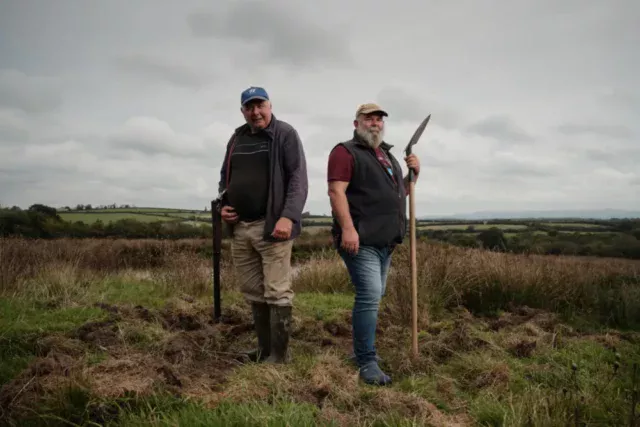
In James Dawson’s new feature doc, selected for Thessaloniki Doc Fest International Competition, two Devon farmers work their farms in radically different ways. One is mammothly into conservation, biodiversity and rewilding, while the other opts for heavy industrial processes, including the extensive use of pesticides and insecticides.
The two men are, one would correctly assume, at odds much of the time. The chemicals of the latter seep onto the land of the former. On the flip side, the wild boar that are newly introduced onto the re-wilded land continually escape into adjacent farmlands, and are seemingly a menace to the grazing sheep.
The farmers seem roughly the same age (maybe in their late-60s), and as far apart on the sustainability spectrum as one can imagine.
But there is one thing that they share. They’re both called Derek.
Derek Gow is Scottish, and devoted to organic farming. He gave up sheep farming literally to allow his land to go to seed, and in the process was determined to reintroduce endangered wildlife into the countryside, starting on his patch. These include cranes and water voles, beavers (there is the possibility that all of the beavers that are currently reshaping the River Tamar, which separates Devon from Cornwall, escaped from his land) and boar, even turtle doves. He states quite openly he isn’t doing all this “to win a popularity contest,” while also pointing out the paradox of modern farming. “We create food in great abundance but at the same time destroy nature, to the extent that it is beyond repair.”
He thus holds a very dim view of view of his neighbour, Derek Banbury. “If anything opposes him, he gets his shotgun and out and blows its face off,” says Gow.
This is an assessment that Derek Banbury wouldn’t necessarily disagree with. When a boar escaped onto his land, he indeed had it shot and butchered for joints of meat (even if it made terrible sausages). “He’s spoiling good land,” Banbury (who is actually very genial and friendly) says of neighbour Gow. “I’ll never agree with it [rewilding], as long as I live.”
Interestingly, Mrs Banbury really likes Derek Gow. She thinks he is a big Scottish softie. What’s more, her bed and breakfast business is thriving because of all the environmental experts who come to speak at events arranged on Gow’s farm.
Equally interesting is that Derek Banbury is of an age when he remembers fields teeming with wildlife, such as bees, insects and butterflies, and festooned with wild flowers. Which is what he sees more and more on his neighbour’s unkempt land and hedgerows. And when Gow takes him for a longer walk around his land, he is thrown into confusion, and forced to concede, “I hate to say it…Sometimes, he’s right…I don’t know.”
Is it possible that Banbury is softening his hardline position on sustainable farming, and would he ever be prepared to introduce root and branch change on his own land?
Director James Dawson was looking to make a film on bio-diversity – “one of those silent crises that which we’re heading towards as a society that’s getting worse, not better” – when he came across Derek Gow. “He’s such a maverick and unusual, and a big character doing unusual things…he’s transforming the land physically,” Dawson describes his protagonist, who has created hundreds of pools and mini lakes on his farmland.
But Dawson was also looking for balance in his story, determined to understand the perspective of Gow’s neighbours, at which point he encountered Derek Banbury. “He was his nearest neighbour, and he was a great character, an A-class character, someone who I always look for in a film, someone who is funny, warm, open, thoughtful, and just generous. And also the direct opposite of my main character as well.”
Banbury doesn’t dislike Gow, far from it. They actually have a close affinity in both loving animals. “But he couldn’t agree or understand what on earth was going on over the hedge. He felt a great antipathy towards what Gow was doing, because he just thought the land was all about farming and about producing food.”
Ask Dawson where he, himself, stands on the issue and he answers without hesitation. “We produce this abundance of food, which is brilliant, but at the same time, we’ve destroyed biodiversity and nature along the way,’ he says. “And you see that the life is being sucked out of the earth, nothing by way of woodland or hedgerows or whatever, just this cultivated land, going as far as the eye can see.”
The disturbing thing is that new generations know little other than fields which resemble these “green deserts,” Dawson adds, referring to ‘baseline shifting syndrome’, whereby “if you’re a young person today, you’ll be used to the fact there isn’t much nature, so you’ll think it’s normal.”
But Banbury does remember times of natural abundance, and so a crucial seed of concern gets lodged in his brain about the industrialised processes that he has hitherto preferred. “He remembers what it was like in those fields 50 years ago, when it was full of life, full of insect life, full of birds and species that are nearly all gone,” says Dawson. “So that was the joy, in a way, of talking to Derek, is that you could tap into his memory about what life was like when he was a boy, and yeah, has was like, ‘I sort of miss that.’”
“And then he did something I didn’t think he was going to do. He turned around and said, yeah, I can see there’s a problem. This is being demonstrated to me now. But I’m going to acknowledge it. And I’m going to try and do something about it.”
The film has also been picked up by CAT&Docs, whose CEO Catherine Le Clef comments: “Around the world, farmers are being forced to rethink how we produce food while the need to restore and protect nature has never been more urgent. By capturing that global crossroads through one intensely personal and entertaining rivalry, the film feels both timely and universally resonant.”
Unsurprisingly, impact is core to the future trajectory of Derek vs Derek, which received two grants from the US-based Redford Centre, a non-profit itself dedicated to environmental impact filmmaking.
“My producer, Serena Kennedy, has come up with a very ambitious plan to have 600 screenings around the country in front of rural audiences, farmers in agricultural shows, village halls, pubs, cattle markets, so we can get the film out, so it can help,” says Dawson.
The date for a UK premiere is yet to be announced, but there are already 50+ venues already lined up who want to screen the film, “and we’re hoping for many, many hundreds more.”
“We hope to help push the debate about nature restoration and farming forward in Britain so that we can start this process of bringing nature back,” he adds. “But at the same time, we still need farming and people who are going to be responsible, and those people are farmers, because they’re the people who are the custodians of the land.”





