

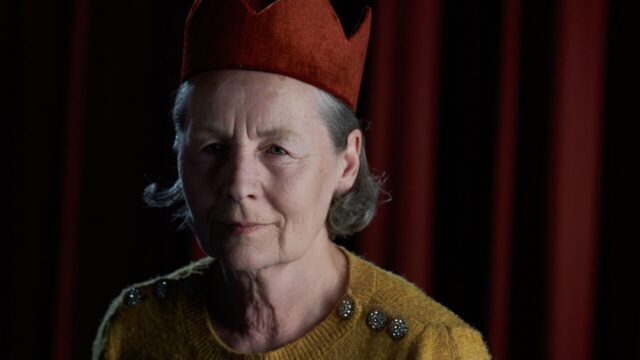
Revered Faroese actress Birita Mohr hasn’t performed for 12 years and some fans in the Faroe Islands may even have forgotten her, but her son, theatre director, actor and jazz musician Búi Dam, certainly isn’t one of them. To him, she is a legend. In his feature documentary Birita (a world premiere in CPH:DOX) he puts her back on stage to jog the public’s memory
Playing King Lear would be a challenge at the best of times anyway, but Birita now has Alzheimer’s.
“She hadn’t got an award – she should have for her life-long contribution to theatre,” Dam explains a key motivation for making the documentary – and for staging such an unusual production of Lear. “One of the goals with the film, and also the play, was to take care of her legacy both for the public and for the family – for my children to know who their grandmother was.”
In 2011, Birita received her diagnosis. By that point, her mind was already fading. At that time, Dam was caught up in his own personal and professional life. He became a father for the first time in 2012. He was busy with directing and acting – and was also often on the road.
“I was in the midst of life,” he recalls. “Things happen and you’re not hanging around that much around with your parents. As she was forgetting more and more, I also lost more and more connection with her.” There was one visit where it seemed she didn’t recognise him.
“It was really clear to me that I wanted to be in a setting that was really focused and concentrated [with her] doing something that she loved – and that was theatre,” Dam tells BDE of the sense of imperative he felt in making the film. “That was also one of the more personal reasons why I wanted to do this project, to have that really close connection with her and see if I could really get in touch with her again – and I really did that with this project…it really gave me that bond.”
There were three main reasons why Dam chose a play as daunting as King Lear for his mother’s comeback. It is, he believes, “one of the best plays ever written,” and working with her on it “was absolutely a dream.” A second reason is “cathartic in nature.” The play confronts subjects he and his family were addressing in their own lives too, albeit “not as violently,” namely ageing, madness and family rupture.
“For all of us involved in the production, it was dealing with our traumas: with our sadness with our anger, our sorrow and so forth in having lost our king because that is what mother was to all of us. She was the leader both in the theatre environment in the Faroe Islands but also of our family. She was definitely the king and now the kind was disappearing…”
A third reason for taking on Lear was that Dam didn’t want to “over-protect” his mother or risk drifting off into sentimentality. “I knew that she was a very strong person. I knew that she was going to love it and she was going to take it – and that is just what she did.”
Some outsiders were sceptical and fretted that it could be exploitative to put a woman in her condition on stage.
“From the beginning, I respected everybody’s doubts,” the director insists. A doctor told him that the family’s view of what was appropriate for Birita might not be shared by some of the public. Nonetheless, Dam had no doubts that this was something Birita “wanted” even if she “couldn’t phrase it in words.” She would be doing something she loved and something that was also “good for her.”
One ground rule respected at all times was that if Birita at any point “said ‘no’ either with words or with showing emotions, then we will stop.”
Early on, we see archive footage of Birita as a clown. The Fool in Lear is made up to look the same as she once did.
“There are many layers to the clown in this film. Firstly, I have vivid memories of my mother as a clown, performing for us children. As a person, she also was a very fun-loving, joyous person – and she still is. She always had that clown within her. She would often laugh until she peed her pants…she was a very energetic and fun-loving person.”
Some of the children in the Faroe Islands used to get frightened when they saw her in outfit because they hadn’t seen a clown before. She would therefore take off the clown costume in front of them, say ‘hi, it’s me,’ reassure the kids and then put the costume on again. Dam suggests the reaction of adults to Alzheimer’s is very similar to that of the Faroese youngsters who were scared and confused by someone in a clown outfit.
In King Lear, the Fool is the one who speaks the truth and reminds audiences of their own mortality. That adds an extra layer of poignance.
The film isn’t just about the director’s mother. He himself features prominently. So does his pregnant wife – and in one startling scene, we see her give birth at home.
“From the beginning, it was important to me that we told a broader story about living with Alzheimer’s…family life, my relationship with my father and his struggles, me living with my wife and her children.” As for the emphasis on what happens to his wife’s placenta, he confides that in Faroese, that word means “the mother cake.”
Cinematographer Franklin Symphor Henriksen was entrusted with extra responsibility for shooting material in which the director was on the other side of the camera.
As it turned out, the six-night run of Lear proved a triumph. The other actors guided Birita through the play and, at the same time, said her lines. Every night, the director would be standing in the aisles in tears as he watched his mother play the scene when Lear loses his mind and meets his dead daughter, Cordelia. He has seen this scene performed many times before by actors with “normal cognitive abilities” and was unsatisfied by how it was played. “But with my mother in it, all of a sudden, the entire scene just opened up. It was so beautiful to watch and I kind of understood Lear at that point.”
Throughout the run, his mother basked in the final curtain applause, but audiences will have to wait and see if she is ever considered for Faroese Cultural Honorary Award.
The producers of Birita are Jón Hammer, Durita Sumberg and Mark Steele. The main funding for the project came from the Danish Film Institute although there is also Faroese investment. The Faroe Islands premiere is set for April 11.
“Making films in the Faroe Islands is a pretty isolated thing. This is also my first film and so I really hope CPH will be a springboard for us to go out with this film,” the director concludes.





