In her latest feature documentary, Time and Water, Oscar-nominated Sara Dosa once again tackles vast, elemental forces. Her Fire of Love (2022) was about volcanoes, love and devotion. This time she is embracing all matters temporal within the context of diminishing glacier activity on Iceland.
“I think for me, both as a person and a filmmaker, I’m endlessly inspired by the power of nature, and how humans can co-create story and meaning with nature,” Dosa tells Business Doc Europe. “Also, as a filmmaker, we’re at this critical juncture in our planetary history, where we’re seeing the destruction of the Earth all around us, and people’s lives as well. And so, I think that whenever there’s stories that can showcase the life force – the sentience of nature, because I really believe these forces possess their own intelligence and own way of living – they also speak to me almost on a spiritual level.”
“I also think that there’s something so wonderfully powerful about the cinematic form to illustrate this life force, this power of nature, whether it’s volcanoes or glaciers,” she adds.
In the film, renowned Icelandic sci-fi writer and poet Andri Snær Magnason is determined to create a time capsule to preserve that which is disappearing drop by drop and moment by moment. As he says in the film, “I became the first to say goodbye to something we never thought we could lose,” referring to the island’s Okjökull glacier which is now gone, a result of global warming.
The overriding fear is that, very soon, all the glaciers will be gone – “millions of years diminishing in a single human lifetime,” Magnason warns.
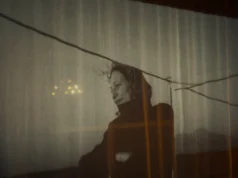
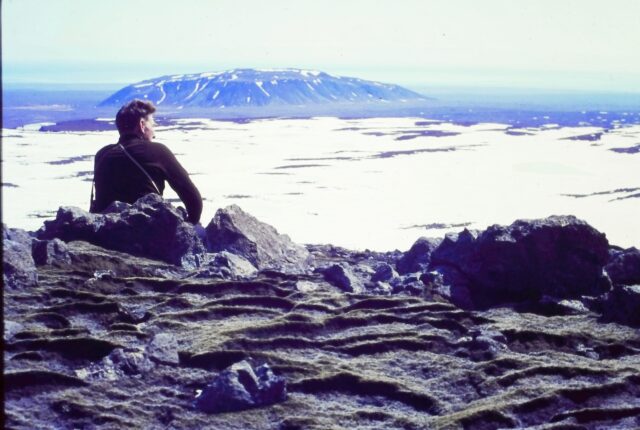
But other things must go into the time capsule, such as the film archive of Magnason’s four grandparents, one set of whom fell in love on the ice and spent their honeymoon on the vast Valnajökull Glacier. But like the diminishing ice-flows, grandfather Arni’s memory is fading. After his death, we see his 96-year old wife Hildur talking to her namesake great-grand-daughter, Magnuson’s own daughter. The director does the mathematics. When his daughter herself reaches the age of ninety-six, that will be the year 2104. He conjectures over how the island will look then – will it even merit the name Iceland? – but nevertheless finds comfort in the “handshake across generations” that his time capsule will represent.
“By having [the film] located in an intimate story, hopefully it can resonate more universally,” Dosa comments of the film’s intensely personal undertow. “This is a story about loss of glaciers and family in Iceland, but people are losing their homelands and their loved ones all around the world.” She further observes that Magnason is showcasing these stories through a lens of love. “It might sound slightly cheesy, but I really do think that love is a radical force.”
In his narration, Magnuson further muses on the transitory nature of time. The ice within the deepest part of the glacier is ancient, but the history that is stored within its solid structure will soon be dispersed far and wide. “Through water, the ice can continue to travel through time,” he observes. “Time is shared.”
Director Dosa, herself, has been fascinated by the contradictory nature of time ever since she was a small girl, she tells Business Doc Europe. “I must have been about three years old, and I remember the car window was rolled down in my parents’ car. And I stuck my head out the window like a little dog, and I kept saying, ‘now, now, now,’ over and over, because I couldn’t understand how there was this word that was meant to articulate this one single moment, and then the moment would pass. And it was just, like, this is elusive.”
“And I think that that kind of framework has guided my filmmaking practise,” she continues. “Film is a time-based medium, and I think specifically working with archive, there’s the opportunity to collage a subjective feeling of memory, and that’s something that we were really going for with Time and Water.”
“And that also resonated with this idea that glaciers are an archive of the Earth, containing planetary memory. So getting to work with time in that very specific, rather subjective and kind of haphazard way that memory functions, was really exciting creatively. But it is something that I think has guided my work overall.”
After the success of Fire of Love, Dosa and producer Shane Boris signed a first-look deal with National Geographic, and Time and Water was one of the first projects the pair suggested. “We were very lucky that they [Nat Geo] came aboard from the beginning. And we also worked with other partners that we had worked with in the past, like Sandbox Films, and so it was like there’s a lot of continuity from Fire of Love going into Time and Water.”
Does Dosa believe that she has made a political film? Lyrical, personal and a feast for the eyes, yes. But is it political?
“No one’s asked me that. I’m really grateful for [that question],” she responds. “I guess I do think that all films in some way are political because all films are critically involved in representation, and I really do believe that representation is infused in a matrix of politics.”
“For this film, I do think that there is a political underpinning because of how we’re trying to centre the life force of glaciers in a kinship with humans,” she continues. “By doing so, you know, it doesn’t lead with politics. We’re not condemning oil giants or any kind of political figure by any means, but I do think that the context of the film that it lives in is a tremendous indictment of the climate crisis and how we arrived at this moment.”
One of the undoubted joys for Dosa on the production was descending into a glacier crevice, she tells BDE. “It was unbelievable. It was incredible to be inside it. I really need to shout out my incredible production team, both in the US and in Iceland, for finding these extraordinary locations,” she enthuses. “And my director of photography, Pablo Álvarez-Mesa, just has an impeccable eye for connecting with not just the beauty of glaciers and water, but I feel like he’s able to kind of intuit. Again, I keep coming back to the phrase ‘light force.’ I feel he [Pablo] specifically knows. It’s almost like he has a divining rod inside him. He can feel the water and translate that through his cameras.”
“To be with my team and guided by his eye inside a glacier, it’s truly one of the most incredible experiences I’ve ever had,” Dosa ends.