

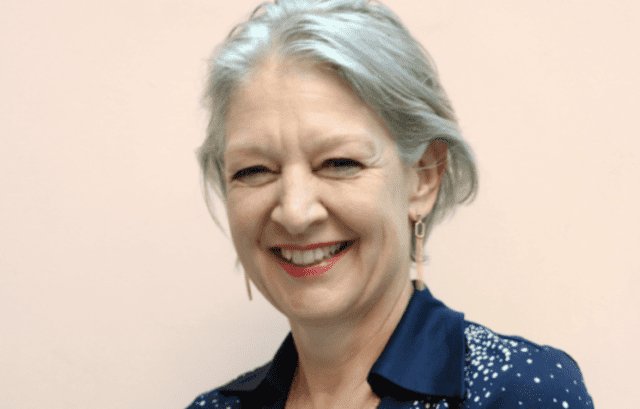
Dutch filmmaker and commissioner Margje de Koning has been at the helm of Movies That Matter (the Hague-based festival for works exploring human rights and social issues) for seven years now. She was appointed artistic director in 2019. Her first edition was cancelled because of the pandemic but she has left a firm imprint on the event since then.
De Koning has chosen to open this year’s MTM (20-28 May) with American Doctor by Poh Si Teng, a hard-hitting feature doc that premiered in Sundance. This follows three American doctors – one Palestinian, one Jewish and one Zoroastrian – who go into Gaza to try to save lives.
The decision to programme American Doctors was partially motivated by conversations de Koning had with Dutch politician and humanitarian, Sigrid Kaag, who lives in the Middle East and told her, “the people here in Gaza are asking me why is everybody looking away…”
Many of the patients in Gaza that the doctors are operating on are children. “The film paints the picture of what is going in Gaza but, at the same time, goes all the way up to the geopolitics of how the world is operating and how Israel is operating. I felt like we should see this.”
With MTM now being a qualifying festival for the Oscars, this has made it even more of a springboard for human rights-driven movies like American Doctor looking for international exposure. “This is a bold, big film, very well crafted in terms of editing…it is very special.” The director and one of the main protagonists, Dr. Mark Perlmutter, will be in town for a Q&A where they will be joined by Palestinian ambassador, Ammar Hijazi.
MTM has its share of world premieres, but de Koning is less worried about having films first than other festivals. “For Movies That Matter, it’s nice to have premieres but it’s not our main requirement. Our philosophy is very much about the impact of the film.”
The festival is full of expertly moderated panels that support the screenings, and that allow audiences to dig deep into the debates surrounding the titles. Ambassadors, politicians and academics will join the filmmakers on stage for in-depth discussions.
Alongside documentaries highlighting war and global injustice, the festival also programmes films like Dutch director Muriel d’Ansembourg’s UK-set Truly Naked, sold by M-Appeal and set against the backcloth of the porn industry. This is an intimate and personal story but, de Koning argues, it still has its place.
“It [MTM] is totally about human rights, but it is also about what is going on in society. What the film does is say we watch porn because we can’t have intimacy any more. What a lot of parents don’t know is that their children from 10 upward are watching porn and thinking that that behaviour might be normal,” the artistic director says. “I think that a festival like Movies That Matter should totally facilitate the conversation about this topic.”
De Koning cites Marc Silver’s Molly vs The Machines, which tells the tragic story of British teenager Molly Russell who committed suicide after being deluged with content about self-harm on social media, as another example of an inmate family story which touches on very important human rights issues.
The MTM boss is unapologetic about screening films like Sergei Loznitsa’s Two Prosecutors, a 1930s drama set during the Stalin trials. In the light of the ongoing war, some Ukrainians have felt indignant about festivals screening Russian-themed material even when it is exposing human rights abuses.
This suspicion even extends to titles like recent Oscar winner, Mr Nobody vs Putin, about a dissident school teacher dealing with Putin propaganda in a remote industrial town after the Russian full-scale invasion.
De Koning, though, insists such films still have a place at the Hague. “I’ve had many, many conversations with them [Ukrainians]. I am very sensitive. ..the way I see it is that I want to inform our audiences what are the mechanisms within Russia itself,” de Koning states.
Last year, she declined to show Anastasia Trofimova’s controversial Russians At War partially because she wasn’t sure whether it was fully independent of the Russian state. However, she did programme Alina Simone’s Black Snow, about pollution in Siberian coal country.
This year’s selection has some Israeli-based stories, for example Amber Fares’ festival favourite, Coexistence, My Ass!
“I want to keep that conversation open. I don’t believe in cancelling,” de Koning explains the rationale for taking Russian and Israeli stories. “I believe in very, very precise curation…I always say I find it very hard to cancel a country in terms of what a government does.” The Dutch government, she adds, hardly has an unblemished record itself.
De Koning has witnessed major geopolitical changes in time at the helm of the festival. Now, the politics behind programming are far more intense and divisive than when she started at MTM. “I can’t just choose a film and say that’s interesting, let’s have that. You have to be very clear in the political line you want to have.”
Nonetheless, she says it is precisely because MTM is a human rights festival that she always wants to encourage dialogue. “I don’t want to be only in my own bubble.”
For obvious reasons, it isn’t difficult in the current climate to find human rights films to show and debates to address. “This year, Gaza is a nightmare, Iran is a nightmare, what is happening in Sudan…” her voice tails off.
The Hungarian doc 80 Angry Journalists looks at the intense pressure on a free press. What’s more, there will be a Q&A with activist Iryna Dovgan and director Alisa Kovalenko (Traces) looking at the way Russia has used sexual violence and torture as weapons of war.
The festival has around 100 films. Three quarters are features and around 80% are documentaries – but there is space for fiction too.
Under de Koning, the industry side of MTM has grown – but nobody comes to the Hague expecting a market. “It’s not business to business. People present their films or works in progress with an impact plan. In the audience, there are NGOs, there are funds, there are surely distributors, sales [agents] and impact producers.”
This year, MTM is launching a call for supporting displaced filmmakers.
Funding is under pressure. The festival has lost some of its backing from the Ministry of Foreign Affairs and has had to make cuts. Nonetheless, de Koning talks up the event’s resilience.
And, yes, there are also plenty of networking and social events. “People like us, we are watching what is going wrong in the world, the misery – but on the other hand, we try to have a good laugh and also to enjoy ourselves.”





