

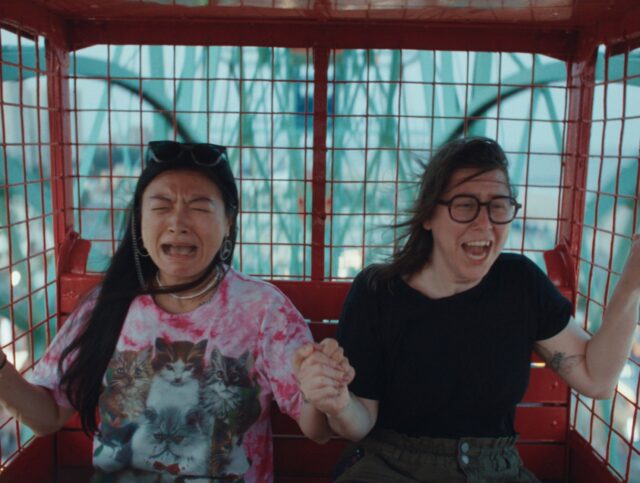
There is that intriguing sense of watching a stranger in a strange land in Viv Li’s Two Mountains Weighing Down My Chest, selected for Visions du Réel International Competition.
Stuck in Berlin after the pandemic, the artist and filmmaker, who comes from traditional stock back in Beijing, decided to embrace the German capital’s ‘alternative’ culture scene. Her resulting (mis)adventures are as hilarious as they are poignant, especially when seen in counterpoint to her more sober and considered, albeit very loving, family life back home.
In her new European and über-millennial surroundings, there is a lot of frank talk of sex, and a lot of choreographed naked frolicking. As a filmmaker, Li is very curious, and as the subject of her own film she is enthusiastic, but also incredulous about what she is observing. That said, when she gets back to China, she defends the West’s support of Ukraine (her male relatives think the Ukrainian cause is a lost one) and, like many millennial folk in their later teens and twenties, she questions why she should bring a baby into a world that is in such turmoil, and whose end, she opines, is nigh.
However, as we see throughout the feature doc, the longer she observes life in the West, the more disillusioned she seems to get, and the more attractive her family get-togethers seem, characterised (as they always are) by tablefuls of delicious food.
“The more open a place is, the more lost I feel,” she says at one point during her Berlin sojourn. “The more choices I have, the less I know what to do.”
What’s more, as enlightened as her Berlin friends purport to be, there is a distinct blind spot when it comes to their engagement with Li’s Chineseness. “I’ve been the only one adapting to their culture and thoughts,” she laments in the film. “I even adapted myself into a non-binary Berliner. Is anyone trying to be a bit Chinese and dare to taste some weird Chinese food?” No, is the unspoken answer.
But back in China she feels like a kid again, and rejoices in reciting poetry aloud (and alone) on a hilltop. She even receives a visit from an enormous Chairman Mao who ascends over the hilltop and asks paternally, “Is Western imperialism scratching your little brain?”
Nevertheless, she remains loyal to the friends she has made in Berlin (despite the blandness of the food they consume), even if she feels compelled eventually to question if the concept of free will is any more or less prevalent in the West than in China.
“I realised that there is less and less of ‘binary’ in how we live. There are a lot of differences, but in the end, we’re the same,” she suggests to Business Doc Europe of the two polar opposite communities within her film.
She further points acknowledges that, however her documentary may have been conceived back in 2021 when the pandemic was in full swing, it certainly evolved much over subsequent years.
“Obviously, after five years, the film changed so much. And it went into places that I never thought that it would go,” Li tells BDE. “In the beginning, I didn’t really know what to expect. I had an idea, and then I had a lot of new encounters after I moved to Berlin. So I got easily distracted, or kind of drawn into a certain world. And then I went through different phases where I felt like, okay, this is what the film is about.”
“Maybe it’s about family. Maybe it’s about femininity. Or maybe it’s about body. And then, maybe it’s about culture,” she recalls. “But then I panicked. I was like, okay, why am I changing my ideas all the time for the film? Then slowly I reflected on this, and I realised, that’s actually kind of what the film is about. It’s about changing all the time. It’s about being influenced by different environments and different opinions and different places. Especially as an artist or as a filmmaker, you’re trying to learn. You’re trying to adapt. And I’m trying to make a film that is not in my original environment. So I found that really interesting, and I found that really relatable to people nowadays, especially in Berlin where everybody’s coming from different places.”
“I learned how to be comfortable, and I realised this is maybe the strength. In the end, it’s the core of the film. It’s about shifting places and adapting, and then learning.”
When asked how she assesses the version of herself that she sees on screen, Li maintains that that particular persona was one that was created for, and defined within, “the limitations of the camera.”
“I never really had that struggle or that problem,” she adds of the distance between her as director and as performer.” It also helped me that when I was in the UK, I studied theatre and I was performing. I was a comedian and was kind of used to showing a vulnerable or an ‘ugly ‘side of myself.”
Li further ruminates on her approach, and her motivations, throughout the film’s long period of gestation. “I was just really focussing on my experience in the queer community, and on my identity. And I was focussing on myself, and I was focussing on a specific kind of culture and how I connect with it. But then I realised this is just one part, and then it expanded into how I feel going back home, how I feel as an artist or how I feel as a person; the loneliness and the feeling of connection and belonging.”
“The film just grew bigger and broader, and more universal. In the beginning, it was staying in this small room. But then it became a building with different rooms. And the film became about going into these different rooms and realising that the whole building is just how life is. That you have to go from room to rooms to see it,” Li ends.
This is an updated version of the interview, first published for the film’s world premiere at Berlinale 2026.





