

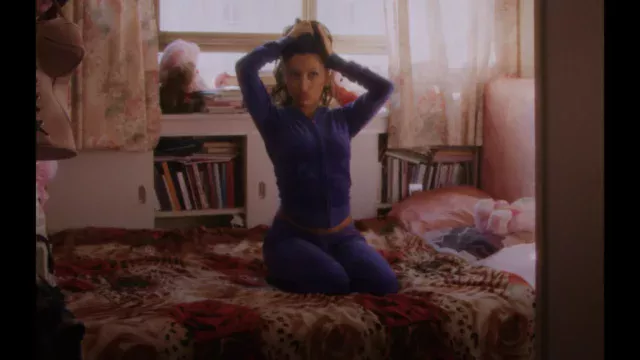
Une chambre à elles is a film about intimacy, the sharing of confidences and the moments of privacy afforded to three protagonists – Claude-Emmanuelle, Régina and Nicole – as they apply their make-up before going out in Paris.
Claude-Emmanuelle, originally from the south of France, is a trans woman who attempted suicide at the age of 25. Ironically, the process of having to come out to as trans to doctors in the hospital offered her a glimmer of hope as to her future life as a woman.
Régina experienced clinical death in her teens and was in a coma for two weeks. When she emerged into consciousness, her personality was profoundly changed and she began to crave the company of older, protective men – with all the potential toxic pitfalls that entailed. She dated girls her own age, but nevertheless looked for comfort elsewhere, even as she despised the ‘Lolita’ intentions of some of the men she met.
Nicole, from Ecuador, extols the virtues of ‘pink femininity.’ She is traditional, and seeks the stability of marriage. She doesn’t even conceive of living together with a partner. She calls herself a feminist, but dislikes feminism as practised in France, where it is a “closed space,” and something she doesn’t feel “embraced” by.
The protagonists don’t speak as they make themselves up. Rather, we hear their stories in voice-over, narrated by the women themselves.
“This separation is mainly an editing choice,” director Martinez Garcia tells BDE. “It allowed me to cut certain parts, reduce repetition, or shorten moments that felt too long. Also, when image and sound were fully synchronized, the result felt more expected, more frontal – closer to a conventional documentary style. By separating the two, I could privilege images that felt stronger to me, create more suspended, sensitive moments, while still maintaining a sense of continuity in the evolution of the make-up.”
This isn’t the first time that make-up features in one of Martinez Garcia’s films. In 2021, she directed the short film, Dihya, which began with a scene where her younger sister and her best friend were doing their make-up while confiding to each other about their relationships, and the violence they experienced as trans women.
“I was really drawn to this device of combining make-up with intimate conversation—it’s a very feminine situation and quite universal in friendships,” she points out. “I wanted to revisit this idea, but by shifting the dynamic: the confessions are no longer addressed to a friend, the intimate reflections simply unfold, with the same sense of naturalness.”
“I don’t wear makeup myself, but I’ve always been drawn to this ritual they [women] offered themselves. These are often moments when confidences emerge naturally, when intimate stories are more easily shared,” Martinez Garcia adds. “I’m also interested in the idea that appearance can evolve and transform, depending on how someone chooses to see and represent themselves.”
Martinez Garcia found and contacted her characters via their Instagram pages. “I was drawn to the way they presented themselves within their intimate spaces, their strong visual worlds, and their relationship to make-up and femininity, which aligned with my vision for the film,” she says. “Of course, as a woman, I’ve experienced things I can relate to, but this film is really about their lives and their stories, which are very different from my own.”
The film world-premieres at Visions du Réel, a decision that Martinez Garcia claims “makes sense,” given Nyon’s embrace of experimentation and hybridity within its programming.
But why a short? Did she ever contemplate long-form in order to tell the women’s stories? “I always conceived it as a short film,” she responds. “I still find it difficult to project myself into a feature—the length feels a bit intimidating. In fact, this is my longest film to date.
“I also had the feeling that beyond an hour, it might become too dense: there’s a strong presence of spoken word, sometimes quite heavy, and a longer format could risk feeling a bit suffocating.”
She also disagrees with the suggestion that it is a film with melancholia at its heart, despite the seriousness of the women’s testimonies. “I’m not sure I would describe it as melancholic—I don’t really feel that way about it. However, the stories are sometimes marked by pain, difficult reflections, and fragile situations—unfortunately, that’s something many women share when they speak about their past.”
“What I really wanted was for the audience to feel empathy for them. To me, they are strong despite what they’ve been through, and today they carry a kind and compassionate view of themselves. I find them courageous, they fully embrace who they are, and I hope that comes through by the end of the film,” Martinez Garcia concludes.
Une chambre à elles is produced by Alice Riva for Joy Productions.





