Meet Arek Pasożyt, aka “Arek The Parasite,” formulator of his own ‘Manifesto of Parasitism.” The protagonist of Mikołaj Janik’s feature doc Bigger Picture (screening in Millennium Docs Against Gravity) is a force of nature, but an eccentric one.
Arek is an artist in his 30s, still living at home and seemingly managing to survive and even thrive without any money at all. If he needs a bicycle, he’ll find an abandoned one in a skip. If he wants clothes, he’ll make sure to get them second-hand.
One of his pet obsessions is finding traces of the Tatra Mountains Panorama, a massive painting from the 1890s that was 115 metres long and 16 metres high – but that was broken up. It has been lost for 130 years and he is searching for any elements of it he can find.
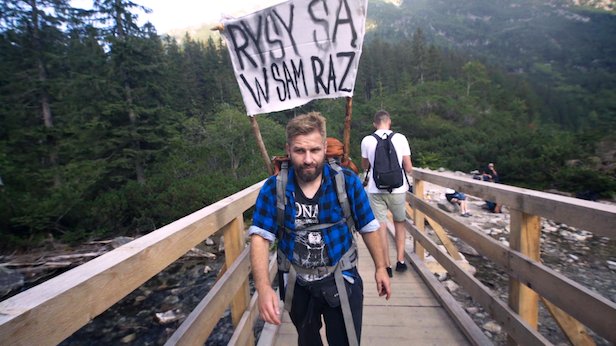
In the film, Janik follows Arek on his own trips up the Tatra mountains. “It’s something you can call guerrilla filmmaking,” the director says of these expeditions. He and his DOP Norbert Wojtysiak would accompany the artist as he climbed. Sometimes, they brought the producer along too “for safety reasons.” Arek doesn’t have “any special experience of hiking or trekking,” but he doesn’t let that hold him back.
When you make a film about Arek, you get his mother as part of the package. She’s a formidable figure, albeit a little suspicious of strangers. In the beginning, she was hesitant about being filmed. She eventually relented – although she soon grew weary about spending too much time in front of the cameras.
“But still I can say she made amazing vegetarian meatballs,” the director volunteers of the family matriarch. She also always offered him copious amounts of tea and coffee.
How did Janik meet Arek? The director explains that he was inspired by the freewheeling approach legendary French director Agnès Varda took in her film, Faces Places (2017) for which Varda and younger artist JR roamed around France, creating portraits of people they met on their travels.
“I had a small dream that maybe I could make a slow movie, a contemplation movie, about performing artists in Poland.”
Someone mentioned to him the “super strange activities” of Arek, for instance spending a month with kids in a specially built wooden shelter. “I discovered he is an extremely open person, absolutely without any kind of shame. This intrigued me. I was also surprised by how constant and confident he was in his ideology.”
Arek is strongly left-wing. He doesn’t believe in consumer culture. He is also relentlessly cheerful, refusing to become downcast about setbacks. Janik likens him to an ancient knight on a heroic quest, or to “some kind of Indiana Jones.”
“Being an artist is a tough job. He is still fighting about being recognised by the art world. He knows almost everyone, but he has not had any special awards or exhibitions…”
Arek may not be endorsed by the cultural establishment but the media covers his exploits, and he is often recognised on the streets. “I think this gives him a lot of happiness. I know that he is [also] making this art for himself.”
Perhaps the artist’s most impressive trait is that he never gives up. “He is trying and trying, pushing and pushing.”
He’ll stage protests against bankers and politicians. His own economic situation remains relatively healthy because he rarely spends any money at all. At present, he is finishing his PHD in fine arts at AAH UMK Toruń, Poland – and his specialist thesis subject is the “refusal to work.” The idea is not to take any paid employment for a year. He can sell his paintings and live off savings, but has removed himself from the labour market.
“Of course, through this whole year of not working, he has to prepare some supplement discussions about it and [research] on how this has influence on him as a human, in a psychological way, an economical way. Does it change anything or not?”
Arek now has his own apartment. He has a partner but refuses to call her his ‘girlfriend.’ Instead, he refers to her as his ‘favourite person.’ “They don’t want to be seen as a traditional couple,” the director explains. Arek’s partner is also an artist. Her speciality is making porcelain dildos. “It’s going really well. They are beautiful things,” the director says of these finely crafted objects.
Over time, the filmmaker and his subject established a very strong rapport. “I think it was just some kind of trust on his side. Also, we built it by talking a lot about each other’s motivations. I think Arek knows that I just wanted to make a good movie about him and that I don’t judge him. I like to think of myself as a good listener…maybe it is not so difficult to hide me in the corner of a room and forget about me.”
As for the Tatra Mountain Panorama, the biggest painting in Polish history, it doesn’t look as if any real part of the monumental work remains. All that can be seen today are “two small sketches and two little paintings in the National Museum [made in preparation for the main art work].” However, thanks to Arek, people are at least talking about the Panorama again.
The artist himself is resigned to the fact that he may never break through as an international artist – but that won’t stop him trying.
And, yes, Janik, as a young director making his debut feature, identifies with Arek. “For him and for me, it’s a moment of an artistic coming of age,” he says of the film. “Maybe this movie is not about art at all but about searching for some kind of dream and then following it and the prices that we are all paying.”
So Films is on board the project as Polish distributor. “But we are still looking for the international premiere and for distribution outside of Polish borders,” Janik notes. The film is also being pitched May 10 to foreign guests at MDAG’s Pole Position – Pitching session in the State Ethnographic Museum.