Ninety years on, it’s very hard to comprehend the internecine violence in Spain during the late 1930s, the time of the Spanish Civil War. It’s this dark period that writer and director Ricardo Iscar is sifting through in his new documentary Herencia (Inheritance), world-premiering in DocsBarcelona.
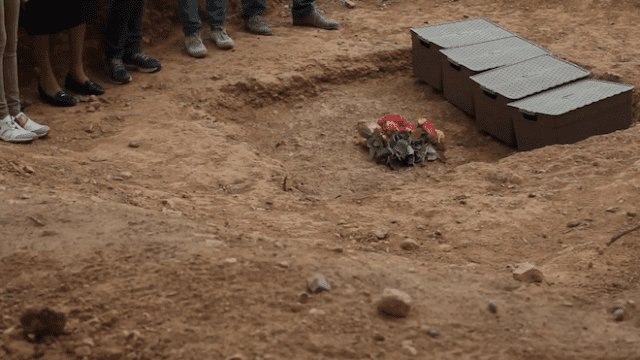
The Civil War has a strong personal resonance for Iscar. Four bodies of workers murdered by the Falangists were buried in a field owned by his family in Salamanca. In the documentary, these bodies are finally being exhumed, and Iscar is there to film the process.
The director was born in 1961. “On the one hand, I think I was always hearing about the Spanish Civil War and having the War, in a way, very close through my family memories,” he says. “Also, at the same time, I had a happy childhood. Even though there were only 30 years [since the Civil War] for me as a child, that was a lot. It was a very, very long time ago.”
Family members would reminisce occasionally about that era. Sometimes, in the evenings, as a bit of a game, his uncle would recreate military parades with the children. “For us, it was just fun,” Iscar recalls. He had heard about relatives who had died in the conflict but that was “an old story” and he didn’t know if it was true or not.
As the director’s career developed, he never thought to make a film about the Spanish Civil War. He read books about it, especially those by foreign authors. He cites Gerald Brenan’s The Spanish Labyrinth as one account which fascinated him.
Now, though, he has been drawn to the subject – and making Herencia has given him new insights into the cruelties and contradictions of the Spanish Civil War.
When it comes to telling his family’s story on screen, it helps that his father was a passionate home movie enthusiast who also used to show the family old Charlie Chaplin comedies. “I think this is one of the reasons I ended making films. It was a kind of magic,” he reflects on this early exposure to movies. In the documentary, we see 8mm footage of Iscar as a dimple-chinned kid, filmed by his father.
Now 65 years old, Iscar says he is “more confident to talk in his own voice, about his own family and about all the past.” Even so, he acknowledges that filming the exhumation of the four bodies was challenging on many levels.
“Look, when they say that you have four bodies in your mother’s farm in the countryside…” the director pauses, He had heard years before from his father that the bodies were there. “But then my father died and I went to study film in Berlin. When I came back, I came to Barcelona and I was far away from that.”
Back home in Salamanca, memories had faded and no-one remembered where the bodies were buried. It therefore seemed impossible to make a film. But then representatives from the Salamanca Memory and Justice organisation called Iscar and told him they had worked out the location. They asked for permission to exhume the bodies. Iscar gave it immediately.
The director’s family had nothing to do with the deaths of the men. The labourers had been murdered by the side of the road. However, they were then buried on his family’s land.
“I had the impression I was in a way guilty for two reasons,” the director says. One was the fact the bodies were in his family’s field and the other was that his family were landowners.
“When they [the Falangists] killed these people, it made everything very complex and very dirty. When you discover the bodies, it’s like the past becomes present – like they were killed two days ago.”
As a filmmaker, Iscar felt the need to document the exhumation process. “I tried to know more about who they were, why this happened and what was the real story behind it.”
This was also an opportunity to delve more deeply into his own family’s history.
As he researched the period, Iscar tried to understand “how this violence could happen and how the absence of respect between political parties became an aggression and, later on, something very violent that could not be stopped anymore.”
It wasn’t seeing the bones of the dead men that most shook the filmmaker. “Bones have no personality,” he says. “But there were three moments that were very touching for me. One is when they found a bullet with some hair. That means proof of the violence….and that there was really a living person behind it pulling the trigger and also that somebody died.”
The second moment was when a shoe was discovered. The third detail was a lighter. Somebody must have been smoking.
Filming this was all part of the process of restoring the men’s identity as human beings.
“As a filmmaker and as a human being, you have to do it but, at the same time, you have no right to do it,” Iscar explains the mixed emotions he felt about his own role. “But you have to,” he repeats. “It is the only way to talk about the past. We cannot look at the past with today’s eyes but we can learn from the past. It is very important to go back and not forget.”
The film features interviews with various elderly figures including some of the director’s own family members. Some found it cathartic to reminisce. “For the ones who lost people, it’s a release to talk about the past.” Others, though, preferred to stay quiet.
Herencia has taken many years to make. “We had no funding. This is the main reason,” the director says of the lengthy production process.
The exhumation began in 2016. Iscar has continued filming since then, gathering information about his family from newspapers and archives. He talks of “filming little by little.” He kept the project going by using some of the money from his own salary as a university professor. At the same time, he was working on another film, Air (2022), a documentary about free-diving competitors.
Some of the same tensions that existed at the time of the civil war persist today. “Nowadays, people in Spain are politically divided,” Iscar reflects on the enmity between right-wing nationalists and leftists. “Between both sides, it is very polarised…they don’t agree on anything.”
Late on in the documentary, Iscar is shown visiting Valley Of The Fallen, General Franco’s mausoleum below which lie the bodies of thousands of people including many leftist victims of the Franco regime. The filmmaker was there with his baby son who suddenly needed an enormous “poop.” He leaves footage of him changing the baby’s nappy in the film – he saw it as an opportunity for a tongue-in-cheek protest against the Franco legacy.
“It was a commentary of what I felt about this Franco mausoleum. When I came inside, I had the same impression as I had when Franco died…when I got to this mausoleum, I had this fear of fascism.”
Herencia shows how conflicts can start “inside a family, inside a village, inside a city and then in the whole country.” Having made the documentary and seen how viciously divided Spain was in the 1930s, Iscar has a warning for viewers: “nothing is guaranteed. The democracy and civil rights we have, we have to fight to keep them…”
Herencia was co-scripted by Iscar and Alessandra Paiva, and produced by El Refugio Producciones in co-production with Suricata Stories, with the support of the SGAE Foundation and the Labed Laboratory.