

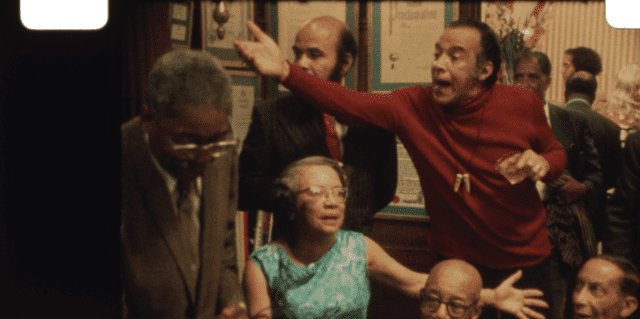
It’s over 50 years now since four camera operators and two sound people under the direction of pioneering filmmaker William Greaves turned up at jazz legend Duke Ellington’s beautiful New York townhouse to film an event attended by some of the most important still surviving figures of the ‘Harlem Renaissance.’ This was the flowering of African-American authors, artists, musicians and intellectuals during the 1920s and 1930s.
Duke Ellington couldn’t make it himself but those who did turn up included such towering figures as poet Arna Bontemps, photographer James Van Der Zee and writer and artist, Richard Bruce Nugent.
One of the camera operators that night in 1972 was William Greaves’ son, David Greaves, then 26 years old. David has been in Cannes this week for the Directors’ Fortnight screening of the documentary Once Upon A Time In Harlem(following its premiere in Sundance earlier in the year). He has been accompanied on the Croisette by his daughter, Liani Graves.
Together, they brought back to life the remarkable material that was shot that night. Liani has produced alongside Anne de Mare. The documentary is sold by Cinetic and has been picked up for the US by Neon. It was made with support from Cromwell Harbor Foundation, in association with Ford Foundation JustFilms and Mellon Foundation.
Back in 1972, the four camera operators, who were all experienced in cinema verité, were using 16mm equipment. “We only had 10 minutes in the magazine. With 10 minutes, it’s not like digital where you could just let it run,” David remembers a process that presented daunting logistical challenges. “Basically, we were two teams filming the party. A team could be in one room moving around, looking for a conversation…trying to find the action, trying to find the light.”
Greaves and his team “didn’t know who was going to be talking about what.” The discourse, though, turned out to riveting. This was the cream of the Harlem art world and intelligentsia. Old-timers were in full flow as they recalled the aesthetic and political debates that had once meant so much to them. Nonetheless, it has taken more than half a century for Greaves’ intimate, talk-based epic to be completed and reach cinemas.
William Greaves himself (who was born in Harlem in 1926) died in 2018. For many years, his widow and fellow filmmaker, Louise Archambault Greaves, continued to fight for the film to be completed, working on the project until only days before her own death in March 2023. At the very end of her life, she had her laptop and notes on her hospital bed and was still trying to work out how best to pull the film together.
“Three weeks before she passed away, she was in the hospital working on this project,” Liani recalls. “With her last breath, she was working on this film.”
“It was my grandfather’s life work and it became her life’s work,” the producer continues. “Their DNA is in this footage. She [Louise] was protecting it with everything she had because she knew how important it was.”
Louise had already been in contact with Emmy-award winning documentary filmmaker de Mare (who told one interviewer she first became involved simply because she “fell in love with Louise Greaves.”)
“I always knew that the footage existed…it was this very important footage that existed,” Liani Greaves remembers. She first watched some of it as a teenager and was very confused by how “raw” it seemed. She didn’t know who all the people were, and nor could she always follow the conversations. “I knew it was important but I didn’t know why.”
However, after her grandmother’s death, Liani took over the documentary as producer, working alongside her father and de Mare, who had promised Louise that she would find a way to get the film out there.
At first, there was no road map. “We didn’t know what we were going to do with it,” Liani acknowledges. There wasn’t even someone to call the shots. Advisors to the project Stanley Nelson and Marcia Smith at Firelight Media asked who would direct? “I will,” piped up David Greaves.
The production, then, was put together in freewheeling, collaborative fashion, but all the elements eventually coalesced perfectly. David remembers that his father had always had a clear sense of the rhythm of the film. The evening would “start it all slowly,” but then, as guests “loosened up,” maybe had a drink or two, and became more comfortable with the cameras, the party conversations would become livelier and more intense.
In the film, we hear Black theatre impresario Irvin C. Miller talking about being lent $5,000 by John T Gibson. “$5000 is like $98,000 today. One Black man loaning another Black man that kind of money at that time is worth a seminar, a study, on integration, segregation, the effects of class and how things are lost…he [Gibson] was the most important theatre operator but there were others – and we don’t have them today,” David talks about the many moments in the documentary which cast new light on Black culture, economics and politics of that period.
Some of the guests at the party tell distressing stories of the racism they encountered – being spat at or not allowed into certain nightclubs. “At the same time that this renaissance is occurring, there are also these lynchings that are happening,” Liani notes. “They are creating art in the middle of this conflict. My grandfather was thinking about that all the time…so much of his work is about this.”
Why has this material lain unseen for so long? William Greaves originally thought he would include some of it in his 1974 film From These Roots, about the artists in Harlem in the 1920s. He couldn’t work out how to combine the stills with the live action footage.
Another challenge with Once Upon A Time In Harlem is that William wasn’t just the chronicler – he was part of the film himself. “You can see him all through the film, in his writing; you can see him asking the questions; you see him asking himself questions,” David points out.
Over the years, William had done additional shooting in order to bring more contemporary aspects into the film – but somehow he was never able to complete it. “I have a sense there was a bit of frustration around it,” Liani notes. They didn’t have a real idea of what they were going to do [with] it.”
In the event, his son and granddaughter were able to look on the material with “fresh eyes” and to find a compelling through-line. Now, they’re basking in the applause, first in Sundance and now on the French Riviera. “We are revelling it…and also being overwhelmed,” David says of the rapturous reception they have received everywhere the documentary has played.





