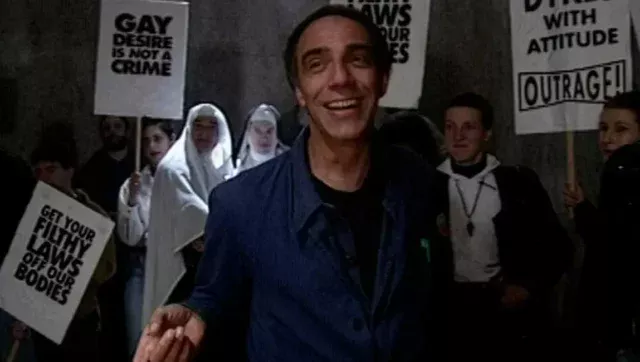
When revered British director Derek Jarman (1942-1994) was making his 1991 feature Edward II at Bray Studios in Berkshire, he was very keen to find a suitable role for young cinematographer Seamus McGarvey. Jarman was always loyal to colleagues and McGarvey had already worked as a camera assistant on two of Jarman’s earlier movies, War Requiem and The Garden. Production manager Sarah Swords suggested doing a behind the scenes film about the making of Edward II, and McGarvey therefore seemed the obvious candidate.
The footage McGarvey went on to shoot forms the spine of Queer Edward II, UK director Theo Rollason’s feature documentary which has been screening to acclaim this week in Venice Open – Out Competition and will have its UK premiere at the London Film Festival in the autumn. Sales are handled by Cinephil.
“Derek had said let Seamus do it, he is a great cameraman. Because everyone knew Seamus from the previous films, and Derek liked to work with the same people again and again, everyone let him do whatever he wanted and ignored him to a certain extent. They were used to his presence, and that was a huge gift for the film I ended up working on because he really is like a fly on the wall,” Rollason says of the McGarvey material.
McGarvey did indeed capture some extraordinary verité-style moments. He shows the producers caught up in one mini-crisis after another. One moment they will be dealing with gossip-hungry British tabloid journalists trying to stir up scandal after gay activists on the Edward II set targeted pop star Cliff Richard (who was rehearsing next door). The next, they will be placating some elderly extras demanding extra money.
McGarvey films his own footage of pop star Annie Lennox giving her beautiful, spine-tingling rendition of Cole Porter’s ‘Every Time You Say Goodbye.’ (In Jarman’s movie, the song features early on, but Rollason uses it towards the end of the documentary where it has an added poignance). He captures Tilda Swinton (who won a Best Actress award in Venice for her performance as Queen Isabella) looking as glamorous as any classical Hollywood star one moment and with cucumbers on her eyes the next.
Most of this material has never previously been seen in public. “There was a will for something to happen, but as is often the case with the very low budget films, the money ran out basically,” Rollason explains why McGarvey’s footage was never used. Instead, it “sat in a cupboard” for 30 years until Ahmad Ahmadzadeh (owner of the camera company that hired out equipment to McGarvey) asked Rollason to have a look at it.
The young writer and filmmaker expected that if he was lucky, he might be able to make a short. He soon realised, though, that such rich material warranted something far more ambitious than that.
One of Rollason’s first steps was to steep himself in Jarman’s diaries and journals.
“After I watched Seamus’s rushes, that was when I started reading everything Derek ever wrote, starting from the beginning and going through to the end. That was when I really fell in love with him as a person and what he stood for. His personality comes through so strongly in his writing.”
Jarman was as adventurous and playful when he put pen to paper as he was in his filmmaking. He would combine scripts, poetry, diary entries and political polemic. “It’s all mixed together and I was really moved by how honest he was about himself and his world.”
These texts (especially the book ‘Queer Edward II,’ from which the documentary takes its name, and his final volume ‘Smiling In Slow Motion’) were “incredibly useful” in giving Rollason a “comprehensive view of Derek’s world.” He also watched all Jarman’s movies again.
The 1991 film of Edward II is a freewheeling adaptation of Christopher Marlowe’s play about the fourteenth century monarch often called England’s first “gay king,” and who was deposed and murdered. Jarman was making it not long after the UK had enacted “Section 28,” the law banning schools and councils from “promoting homosexuality.” Queer life was under attack and Jarman was a leading campaigner against the homophobic legislation.
Rollason’s documentary doesn’t just rely on McGarvey’s footage but also includes clips from chat shows and political programmes on which Jarman appeared (everything from The Jonathan Ross Show to Newsnight on the BBC) He has some stirring footage too of Section 28 protesters outside Parliament.
“I loved the energy and the sense of being right there in the moment that you find in Seamus’s footage but it quickly became apparent that in order to appreciate what was going on politically at the time, as well as who Derek was and what he stood for, it would need these little bits of extra archive,” the director reflects. “It was really plugging the gaps of what people would need to understand life on set. Some of that was the political context which we explore through news and chat shows. Some of it was Derek’s life away from set.”
There are some sequences showing Jarman getting away from the fray and enjoying his other secret passions, painting or gardening, at his beautiful cottage by the shore in Dungeness. (This was a sanctuary for him after he was diagnosed as HIV positive in 1986).
Rollason was keen to ensure material he used came from the same period that Edward II was being shot. “We never really leave this small time-frame – most of the film is 1990 or 1991.”
Another aim of the documentary is to turn new fans on to Jarman’s work. “I live in London and Jarman’s films do screen fairly regularly there across the various repertory cinemas,” the director argues that his subject’s work is still appreciated today and that “a contingent of younger people are really into that.” Nonetheless, he acknowledges that Jarman isn’t as well-known as he was in the early 1990s.
“That is unimaginable, somebody who was essentially an experimental filmmaker holding that kind of status today.”
Another goal is to give Jarman back his edge. “Where I did see a popular Jarman legacy disseminated, it was often through a slightly depoliticised lens. What I discovered through the research and through Seamus’s footage was how fiercely political Derek was in this period. Edward II really was at the end of his life and I think his HIV diagnosis and then Section 28 really did radicalise him even more than he had been before,” Rollason says.
“In the last stretch of his life, he was a political person to his core. I did feel a duty to correct the record where there was a slightly smoothed-over idea of Derek as a sweet filmmaker who had a quaint littler garden and did his paintings. That was all a bit twee in some sense. Derek would hate that. I was on a bit of a mission to restore the political anger and subversive element of Jarman’s work!”