

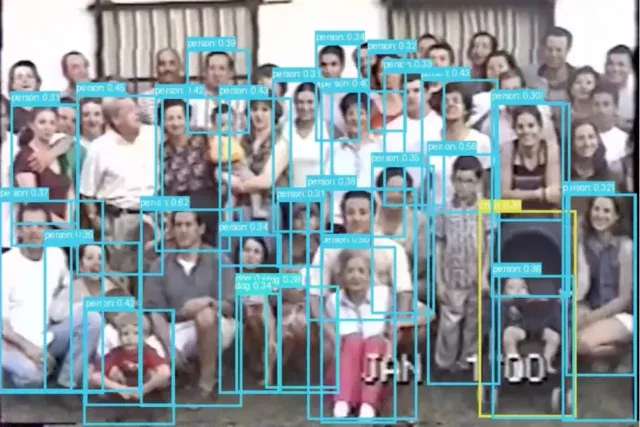
The End of Times, the new Colombian hybrid documentary directed by Bibiana Rojas Gómez and Juan David Cárdenas, opens with home movie footage of a New Year’s Eve party on the eve of the millennium. Everyone is in costume. It’s a riotous gathering. On the soundtrack, we hear a voice over from a certain Salome Kumara Cárdenas, now living in Canada but reminiscing about the family gatherings at her grandparents’ house. She is searching for the reasons behind her mother’s depression.
The New Year footage isn’t quite what it seems. As Juan David Cárdenas explains, it was indeed shot in his grandparents’ home but Salome herself is partly a fictional construct (albeit a character drawn from real-life prototypes). The film, sold by Split Screen, is screening in Venice’s Critics’ Week.
“My father had twelve brothers and sisters and I have a lot of cousins. There was an aunt who was addicted to filming – and she filmed everything,” the co-director explains how so much video material from the family celebrations ended up in his possession. “The family is a particular family. They [the relatives] have an amazing sense of humour. They are joyful, always drinking and having fun.”
Cárdenas had a hunch that he could do something creative with the videos. It’s ‘pure fiction’ that all this film was about to be thrown out (as is suggested at one stage in The End of Times). The VHS cassettes were stored by her aunt in safe place in the grandparents’ house. She agreed to lend them to Cárdenas so he could have them digitalised.
The two directors came up with the idea of reflecting on the coming of the year 2000 – and all the doom-mongering, that the start of the new millennium would bring apocalypse and ‘the end of times.’ They also touch on themes like migration, political violence in Colombia and the legacy of colonialism.
Cárdenas and Gómez began their collaboration in unlikely circumstances. Gómez was a student in one of the Masters classes that Cárdenas teaches at university in Bogota. Their work together also includes various other films, among them 2022’s The Sound of The Crickets (which was medium length).
Gómez comes from experimental cinema. She’s an animator who has also worked in experimental documentary. Cárdenas is from a more traditional film background but is also an academic with a PHD in philosophy, art and critical thought. In his academic work, he specialises in political philosophy and the philosophy of technology. He describes himself as being as much a “theorist and philosopher of cinema” as a director. “I feel so happy I can have this double life, as a theorist and as a professor, and as well to create films.”
“I admired a lot how Juan put complex subjects into words and thoughts. I try to do that in cinematic form,” Gómez says of her co-director.
“We realised that we made a good couple creatively,” Cárdenas adds. “We are working together because we complement each other.”
Both directors have their own separate projects, but say how, when they work together, they believe that “something special happens.”
The End of Times posed some obvious practical challenges – not least the sheer volume of video footage the directors had to sift through.
“I told her ‘Bibiana, we have two problems. We have a lot of material [over 70 hours] and the other problem is that I am so close to it that I am not seeing the creative possibilities because I am seeing mainly my family.”
Gómez was able to bring a detached eye to the footage that was so personal for Cárdenas. They spent many months poring over the images and eventually they came up with the narrative structure.
“We mixed reality with fiction,” Gómez explains. The duo also talk of taking “an anarchist’s approach to archive.”
Cárdenas again emphasises that the fictional elements are often rooted in reality. For example, some of his cousins really did emigrate to Canada and some also suffered from depression, the condition that begins to afflict the character in the movie. “What we were doing was selecting real anecdotes and trying to feed the fiction with them.”
In the film, the two directors experiment with multiple formats. They’re using Video8, Hi8, MiniDV, Mobile Phone Video – and they add AI to the mix, with subversive and often hallucinatory results. Images pixilate. Celebrities, everyone from Kurt Cobain to Margaret Thatcher, suddenly pop up in the close-knit world of the family.
“We realised we could use the VHS and analogue material to create a contrast between different moments in political history in Latin America,” Cárdenas describes one layer of the movie. He adds that with the AI, they were using a “hi-tech promise’ to depict “a low-tech reality” and to “break the promise of perfection.”
They deliberately gave “absurd prompts” to the AI in order to disrupt the flow of images. “We were trying to feed the AI with the history of anarchy.”
Financing the End of Times was a painstaking process. Early on, the main money came via small grants from an institution where Cárdenas teaches.
The two directors pay tribute to their producer, Luis Esguerra Cifuentes of Bruma Cine in Colombia. He was actually the distributor of their earlier work, The Sound of Crickets. “We really fit together amazingly,” remembers Cárdenas. “When we realised this film wasn’t going to be a short, we called Luis and told him we were working on what we thought was going to be a feature length film, and asked if he would like to produce. He saw a rough-cut and accepted the invitation.”
The filmmakers applied several times for financial support in Colombia without success. “We didn’t get a cent!” This was too strange and unclassifiable a project for backers who generally prefer much more conventional movies.
The real breakthrough came when the film was chosen for the Rough Cut Lab at Visions du Réel in Nyon in Switzerland in 2025. “It was the turning point for the history of this film,” the directors acknowledge. “When we were selected, everything changed. Everything became faster.”
All of a sudden, the film began to be invited to other labs – and was eventually chosen to premiere in Venice.
Now, several other major festivals, both in Europe and Latin America, are circling the project. “This is a film about the promise of progress from the margins of the world,” Cárdenas sums up the documentary’s ironic approach. He adds, though, that his relatives can’t wait to see the movie and they’ll be watching it in a very different way to other audiences. “They’re not watching the film – they are watching their family history, their past,” he notes.





