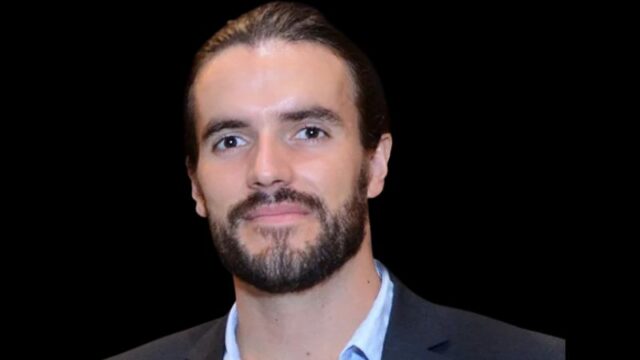
Since becoming director of Doclisboa last year, Hélder Beja has already put his stamp on the festival. He stands for an “interdisciplinary,” adventurous and collegial approach to programming.
Beja’s vision for the event can be seen in the choice of opening film, Edgar Pêra’s Asphalt Guerrilla, which blends fiction and documentary in playful, provocative fashion in its portrayal of a leftist militant group.
“A lot of Edgar’s films have shown at Doclisboa and so there is that historical relationship between the festival and the director,” Beja points out. He first became aware of the project while serving as a juror at Documenta Madrid. The film’s producer Rodrigo Areias told him “that they would very much like us to take a look and consider it for Doclisboa.”
Pêra’s cinema is often considered “a bit divisive” but, in this case, the Doclisboa selection committee members were all enthusiastic. “It’s a film about a political movement in Portugal, but it is also a film about the politics of cinema and the idea of continuing your resistance through cinema – it’s a film full of energy, kind of a punk film!”
Doclisboa (15-25 October) is one of the first events in a packed autumn season for documentary markets and festivals that also include Ji.hlava, DOK Leipzig and then, a few weeks later, IDFA. Beja argues, though, that its footprint is very different to those of the other events.
“We truly defend and believe in film above all,” the event’s director declares. “We have gone a little bit away from the term ‘documentary’ these days, even if we have it in the name of our festival. ‘Documentary’ is a word that very rarely appears in everything that we write.”
Mention the term and some people will think of straightforward reportage. That is not at all what you are likely to find in Lisbon over the next 10 days. Instead, the chosen works is diverse and “difficult to classify.” Certain titles can still be categorised as documentaries. “But we are not so much interested in labelling the films as in exploring their possibilities.”
When Beja took the reins last year, he was determined to work in a collective way. He has Boris Nelepo and Cecilia Barrionuevo as programming managers and Cíntia Gil as Associate Programmer. He says his colleagues are methodical and painstaking in how they pull the festival together.
“The festival we inherited, in terms of its programming, was quite exciting already. But there are some changes. One is the clear notion that sometimes less is more. For example, we decided not to have two retrospectives every year but one.”
The subject of that retrospective this year is Lino Brocka (1939-1991), one of the acknowledged giants of Filipino cinema. Last year, the festival put the spotlight on William Greaves – and 12 months on, as Beja puts it, “Greaves is everywhere.” The posthumously completed version of his early 1970s-shot documentary Once Upon A Time in Harlem is among the front runners for major prizes in the current awards season.
“Now, with Lino Brocka, the international interest is even bigger. We are really happy to be part of this movement to make his films available to more and more audiences.” The festival has spent time, effort and money making English and Portuguese translations of Brocka’s work.
When it comes to the more general programming, Beja and his team haven’t always made the obvious choices. “We tried not to rush into decisions,” he explains why they resisted the temptation to select titles just because they may have made an impact at an A-list festival. “By being a little bit more cautious, that gave us space and room to programme in the way we really wanted to programme.”
Beja has an unusual background for a film festival director. He is a former arts journalist who ran the Macau Literary Festival for several years, and he also has a postgraduate degree in Anthropology – Visual Cultures. It is no surprise, then, that he is so keen to broaden the type of work shown at Doclisboa.
“I want to present proposals to my team in the future of intertwining cinema with other art forms,” he says. “We intend to work more in the future with literature and with arts.”
One challenge is ensuring the festival maintains its local appeal while also drawing international visitors. “I would say we are mostly a national festival in terms of audience but with a very intense desire to achieve an international impact,” Beja suggests.
There is a concerted attempt to make the festival “as accessible to international audiences as possible in terms of translating, subtitling etc.”
At the same time, Beja highlights Doclisboa’s role in supporting local talent as a time when, as he puts it, “Portugal is going through a very difficult moment in terms of cinema and cinema exhibition. We are far behind [other] European countries in terms of available screens and the diversity of cinema that is shown…in that sense, the festival has an important role. It’s not just for 11 days but throughout the year.”
The Portuguese competition has 11 films, every single one a world premiere. “I am not sure if this is unique in the history of the festival but it is quite impressive,” Beja enthuses about the diversity of the selection. There are titles dealing with Portuguese ex-colonies in Africa (Pedro Neves’ Os Continuadores da Revolução and Ico Costa’s People and Power). Other titles look at exotic landscapes (André Santos Martins’ Golden Hour) and veteran director Manuel Moss returns with his new documentary Everyone’s Voice, about a campaigning weekly newspaper’s work during the Portuguese dictatorship.
Last year, audience figures went up by around 5,000 visitors (to 25,000). That showed the event’s success in attracting film lovers across Lisbon. Beja suggests that working directly with public libraries and student unions played an important part in boosting attendances. “We did everything we could. We tried to be creative.”
Beja is also involved in Nebulae, the industry side of the festival, working closely with industry head, Marina Thomé.
“It’s a reflection of our ideas on cinema. It is not different from our programme. It’s just projects at a different stage, the films of the future that we should nurture and support,” he suggests.
Doclisboa doesn’t aspire to be a big industry festival. The approach instead is more intimate and bespoke. “We try to do it small. Maybe in the future, it could even be smaller, but very, very well curated. The projects, the people that we bring here, programmers, agents, producers, every guest we talk about.”
This year, the guest country is Greece. “In terms of culture, scale of production and approach to cinema, there are a lot of similarities between Portugal and Greece. On paper, it seems to make a lot of sense to be closer and co-produce. The reality is that that doesn’t happen – and so what we are going to explore here is the possibility of kickstarting something.”
Beja chuckles when asked if Alain Cavalier, 95, is the oldest director to have participated in the festival. His new feature, Thanks For Coming, closes the festival.
“He won’t be at the festival. He is not travelling anymore,” Beja says of the nonagenarian French auteur. “But in Doclisboa, we have shown so many of his films. There is a real passion for the cinema of Cavalier. It just seemed a film that we would be happy and proud to close the festival with. It’s very meticulous, a film of domestic environments and small gestures – a small film that becomes huge if you look at it in the right way.”
This may be Cavalier’s farewell movie but having it end the festival is, Beja suggests, “paradoxically, a gesture full of life.”