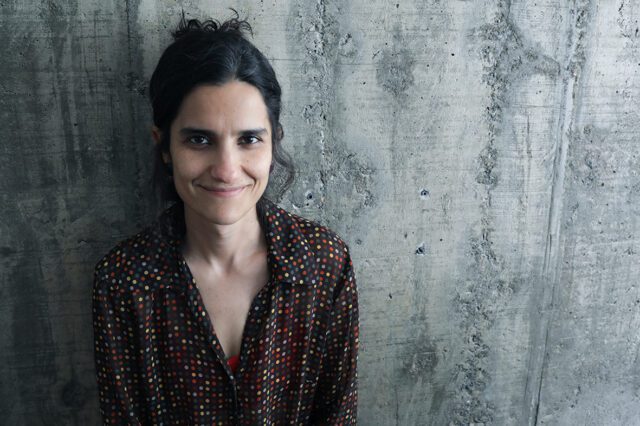
Nebulae, Marina Thomé declares, “is, above all, a space for critical development and artistic creation.” She is describing Doclisboa’s industry and networking event (16-24 Oct), of which she is the coordinator. Her language is instructive. The emphasis is on nurturing auteur-driven work, not on striking deals or making flashy business announcements.
“It [Nebulae] reflects Doclisboa’s editorial vision and grows directly from the festival’s programming. Throughout the year, the industry and programming teams work closely together, so the projects we invite are part of the same conversation taking place across the festival,” Thomé continues. “Success, for us, is creating an environment where filmmakers can develop author-driven projects that challenge cinematic form and language, while creating spaces for reflection through roundtables, conversations with festival programmers, training activities, labs and live cinema performances.”
Every year, a new country is invited to come to the event and to present new projects which Portuguese partners may be in a position to support. This year, the Greeks are in the spotlight.
“The invited country is always the result of a long-term relationship. These conversations begin well over a year before each edition. Beyond our ongoing dialogue with producers and institutions connected to the country, this year we also attended the Thessaloniki International Documentary Festival, where we participated in the industry programme and met with many local professionals,” Thomé explores the groundwork she and her colleagues undertook long before the festival begins.
“We found many similarities between the Portuguese and Greek documentary ecosystems. Both countries work with similar production scales, funding structures and co-production realities, creating a natural basis for collaboration,” the Nebulae head adds.
The festival launched an open call for Greek projects, and the final selection was made by a committee bringing together Doclisboa’s programming and industry teams. Throughout Nebulae, the filmmakers behind the selected Greek and Portuguese projects will present their work and also take part in networking sessions and one-to-one meetings.
There will also be a public conversation between the Hellenic Film and Audiovisual Center (EKKOMED), the Portuguese Film Institute (ICA) and producers to discuss funding opportunities and future collaboration. “Our aim is to create lasting connections and encourage future co-productions between the two countries,” Thomé declares.
Last year, Thomé and her team introduced a new showcase for Portuguese projects in the editing stage. The response was encouraging and the showcase will again be held this year.
“The feedback after last year’s edition was extremely positive, both from the filmmakers and from the invited international professionals. We believe it’s important to have spaces like this in Portugal, where filmmakers and industry professionals can meet around projects in an international context,” the Nebulae boss reflects.
One measure of the success of the showcase is the number of production companies, from the newest outfits to the most established, who applied.
“Although the projects are formally diverse, some recurring concerns emerge. Many engage with Portugal’s historical and contemporary relationship with Africa. Others explore the disappearance of rural landscapes and ways of life in a rapidly changing country. Memory is another strong thread, whether through archival research, forgotten communities, or intimate family histories that resonate with broader social and political questions,” Thomé says.
Among the titles is The Fleeting Stones of Borralha, set in a mining community where there is a plan to re-open long abandoned pits. This is made through auteur-driven outfit Madame Films, formed in 2020 by Cláudia Rita Oliveira.
Also being presented is When Night Falls, which follows five Italian-Senegalese girls who travel through Senegal in search of their roots. This is made through Cidades Irrequietas Filmes, founded by Patrícia Cairrão and Ricardo G. Santos.
Meanwhile, Framing The Revolution, directed by Érica Pereira do Nascimento, profiles seven pioneering women filmmakers who reinvented Portuguese cinema after the 1974 Revolution.
In recent years, Thomé believes, Portugal has taken important steps to ensure the voices of women filmmakers continue to be heard. She cites in particular the creation of MUTIM, an association that advocates for greater gender equality across the audiovisual sector.
“There has certainly been progress since 1974, but we are still far from achieving real equality,” she warns. “The imbalance is systemic, and addressing it requires action at every level of the industry, from funding and production to programming and criticism. At Nebulae, these concerns are present throughout the programme, in the selection process, the invited projects, the roundtables, the tutors and the conversations we facilitate.”
Thomé is happy that Nebulae this year has a strong international jury, led by Tyler Wilson, Senior Programmer of Film at Lincoln Center in New York; Filipino filmmaker John Torres; and Portuguese filmmaker and producer Leonor Noivo, co-founder of Terratreme Filmes.
“Together, they represent programming, filmmaking and production, bringing complementary perspectives to the selected projects,” she says.
As ever, Nebulae has a Latin-American flavour. Projects from Argentina, Colombia and Brazil, among other countries, are again being presented in the Arché section.
“These projects often engage directly with the realities of the present, bringing urgent, personal and politically aware perspectives on the world we live in, always through a strong authorial perspective. Another interesting aspect is that, much like the festival programme, the projects are becoming increasingly hybrid, both in terms of form and in the way they move between reality and fiction.”
Nebulae is also one of the few international industry initiatives that pays attention to film criticism. Its RAW residencies help emerging critics to refine their writing through dialogue with filmmakers and other critics. “At a time when there is less and less space for this kind of critical writing, supporting new voices feels more important than ever.”
Thomé acknowledges that Nebulae faces plenty of challenges of its own, among them “fragile financing structures and the need to protect spaces where artistic risk can flourish.” Nonetheless, she can’t help but strike an upbeat note about what the programme has achieved over the last seven years.
“Many films developed here have gone on to premiere internationally, secure co-productions or find new partners,” Thomé says. “Seeing those projects grow, and knowing that Nebulae played a meaningful role in their journey, makes us feel we are on the right path. At the same time, we know the industry is constantly changing, and we need to keep adapting. Nebulae will continue to evolve in whatever direction is necessary.”