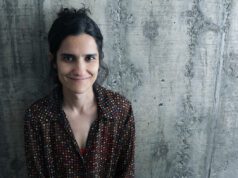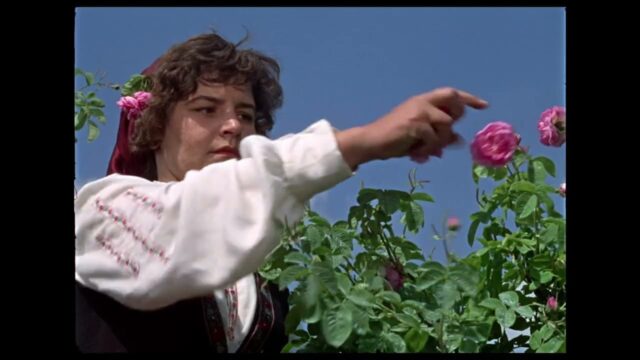
Rayna Teneva grew up in Kazanluk, a Bulgarian town famous for its arms factory, Arsenal AD, and for its rose oil, made from flowers picked in Bulgaria’s “rose valley.” The artist and filmmaker, who is now based in Vienna, isn’t therefore surprised that her feature Geography Is Destiny (an international premiere in Doclisboa’s International Competition) is so often described as being about “guns and roses.”
Nonetheless, she hopes audiences will see beyond such an obvious cliché.
Teneva returned to her home town to make the film. She spent time picking roses and also got a job inside the arms factory. “The access inside is basically impossible,” she says of the massive arms manufacturer which sells every kind of munition, weapon and explosive imaginable (and is famous for manufacturing Kalashnikov rifles). She started filming in 2021 and went back several times. The last time she filmed was in December 2025.
Her film, she emphasises, is not an exposé of the arms industry. She describes it more as an exercise in psycho-geography. The title comes from a line by Ibn Khaldun, a celebrated Arab-Tunisian scholar from the Middle Ages, who argued that landscape strongly influences the way societies evolve, how their inhabitants behave and where power lies.
She acknowledges, that “fear is a very big part of the social tissue of this place because of this weapons factory which is one of the biggest employers in the country.” Those who work there won’t talk about their jobs or say anything that might cause trouble. She didn’t want to put anyone at risk by taking her camera onto the factory floor.
Her own job involved drilling aluminium pipes. “I was working on machines that basically make holes.” The machinery made “very strange sounds” and she was startled by “how much handwork is required.” And, no, it wasn’t an enjoyable work experience. “I was absolutely full of fear and anxiety and stress…and because I could not really work there long my pay was very low.”
The film, which was also part of the Bulgarian pavilion at the Venice Biennale this year, doesn’t have footage of her at work on the factory floor. “For me, reproducing the imagery would not be exciting artistically.”
Although it has high-tech surveillance cameras on top of its towers, the factory is in oddly ramshackle condition. Teneva is shown wandering with her microphone boom through its grounds, which are mossy and overgrown.
At one stage, we also see Teneva on the shooting range, practising with a gun. (Her boyfriend filmed her). “I knew that there wouldn’t be any visuals from the factory,” she explains why she chose to include this sequence, In the factory, workers are always tinkering with components of weapons that are still being built – but in this scene she is shooing an actual gun. The process was “very physical, very nasty somehow, and very, very loud.” The kick of the gun hurt her shoulder. She hit the target but the instructor told her that “at the beginning everybody hits the 10 because it is full concentration. If you do it second, third or fourth time, then you become less precise.”
The spark for the film came around 2018 when she read several articles boasting that her home town didn’t have any unemployment. “That contradicts completely the memories I have from the early 2000s when I was living there and when people would not get paid for three, four or five months.”
The arms factory was fully privatised in 2012. “Then, of course, it started producing a lot, exporting a lot, and it increased its profits ten times in ten years.” This didn’t mean the pay improved. Workers, she says, are still not properly remunerated.
Ask the director about her own childhood in Kazanluk, and she admits that she “always wanted to leave. I don’t know why. I have a lot of very contradictory emotions toward this place. The guns and the roses reflect the way I feel towards this place.”
Teneva was born in 1986. She grew up in the period when former Soviet countries were trying to transition into liberal, capitalistic democracies. She talks of the “anger and disappointment” about how this process eventually played out. “This was probably also the reason I wanted to run away and go somewhere better!” She moved first to Sofia and then to Germany before eventually ending up in Austria.
Returning to Kazanluk to make the film was “very nostalgic.” She put her child in day care, rented a flat and immersed herself in the daily life of the town. “I decided to make this journey back. That is a serious act. I hadn’t been there for 20 years.” Some of her family appear on camera. We see her aunt, whose job is to bake cakes for any workers at the arms factory who were celebrating their birthdays.
This wasn’t an easy movie to finance. The director points out that she comes from “the arts,” not the traditional film world, and didn’t have extensive industry contacts.
“It started very small and I was a bit afraid to scale it up,” the director says of the film which she produced alongside Sophia Schiller, and which was made through German outfit, Filmwerk Kalliope alongside Bureau Artrecord. Her partner was her DOP. She received some funding from the Bulgarian culture ministry, the Bulgarian Fund For Women, The Austrian Culture Ministry, Studio29, and The Singer-Zahariev Foundation.
“I am beyond happy that I can go to Lisbon now with the film,” Teneva says of her selection at Doclisboa.
The director is now hatching a new project, one that she is making with a colleague and that she describes as a kind of ‘road movie,’ albeit one set on a train. “We travel with the train from Vienna to Bulgaria and back to Vienna.”
The further east you go, the slower the train gets, and travelling, she suggests, becomes more and more dream-like. “We did one already one full research trip last year,” she volunteers. The aim now is to secure funding to continue the filmmaking.