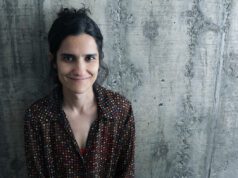
A decade ago, Portuguese filmmaker Cláudia Ribeiro, then in her mid-20s, went to work on the grape harvest in the Beaujolais region of France. At the time, she needed money to make her first film Entre Leiras (2020).
“I’ve always been fascinated by – and have often wondered about – the extent to which the places we live, and the cycles of nature that surround us, influence who we are and who we become,” Ribeiro tells BDE of the circumstances which have now led her to make Vent du matin (a world premiere in Portuguese competition at Doclisboa), a film that unfolds over a year within the region’s vineyards.
On that first visit to Beaujolais in 2016, she had met among the grape-pickers “many people who were questioning their own lives and what to do with them, from various European countries, some with college degrees but without the financial stability to achieve what they’d always dreamed of, others who believed that instability brought them freedom.”
Eventually, Ribeiro ended up at the Cortay family’s vineyard. “There, the dynamic was different,” she remembers “a family atmosphere where workers were provided with room and board during the harvest season. This shared living experience brings together two completely opposite lifestyles and fosters a dialogue between them.”
The director was intrigued by the contrast between the Cortay family, with their settled life, and where year after year, in the same place, they aim to produce wine, and the much looser world of the grape-pickers, many of them young, itinerant and not sure what the future might hold. It was this “convergence of different perspectives and rhythms of life” that led her back to the region to work on her documentary.
“When I was there in 2016, there were many grape-pickers and many family members, but I didn’t know what went on there the rest of the year. When we arrived there in November 2022 to begin the vineyard cycle with pruning, I realised that the whole family is very close-knit and they all live there, leading a very stable life with well-defined goals—to maintain the family’s agricultural business.”
Two of the grandchildren, who were 12 years old when she helped with the harvest in 2016, were now young adults, finishing their studies in tractor mechanics and winemaking.
Spending many months in the region, Ribeiro was struck by the “silence and tranquillity” in which the inhabitants lived for much of the year.
“During the harvest, there are many people talking and silence is rare, but the rest of the year, the transitions between seasons, in addition to being clearly marked by the landscape, are also marked by the soundscape. And this was something I believe helped shape the structure of the film.”
As a kid, Ribeiro had loved watching BBC wildlife films and had dreamt about becoming one of the camera operators on these films – “the ones who supposedly stay in one place and observe what lives there.” Her shooting style on Vent du matin reflects her childhood aspirations. There is no voice-over. The director talks instead of “noticing patterns, and waiting for them to happen again, but with the camera in my hand.”
It is a point of documentary principle for Ribeiro that she rarely, if ever, stages anything or asks characters to repeat actions. She admits, though, that after her previous film Entre Leiras (which followed life in a tiny rural village) and now Vent du matin, she may experiment with new approaches to storytelling. “Especially because this aspect of filming the ‘real’ makes me feel quite like a vampire. I think we never give back to those we film what we take for ourselves. And that makes me feel bad.”
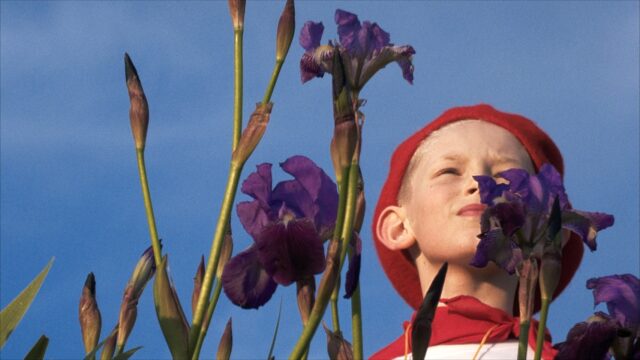
Vent du matin was shot over a period of four or five months. Filming began in November and December 2022. The crew then returned the following year in the spring, summer and autumn. The highly evocative imagery of a kid in a red beret in the middle of the vineyard was shot in April in Sainte-Paule, when the Fête des Conscrits was taking place.
There was no production schedule as such. Instead, “the idea was to arrive, see what was happening, understand the family’s needs at that moment, and immerse myself in them, so that I could then film them.” The basic aim of the film never changed. She was there to film a year in the life of the vineyard. She shot a lot of material (“but I don’t think I filmed too much.”) Editing proved relatively straightforward. She and editor Raul Domingues had a clear idea from the outset of the shape of the story they were telling. They tried to be as sensitive as possible and not to make either the family or the grape pickers feel vulnerable or exposed.
Ribeiro had checked early on with the grape-pickers that they were happy to be filmed. “Everyone agreed, and our presence was never an issue. We were part of it all. Some had harvested with us in 2016; others were Portuguese friends who, right after our trip in 2016, started going there to harvest every year; and those we didn’t know reacted well.”
Nonetheless, there were obstacles to overcome. “The biggest challenge was going to France to film with only minimal support from the Guimarães City Council (in northern Portugal). I knew that if I didn’t film at that time, I would give up on the project. Two great friends came with me: Vanessa Duarte, as production manager and assistant director, and Paulo Lima, as sound director. Both had already worked with me there during the 2016 grape harvest, and despite the less-than-generous pay, they agreed to embark on this adventure with me,” the director notes of two of her key collaborators.
Ribeiro is a member of the Porto-based Rua Escura cinema co-operative, along with André Gil Mata and Frederico Lobo. It therefore made sense to have Rua Escura as the production company.
“However, this project began before I joined the co-operative. Susana Nobre, a member of the production company Terratreme, was the person who encouraged and supported me in this project from the very beginning. Together with them, I submitted all the grant applications, and together we received post-production funding from the ICA (Portugal).”
Although it’s the world premiere in Lisbon this week, the director has shown the film to the Cortay family – and has received their blessing. Distribution in Portugal is set for next spring through Nitrato Filmes and RTP has taken broadcast rights.
And, yes, there were some obvious upsides to shooting in the Beaujolais vineyards. Ask the director if she enjoyed sampling the local vintages and she replies soberly: “I’m not going to say no – I’d be lying.”