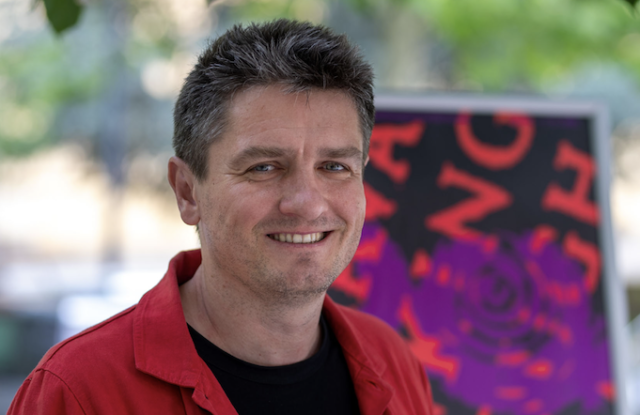
He may have been at the helm of Ji.hlava IDFF, one of the CEE region’s biggest, boldest and most important docfests, for three decades, but festival director and founder Marek Hovorka is as energised by the 2026 programme as any of the previous twenty-nine.
“When the world is on fire, documentary films shine,” Hovorka tells Business Doc Europe. “This year’s programme never stops surprising me. Its intensity, its ability to reach audiences, and the incredible diversity of cinematic approaches. I really believe documentary cinema has never been as strong as it is today… We’ve been experiencing something like a golden age of documentary filmmaking in recent years.”
Kicking off October 23, the 30th edition of Ji.hlava will showcase 350 films across its competitive and non-competitive sections, including 106 world premieres, 28 international premieres and 8 European premieres. As ever, the Opus Bonum competition will present the best of world documentary cinema, while the First Lights competition will showcase the most remarkable documentary debuts. The best experimental films will be featured in the international Fascinations and Czech Exprmntl.cz competitions. New Czech documentaries are on offer in the Czech Joy competition, while the Testimonies competition, dedicated to “powerful documentary films which deal with important social, economic, environmental, and political phenomena,” features fifteen dynamic new and recent docs.
But it all started back in 1997, conceived in the minds of a group of high school students in the Czech city of Jihlava, of whom Hovorka was to become primus inter pares, and since then, the festival has screened 6,388 films to approximately 940,000 cineastes. (The first film the festival ever screened was Miroslav Janek’s The Unseen.)
“Documentary cinema has fascinated me for the whole thirty years,” he describes the festival’s evolution. “I think we’re living through an amazing period of diversity and dynamic development. But of course, things have changed dramatically over those three decades. In the beginning, filmmakers submitted their films by sending us VHS tapes. The films themselves were mostly on film prints or Betacam tapes. One of the first big upgrades to our office was buying a fax machine. On the other hand, we already had our first website in 1999! So yes, thirty years is a long time.”
“But just as cinema itself has developed enormously, so have documentary film festivals. Many things we take for granted today simply didn’t exist back then,” Hovorka recalls. “Looking back, alongside IDFA, Ji.hlava was one of the pioneers of festivals dedicated exclusively to documentary cinema. And that included developing industry activities, as well as, in our case, publishing books and other materials. You have to remember that we were operating in an environment where even journalists working for national media weren’t quite sure whether documentary films belonged in the news or in the culture section. That’s why, during our first decade, we devoted so much energy to education and to promoting documentary cinema, both in the Czech Republic and internationally. We developed a whole range of projects with exactly that goal in mind.”
For the documentary cognoscenti, the CEE is considered an epicentre of creative and business excellence, (even if this is not reflected in the selections of some of Europe’s core docfests, as Hovorka has reminded year on year in Ji.hlava’s East West Index), and there is no doubt Ji.hlava has been a key driver in the region’s growth and influence.
“In 2001, Andrea Prenghyová and Filip Remunda approached me with an idea. They asked whether we would be interested in organising the first Eastern European Pitching Forum during the festival,” Hovorka tells BDE. “I loved the idea immediately, and despite some scepticism from my colleagues, I strongly supported it. It turned out to be a great success. Andrea and Filip subsequently founded the Institute of Documentary Film and continued organising pitching forums through their own organisation.”
Around the same time, the festival launched an educational platform called Media and Documentary Film, aimed at students of film studies and journalism.
“Then, in 2005 – the same year YouTube was launched – we established the first VOD platform dedicated exclusively to documentary films, today known as DAFilms. We followed this by founding Doc Alliance, the association of European documentary film festivals.”
“We also started developing presentations of upcoming documentary films, first at the Karlovy Vary International Film Festival and now in Sarajevo. And later we added the Emerging Producers training programme, helping to build a strong professional foundation for a new generation of producers.” Hovorka underlines. “For us, it has always been essential to connect Czech and Central European documentary filmmaking with the wider European and international context.”
The festival’s continued dedication to Czech documentary over the past 30 years is strongly reflected in this year’s largest-ever selection of local output in the international competitions, and the introduction of a Special Short Film Award in the Czech Joy section. What’s more, Helena Třeštíková, the Czech pioneer of long-term observational documentary filmmaking, will receive the festival’s Contribution to World Cinema Award in 2026, alongside Vietnamese-American director Trinh T. Minh-ha.
“Both are also pioneers in bringing a female perspective into filmmaking, which was still very much a male-dominated world when they started their careers – and both are university teachers,” says Hovorka. “I think this is an essential part of their contribution as well – their willingness to share their experience with younger generations of filmmakers.”
But why documentary? What determined Hovorka to embrace non-fiction all those years ago, eschewing the altogether more glamorous potential of fiction with all of its glitter and star quality? The Ji.hlava boss considers the question carefully.
“These are two fundamentally different principles of filmmaking. Either you create everything specifically for the film, constructing an entire world, and that’s fiction. Or you work with a world that already exists, where you always see less than you actually show [documentary],” he answers. “For me, both approaches are absolutely equal forms of artistic expression. And from the audience’s perspective, they’re also two completely different, autonomous worlds.”
“As a viewer, you approach a documentary very differently from a fiction film. You always establish a certain framework of trust, but the rules are different each time,” Hovorka continues. “With documentary cinema, that trust comes from authenticity, from the belief that the filmmaker isn’t manipulating you, but is using different artistic forms to share their own experience as fully as possible…What fascinates me about documentary cinema is precisely its given reality, its physicality, its concreteness. A reality that’s much richer and more layered than we can possibly realise at the moment of filming.”
For the 30-year anniversary edition, the festival’s Andrea Slováková, who programmes experimental films at Ji.hlava but is also a filmmaker and poet herself, has created a one-hour film called Ji.hlava 30 – Thinking Through Film!, based on the festival archives of the past three decades.
“The starting point is the way filmmakers think about cinema. These are directors who have come to Ji.hlava over the years with their films, discussions and masterclasses. And it’s fascinating to see how differently they speak about their fascination with cinema, how entertaining, thoughtful and deeply focused they can be when talking about their fascination with their own films and the films of others,” says director Hovorka, referencing the likes of Naomi Kawase, Frederick Wiseman, Peter Kubelka, Godfrey Reggio, Jóhann Jóhannsson, and others.
“What’s also beautiful about the film is that you can actually see how the medium itself has changed,” he adds. “We jump from the rough, grainy images of the first digital cameras to the almost perfect image quality of today. Even the timecodes on screen and the dates of the recordings change over the years.”
“Andrea has also created a soundwalk for the anniversary, a walk through the city that introduces the festival, its history and specific locations, but also the cultural roots of the region, which has a remarkable tradition of poets,” Hovorka maintains. “So even people who have been coming to Ji.hlava for years can discover the city in a new way, following places connected by the iconic white line that has become one of the symbols of our festival.”