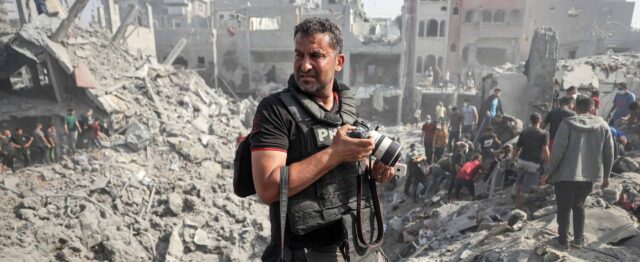
After the October 7th attacks in Israel, when Israeli prime minister Benjamin Netanyahu warned the people of Gaza to “get out” because “we are going to strike everywhere with all our might,” the Israelis enforced a media blockade. No foreign media were allowed to enter Gaza. During a period of utter carnage and destruction, Agence France-Presse’s Palestinian journalists and photojournalists were among the few reporters still covering the conflict, albeit working in often horrific circumstances. Nobody seemed to want them there, neither the Israelis nor Hamas.
Hélène Lam Trong profiles these journalists in her award-winning documentary Inside Gaza (an Oscar contender thanks to its Best International Feature prize at Doc Edge).
The Palestinian journalists were eventually forced into exile, Lam Trong first met them face to face them in Cairo where they headed after being evacuated. “I had interviews with four of them. Some are photographers, seasoned ones,” the director remembers. One of her main goals in speaking to them was to “re-humanise them.” She wanted viewers to understand the suffering these journalists had endured. Their faces are seen in large close-up as they describe their experiences.
“To shorten the distance between them and the public was the main goal,” the French filmmaker and reporter notes of the intimate style in which she shot the interviews.
In late 2022, Gaza was in the midst of what local reporters first expected to be “a small war lasting about 20 days.” It soon became apparent, though, that this was very different from what had gone before.
“As you see in the film, the AFP offices in Gaza were bombed, in November 2023,” Lam Trong remembers how Palestinian journalists and their families themselves came under threat.
Producer Yann Ollivier, Head of Documentary AFP DOCS & FACTSTORY, wanted to “raise awareness of the situation of journalists in Gaza, especially the ones with AFP.” That was how the idea for Inside Gaza was first hatched.
This was a period when the outside world was paying no attention to the plight of these journalists. It wasn’t unusual for reporters to be attacked. This had happened in many other conflict zones too. The difference in Gaza, though, was that foreign leaders and international media stayed silent. As one subject observes in the documentary, it was as if “the world had lost its moral compass.” No-one campaigned or intervened on the journalists’ behalf.
“Yann wanted to make a story about his colleagues and raise awareness about what was happening to them. He contacted me. I didn’t know him, and I have never worked for AFP myself. but I have been a reporter myself for 20 years,” Lam Trong recalls. She had recently won a prestigious French journalism award, the Albert Londres Prize, for her documentary, Daesh, the Ghost Children. The producer realised that she had the exact credentials needed for a project like this.
“To be honest, I didn’t say yes right away. I am an independent journalist and I work in the Middle East. I realised this could have consequences on my career,” the director admits to an initial wariness. She soon overcame this when a mentor told her “you can’t say no, you should feel lucky to be the one being called.”
This wasn’t an easy documentary to finance. Potential broadcaster partners and funders were initially reluctant to support the filmmakers. “At that time, Gaza was the most toxic topic. It was the very beginning of that war and funders were afraid because raising any question about what was happening in Gaza was taking the risk of being accused of antisemitism – of course, no-one wants to be accused of antisemitism.”
Since it premiered in December last year, Inside Gaza has won several awards including the Grand Prix at Figra and best documentary prize at Montreal’s Cinemania festival where it also picked up the audience award.
Although Arte, RTBF and the CNC among others eventually supported the film, Inside Gaza subsequently struggled to find theatrical distribution.
Lam Trong was “more than upset” about the level of disinformation in the international media about Gaza. “I could see how easy it was to manipulate public opinion,” she says. “This was kind of new, to have such simple readings of very complex situations.…Gaza is so frightening. It makes you so uncomfortable to think about what is happening there that most people choose not to look.”
The director argues that the film is as much about the freedom of the press as it is about Gaza. One point she repeats is that it’s impossible to make balanced judgements unless you have proper information – and that is what the press, when it is working properly, will provide.
“It was important for me to talk about the very essence of journalism which is field journalism, ground journalism. This is what the Palestinian journalists have been doing and they have been killed for that.”
Palestine, she adds, “is the deadliest place for journalists ever…and when you kill journalists, you kill reality and peace at the same time. I hope the public will understand that.”
In recent weeks, Yuval Abraham and Rachel Szor’s documentary Naza, which exposes how the Israeli Defence Forces killed Palestinian civilians through a testimony from secret Israeli military sources, has been doing bumper box office business with revenues of $15mn already achieved globally. Inside Gaza, which had its world premiere last December, has been watched by over a million people on TV but hasn’t secured worldwide theatrical distribution.
“I think we were a little too early…something has shifted,” Lam Trong suggests. “I think until recently, the only acceptable films about Gaza were those that were about humanitarian issues, women and children mostly, never political.”
Inside Gaza isn’t overtly political itself but it deals with the freedom of the press and includes many deeply shocking images of death and suffering captured by the Palestinian photojournalists working for the AFP.
While editing the documentary, the director watched “more than 300 hours of footage and looked at more than 5000 photos” from the journalists.
For reasons she can’t quite explain, the still images often resonated more strongly than the moving image footage.
“I’ve seen Naza. It’s a great film. I am really happy this film exists. It is a very important film. On the other hand, I am sad to see how it is easy for the audience to believe anonymous Israeli men in the dark on the roof. They share incredible information, but they don’t have any evidence of what they are saying – yet people believe them and it is a shock for the audience.”
She contrasts the testimony in Naza with “the footage, videos, photos and figures” produced by the Palestinian journalists, many of whom have been killed collecting this information. “And nobody would believe them. That is something we should all try to think about.”
Cynical attempts have been made to undermine the work of the Palestinian journalists and photo-journalists. Some have even been accused of falsifying images of death and atrocities. They have also been criticised by both the Israelis and Hamas.
“When nobody wants you on the ground, that tells that you are in the right place. When you choose to do journalism, you don’t do it to make enemies but you don’t do it to make friends. If you are friends with nobody, maybe that is because you are a good journalist,” the director concludes.