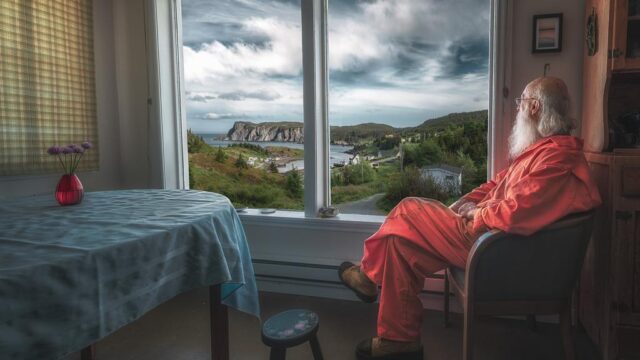
Your classic muse rarely looks like Gandalf, or Socrates. Nor do they impose themselves quite so fervently on the decision-making processes of an artist seeking to capture their likeness, their soul, their essence. But one such muse was Newfoundland resident Robert Tilley, a man who was both kingly and kind – and opinionated – in equal measure.
None of this preamble should detract from the remarkable artist responsible for creating Tilley’s astounding portraits. Before she arrived in Newfoundland, Chinese Ting Ting Chen had never even picked up a camera, but over the years transformed herself into a true master of the craft, a woman whose work has gained world-renown, and is imbued both with a vagabond curiosity and a painterly majesty.
In her short documentary The Muse, produced by NFB [National Film Board of Canada], director Wanda Nolan, also from the Canadian province of Newfoundland, delivers a highly poignant and moving dual-portrait of Robert and Ting Ting, and their unusual relationship. (NFB’s animation studio won the Academy Award® for Best Animated Short Film this year with The Girl Who Cried Pearls.)
Nolan was advised by a producer friend that the pair would make a “great story.” When the director met up with Ting Ting, she was not disappointed. “I saw the photographs and I knew immediately,” she tells BDE. “They were so compelling, and they automatically raised questions in me. How did Robert and Ting Ting meet? Who is this person that’s so willing to portray himself, who is such a chameleon in front of the camera? All of those questions.”
She was equally intrigued by the contrast between the two. “Their age difference, their culture difference, their experience in life. The fact that it’s a young woman taking pictures of an older man. They defy all the things that we’re told are not supposed to happen, especially in these toxic times right now. It was just such a beautiful, uplifting story that really goes against the [contemporary] narrative… There is this wonderful integration of cultures that is happening.”
“As a documentarian, you’re looking for people that can tell their story, people who, when you put them together, are going to have a magic and a dynamic that is going to translate to the audience. You’re looking for contrast,” the director adds.
Nolan points out how Newfoundland has historically been a staging post for immigrants en route to the larger Canadian cities. But Ting Ting was destined to remain, enchanted by the beauty and the remoteness of the place.
“Ting Ting shows our culture, living and breathing. She’s contributing to it through these photographs, and to this canon of who we are, as Newfoundlanders and Labradoreans,” she stresses. “She’s participating and contributing to who we are, and our definition of ourselves, and helping us to re-see ourselves. And that I find really profound and deep.”
“It’s also a story of her becoming a Canadian at the same time,” the director further underlines.
Tilley opened his door to Ting Ting when she arrived in 2018, became her friend, guide and confidant, and eventually her muse as she honed and developed her prodigious skills. His continual transformation into what she wanted him to be in front of the camera was remarkable, in equal part dramatic, whimsical and statuesque, and eternal. Yes, he can be a wizard or a philosopher, but we also see, through Ting Ting’s lens, a king or a saint, or a Roman senator at a Bacchanalian feast.
“It’s also that kind of magic that happens with documentary, that you don’t know what is going to happen until it happens on the camera,” Nolan explains of the artist/muse relationship she was observing at first hand. “There’s a lot of give and take going on as well. He’s strong-willed and playfully argumentative.”
Robert is also losing his memory and, as we see, the kindness he showed to Ting Ting when she first came to the island is being repaid to him many times over by his grateful friend. Whereas he was once her guide, she now takes on many of his care duties, such as chauffeuring him everywhere, all the time remaining by his side.
At one point, she drives him back to his “ancestral home” in Elliston, which is like a “time capsule.” Everything seems set in aspic, even the old organ that is still in the parlour.
Ting Ting, who had hitherto lived an altogether more academic life back in China, is naturally collaborative but, as we see in the film, retains a firm hold as they undertake their photographic business. He does what he’s told to do, all the time looking magnificent, but she’s willing to take on ideas from him as well. She never seems destined to be an ivory tower artist who’s determined to follow her own path. “Ting Ting bosses him around in there, but Robert was never going to do something he did not want to do.”
Ting Ting stresses, however, that without Robert, “I don’t think art would be part of my life.”
“They were truly equals. You look for those things for a documentary, but you can’t manufacture that,” Nolan underlines. “You have to have those people that are willing to be who they are and to show up. Robert and Ting Ting were very much like that. I knew that they’d be great on camera.”
The island of Newfoundland is more than a mere backdrop to the unfolding story. It is an existential component within the lives of the protagonists. “Part of becoming Canadian became this love and fascination for all of this vastness, the vast ocean, the beauty of this place. Ting Ting fell in love with this island and this place that she’s chosen to live in. It has a magic and a specialness to it.”
Robert, on the other hand, was born in 1948, a year before Newfoundland became part of Canada (prior to this it was a British-appointed commission). “So he was born a Newfoundlander and was naturalised into a Canadian citizen. And here’s Ting Ting coming here and becoming a Canadian as well,” Nolan articulates their common trajectory.
Sadly, Robert died before the film was completed. “He would have been so proud because he loved going to all the gallery exhibits. He just loved people. He really loved going around with Ting Ting. And he loved being the star of the show. I’m heartbroken that he didn’t see it. I really am.”
Likewise, Ting Ting is mourning Robert’s loss “very, very deeply. It means a lot to her to have this [their relationship] captured. We’ve talked about it a lot, and yeah, it’s very important to her.”
Nolan further explains to Business Doc Europe why documentary is the perfect medium to tell this rich and uncommon story. “For me, it’s the connection to the subject that makes me love doc. There’s not a better medium to express the complicated human heart, especially nowadays where social media has made the world so polarized and any contradictions are seen as an indictment of character.”
“With Ting Ting and Robert, they hold so many stories through their friendship – about race, gender, age, power structures, etc… and seeing them move through the world allows us to rethink our worldview. It’s beautiful,” she ends.