Last year, Israeli director Hilla Medalia was Oscar-nominated for her heart-rending short documentary, Children No More: Were and Are Gone, which captured on camera the vigils held by Israeli activists for kids killed in Gaza. She is back on the awards trail with a new short, Outposts: Nothing Here Is Yours, looking at the long-term campaign of intimidation, harassment and violence against Palestinian communities on the occupied West Bank by Israeli settlers.
Outposts, which recently screened at Doc NYC, is again produced by Sheila Nevins, the redoubtable ex-HBO and MTV executive. who was working alongside Medalia and Yael Melamede.
“We came back after the Oscars and thought, ‘what we should do next?’” Medalia remembers how she hatched the new project. The violence on the West Bank wasn’t new, but had grown a lot more vicious in the wake of the October 7th 2023 terrorist attacks in Israel, and the subsequent bombardment of Gaza.
The goal of the intimidation is to displace the Palestinians by making their lives impossible. The settlers, who are well resourced and well-armed, want the land for themselves. All too often, the Israeli army turns a blind eye to their thuggery.
“It has escalated a lot,” Medalia notes. The settlers (“the hilltop guys” as they are nicknamed) have the tacit support of the authorities to scare the Palestinians off their land. Their strategy is crude. They establish their own bases above Palestinian communities with the goal of expelling them. They’ll march uninvited onto the Palestinians’ lands and sometimes even into their homes. Often, they will be bearing cudgels. They want to provoke a reaction. They know that the Israeli authorities will nearly always take their side.
Right-wing politicians including figures like Bezalel Yoel Smotrich have been accused of fanning the flames of the violence with their incendiary rhetoric.
At least, awareness of settler attacks is now growing. During the olive harvest, activists and international volunteers supported the Palestinian farmers.
“There has slowly been more and more in the news, but the harassment is daily,” Medalia points out. There are hundreds of low-level incidents of settler youths causing trouble for the Palestinian communities, perhaps scaring their livestock or threatening their water supply. These types of incidents, which are too small to catch the media’s attention, are what her documentary shows.
“This is really what makes Palestinian families give up – the lack of access to their land, this daily harassment,” the director notes. “The map is being shaped now and the film is our way of trying to intervene.”
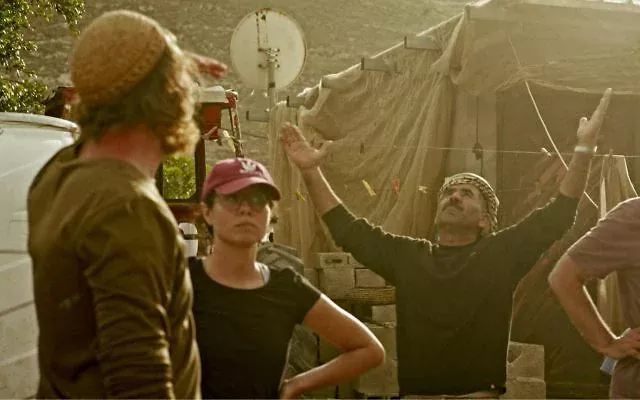
Medalia and her small team started filming in the early summer. Some of the stand-offs between the settlers and the Palestinians take on a surreal hue. The activists are “armed with their cellphones and body cams” while the settlers themselves are also busy filming everything with their phones. There is a rush to document what is going on. Both sides can use their footage to support their claims of misbehaviour – but everyone knows the Israeli authorities will favour the settlers’ versions of events.
Outpost was filmed in various locations including at Khirbet al-Tawil, south east of Nablus, and in Taybeh, north-east of Jerusalem. These were all places with strategic significance. If the settlers manage to displace the Palestinians in these areas, they will then have control of large swathes of land.
The settlers’ attitude is clear. They feel that this is their God-given land and that those living here are merely interlopers. They don’t even begin to acknowledge the Palestinians’ rights to be there, and they like to paint the Palestinians as terrorists.
One scene in the film shows the Palestinians building fences around their homes. Traditionally, they would never do this – but now they feel they have no choice if they want to protect themselves and their property.
A lot of the harassment is carried out by children and teenagers. Many are from Orthodox backgrounds. Whereas other families might send their kids to summer camps, the settlers send them to take part in campaign against the Palestinian communities.
Outposts, which is 30 minutes long, was shot on a modest budget. There isn’t yet a broadcaster on board. Medalia hopes, though, that it might eventually be shown in a double bill with Children No More.
“We started it just by going,” she remembers. Her cinematographer Avner Shahaf and editor Erez Laufer had both also worked on Children No More. The project was shot with a small crew. “It was really just Avner and I spending nights and days on location.”
At Doc NYC, the film won a Louise award “which came with a nice cheque.” Now, the director and her team are planning how to get their film seen as widely as possible. They are working with The Film Collaborative on festival strategy and have already been selected for Hampton Doc Fest in the US and the Watch Docs Human Rights in Film International Film Festival in Warsaw early next month.
And, yes, there is an impact campaign to get the documentary shown in the West Bank. The aim is to ensure it is seen not just by the activists but by the general public.
“Will anyone broadcast it in Israel? I don’t know,” the director asks, before answering her own question. “I can tell you that with Children No More, nobody would broadcast it in Israel, but with his film…maybe! There are not a lot of options…but I am hoping there will be more openness. I do feel that people are unaware of the level of what is happening.”
Medalia acknowledges there has been increased media coverage of settler violence against Palestinian communities. “But I feel that, even in the reports, you don’t understand it or feel it to the extent that the film is showing it.”
The documentary shows some very disturbing scenes. “But god knows what happens when we are not there with the camera. I am sure it is worse.”
There are certain Palestinian communities that don’t want the activists to be present but most are happy to have them there. These activists are often Israeli citizens “and because they are Israelis, they can sometimes do things that the Palestinians are not able to do…they [the Palestinians] would be arrested!”
The film features three communities under attack from settlers but there are many, many others. “You drive in the West Bank and you turn your head to the right and you see outposts, you turn your head to the left and you see outposts. Everywhere you look, they are there. It is crazy!”