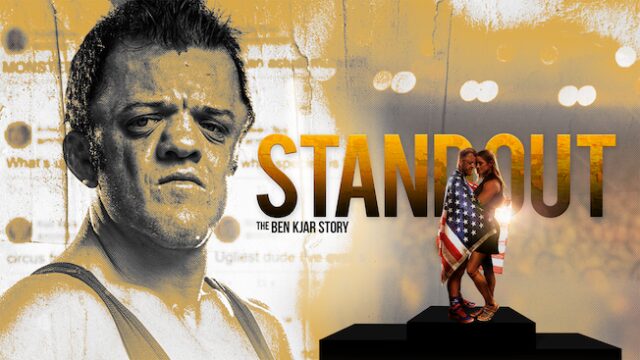
Tanner Christensen grew up in Centerville, Utah, the same town as Ben Kjar, the subject of his Oscar-contending feature documentary, Standout: The Ben Kjar Story. Christensen was a couple of years older than Kjar, but he still knew all about him. This was the guy born with Crouzon Syndrome, a rare facial disorder, who overcame all the odds to become a top-level wrestler.
“I had known about Ben all of my life. We were not great friends or anything but it was a small enough town that really everybody knew who Ben was,” Christensen remembers. “It was not only because he looked different and stood out that way, but because he was a very gregarious kid. He was just kind of a magnet for people around him.”
Christensen comes from a filmmaking family. He has edited many films made by his father, the prolific cinematographer and director, Thomas C. Christensen. Standout is his first stab at directing a feature documentary.
When he first approached Kjar about making the film, there was no response. Christensen thought he was being given the brush-off – but then discovered that the reason Kjar hadn’t replied was that he was in Africa, climbing Mount Kilimanjaro.
“When he finally called me back, I had left him a voice note – and admittedly it was a terrible voice note, just the worst pitch you could possibly imagine,” the director says of the toe-curling message he left on the answer phone. “I should not have approached him like that. I was just grateful he called me back. It took a few meals with him to tell him what I thought I could do with the film.”
Christensen was friends with Kjar’s cousin – and so had someone to vouch for him (and to give him Kjar’s contact details). Kjar had been approached by filmmakers before and had turned them down. In this case, though, he liked Christensen’s ideas. “Then we were off to the races!”
There was plenty of archive to draw on. The Kjar family had “filmed everything” from Ben’s birth to his surgeries, from his school parties to his emergence as one of America’s best young wrestlers. “What a gift that was. His family, friends and competitors, as soon as Ben was aboard, they all jumped in. They’ll loved Ben so much. If it was something he wanted to do, they were all willing to give their full effort.”
Ben had been mocked as a kid because of his appearance, but what viewers also learn from the film is that he was resilient, funny and charismatic, and refused ever to play the part of the victim. His exploits as a wrestler – racking up 129 victories in college and becoming Utah Valley University’s first NCAA Division I All-American – command immediate respect.
Nonetheless, Christensen is at pains to point out that this isn’t just a sports movie – and is not sure he would have made it if that was all it had been. (“I don’t know if I love wrestling that much,” he confides.)
Despite the home movie footage at his disposal, Christensen ended up casting young actor Colton Fielding as the five-year-old Ben. Colton was also born with Crouton Syndrome. “We had seen all the archival material and there were just some moments where we didn’t have anything to visualise it,” the director explains his use of recreations. “We went on a hunt for a kid that could play Ben. There are really not that many people with Crouzon Syndrome – and it turns out there are really not any actors.”
Just when the director was despairing of finding anyone, Kjar received a social media message from a family he didn’t know inviting him to dinner. He accepted. “And there was Colton Fielding. He looked just like Ben as a young kid and he acted like Ben did too – he was a really energetic and gregarious kid. A lot of these kids are shy and reserved, but he was not.” His parents agreed to allow him to be in the movie. Colton had never acted before but, the director says, he did “a phenomenal job.”
The film was made on a low budget and largely self-distributed, but went on to make over $650,000 at the US theatrical box office. (“It was really just us, a team of two or three people, hustling to get it out.”) Its home entertainment roll-out was overseen by the Samuel Goldwyn Company.
“One of the things I have been most proud of has been to see the impact it has had on the facial difference community,” Christensen reflects. He approached Dallas-based non-profit Children’s Craniofacial Organisation early on and has had strong support from them. He has also worked closely with the Utah Smiles Organisation led by Dr Devan Griner who came up with the quote: “if you’re a kid with a facial difference, you need to see this film – and if you don’t have a facial difference, you need to see it twice.”
“We’ve been invited to conferences which different organisations which help these kids…They bring Ben in, he’s like the keynote, they watch the film and he talks to the kids directly.”
Having his father as producer and DOP helped Christensen solve many of the logistical problems facing him as a debut director. “Having him there, it felt like I had a ‘cheat code’ on set. His experience and knowledge is so vast that if we ran into a problem, he had great ideas how we could fix it…he’s a master of low budget filmmaking. I couldn’t have done it without him,” Christensen states.
Jared Hess (Napoleon Dynamite, A Minecraft Movie) was also a producer – and Christensen regards him as an equally important mentor.
Funding came from “a couple of private investors.” Christensen took on multiple tasks including the editing. In an effort “not to make it look like a student film, where my name is up a thousand times,” he didn’t take the editing credit.
The US wrestling community also embraced the movie. Kjar went to high school and college wrestling tournaments to promote it. Wrestling coaches, many of whom remembered Kjar’s feats, also threw their weight behind the film.
The world premiere was held in Slamdance, now in LA. The Ben Kjar Story went on to screen at several other festivals. Now, the film is competing for an Oscar race having qualified by playing in LA County for a week. “Ben and I went out there for that. It was a great response. We filled the theatres most nights and Ben also did a wrestling clinic at Santa Monica High School.”
Christensen is now about to work as an editor again on one of his father’s new movies, about inventor and TV pioneer Philo Farnsworth.
As for the Ben Kjar movie, it, like its subject, is continuing to punch well above its weight. “We barely had two nickels to make this film,” Christensen confides of a documentary now in the heart of this year’s awards race.