

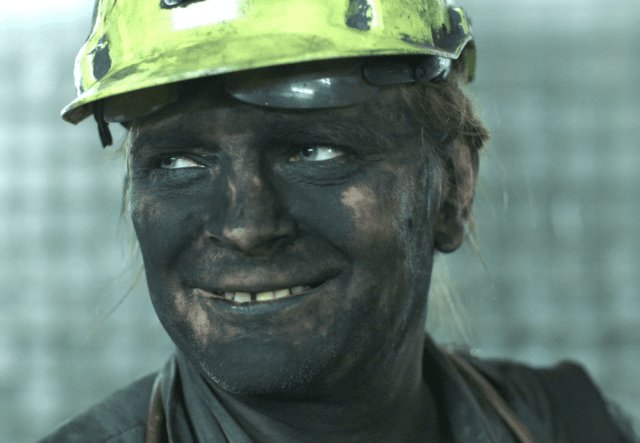
“He’s a guy who is dirty on his skin but is very pure in his heart,” says director Jindřich Andrš of his lead character, former miner Tomas. “I didn’t say this when raising money for the film. Maybe if I had, I would have raised more…”
When it is announced that the coalmine is about to close, Tomas, who has been going down the pit for the past 25 years, is offered the opportunity to retrain as an IT programmer. The odds are, of course, stacked against him. He is both a boozy heavy metal addict and a boorish football fan who sings of his hatred for Sparta Prague, the sworn enemy of his beloved SK Jilesia. What’s more, he hails from the Badlands of Ostrava, far away in the north-west of the country.
And aside from all that, Tomas is in his late 40s with nobody in his life, and he would be competing in the jobs market against kids less than twice his age. Kids for whom IT is already a second language. Surely Tomas is little other than a deluded impostor?
Actually, no. That is not the case at all, and the portrait that director Jindřich Andrš paints in The New Shift is one of a man who is willing and able both to re-invent himself and to (re)learn the rules of engagement to find gainful employment in a new industry. What’s more, he is revealed to be smart, determined and street-wise. He also has a gang of close buddies (former miners), three happy teenage kids and a rakish charm, as evidenced by his ability to attract a well-suited partner in the form of Nada.
“It was very big luck that I met such a great character as Tomas,” says director Andrš. “He is authentic and charismatic, and at the same time his story developed in such an interesting way. It was pure luck that this happened to us.”
“It wasn’t just about the career shift but when his whole life shifts,” he adds. “He finds a new love. He changes some of his values and he changes how he looks. But the thing is that I am sure that in his core he doesn’t really change. When he watches football, he is still a miner in his heart. He is a physical type of man but he had to learn how to adapt to survive in this new kind of world that he didn’t know before.”
Tomas seems to do reasonably well from the start in his new profession (although for non-programmers the array of characters and symbols that determine code seem baffling and impregnable). But he is far from polished at interview and must learn to fine tune his propensity to give nothing other than honest answers when speaking with HR folk at job fairs.
One crucial scene pits him against a younger friend in a bar who tells him he is wasting his time, that IT is a young person’s profession, that he is deluding himself, all of which Tomas takes to heart as he starts work in a brick factory.
But Tomas is savvy, and his desire not only to write code but to truly understand it meant that his computer skills had taken him off-piste when trying to find solutions. All of which had been noticed by his course tutor who invites Tomas back to lecture on his guerrilla approach to code. Which also means, crucially, that his job prospects are improved. What’s more, he works hard on his interview technique.
“When he is taught what to say, that this was the ‘dream job’ when down the mine etc, he is accepting that this is a kind of a game that maybe we are all playing every day, but we don’t have the sensitivity to see it,” says Andrs.
The director spent two years following Tomas and was with him during all of the profound and crucial changes that he underwent, and they became firm friends, says Andrš. But the director was also there to make a film, which at times he found difficult from an ethical perspective.
“Some of the shootings were becoming too difficult to handle, like the interviews,” he observes. “Tomas had never done a job interview before, and for him it was like the ultimate moment to change his life. But there is Jindřich the director and his film crew who want to film the interview, which could possible destroy everything that Tomas is trying to do.”
“His employers could be scared because if they would take him on, because then they would also be taking on the film crew,” he adds. “They are not getting just Tomas, which can be very stressful for everyone. That was very difficult to balance.”
The film reveals many satisfying twist and turns and proceeds at a fair pace as Tomas’ abilities, confidence and popularity grow wildly, and we begin to hope that his journey may be taking him from the coal-mine to the goldmine.
Not that what he sets out to do was ever in any way easy – far from it – and we have to wait until the end to see if he is ultimately successful, but suffice to say our emotional investment in watching Tomas on his journey is handsomely repaid before the film’s end.
Or is it?
It all depends on your age, says director Andrš. “We had a lot of test screenings before finishing the film, and the reactions were very different depending on whether or not it was a young or middle-aged/old audience,” says the director, who is 26 himself.
“The young people up to around 30 years old were, like, oh my god, this is such a sad film, he is just suffering at the end,” he says of the reaction to Tomas considering a deskbound future. “But older people of 50+, they see it very positively. They told me it’s such an optimistic film. Maybe when you need to have a job to feed a family, you understand Tomas that much more, that this was a big success for him after all.”





