

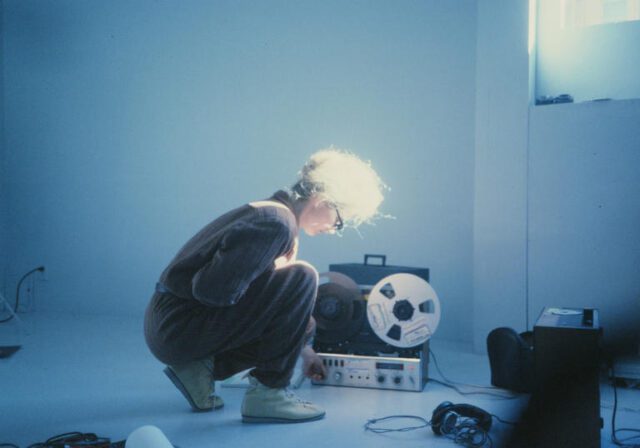
Photo credit: Peggy Weil
As Sheffield prepares to pump up the volume ahead of the October 31 European prem of Sisters with Transistors, first time feature director Lisa Rovner plugs in with Business Doc Europe.
Sisters With Transistors tells the story of the female electro-pioneers working in the mid to late 20th Century, whose work helped define the sonic and musical landscape that we inhabit today.
Maybe it’s the Doctor Who vibe (yes, the iconic electronic soundtrack was written by Delia Derbyshire before the sixties had ever decided to swing), or perhaps it’s Laurie Anderson’s mellifluous narration. Or it may it’s how, in ancient-seeming archive, we see the likes of sonic genius Daphne Oram diligently working on sound in her lab, testing its possibilities via trial and error and then naming the whole process ‘oramics’. Whatever it is, Sisters with Transistors (reviewed here in BDE) is one of those docs that is impossible to ever tire of.
And for that reason filmmaker Rovner has to be a muso herself, surely, such is her understanding of, and obvious love for, the subject? Actually, no, she says.
“I’m not a musician but music has always played a big part in my life. I can’t remember or imagine life without it. I moved away from pop music at the age of 11 and haven’t really looked back,” she explains.
But there were other reasons to tell this story. “I studied politics science in Canada so ever since my early twenties I have been thinking deeply about the politics behind storytelling, the stories we’re told, the stories we’re not told and the consequences. I think all of my work revolves around confronting dominant narratives with counter narratives.”
“So when I discovered a timeline of female pioneers in electronic music and began to look into Clara Rockmore, Daphne Oram, Bebe Barron, Delia Derbyshire, Maryanne Amacher, Pauline Oliveros, Wendy Carlos, Eliane Radigue, Suzanne Ciani, and Laurie Spiegel and realised these women photographed with machines were among the greatest pioneers of modern sound, I was compelled to break the silence that surrounded their stories,” she adds.
Rovner concedes that she is not telling the whole story, as there is only so much footage out there that document those pioneering times. Sound is to be heard but doc, after all, is to be seen. “The film focuses on women for whom I could find archive, but of course there are many others whose stories also merit attention, I just couldn’t find any archive to illustrate their story,” she comments.
“The archive really drove the story, it dictated what I was able to explore in the film. I’m sure there is more archive out there, although I have to say I tried as hard as I could to find it. I was finding replacement archive right through the online edit, the main challenge with archive is the price it costs to license and how difficult finding good stuff is.”
The film studiously avoids the staple doc approach of interviews and talking heads, instead weaving a complex, fascinating and entertaining story from the materials she had at her disposal.
“From the beginning I imagined the film as an illustrated oral history, we built a visual world from the audio,” she says. “It’s a long process to figure out what works with what. Thanks to the three brilliant editors I worked with – Kara Blake, Michael Aaglund and Mariko Montpetit – you really get a sense of each woman’s individuality. Even though they were all pioneering electronic music, with each subject you experience a different world, a new soundscape which reflects their different interests and surroundings.”
“They were all pushing boundaries, but in completely unique and idiosyncratic ways. The filmmaking had to reflect that,” Rovner concludes.





