

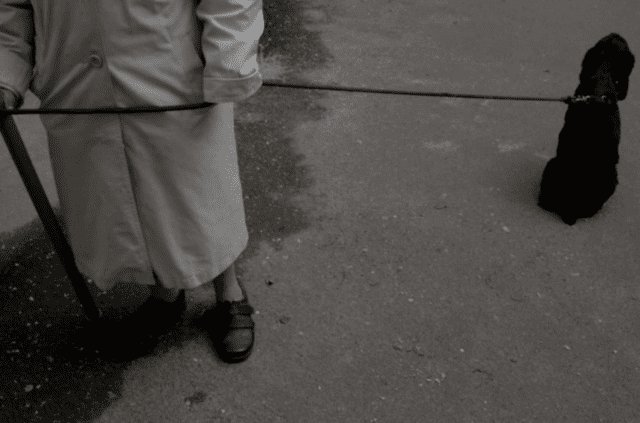
The rain is filling the gutters. The streets are empty of humans, but stray cats and dogs are scavenging for food. So are flocks of pigeons. This is the St Petersburg during lockdown shown in Russian director Tatiana Chistova’s Bless You!, world premiering at DOK Leipzig.
Alongside the images of the empty city, we hear recorded conversations between St Petersburg’s elderly citizens, many of them distressed and confused by Covid-19, and the city’s help services.
The idea for a film about the pandemic came from Chistova’s Polish producer, Maciek Hamela (Impakt Film). “I told him we had a very serious problem with old people because the structure for helping them is very bad,” the director remembers.
At first, Bless You!, selected for Audience Award short film competition, was meant to be a short episode within a bigger film would look at Covid in different countries. In the end, Chistova and Hamela decided to make it as a separate documentary.
Chistova won’t reveal how she got hold of the audio recordings used in the film. “That’s my private thing.” Nonetheless, her indignation at the way that St Petersburg’s elderly citizens have been neglected during the pandemic is self-evident. 90% of the calls the old folk make are about food – and how they’re supposed to get hold of it when they are stuck at home, often living on tiny pensions.
“I needed to find a metaphor…everybody knows that the birds in the city often get food from old persons. They (the old persons) give them bread or corn,” Chistova explains why she included the footage of the pigeons. Thanks to the pandemic, the birds too are hungry and confused.
Over the centuries, St Petersburg has endured its share of disasters and fires. Certain buildings still bear the scars of the old disasters.
Filming during the lockdown presented its challenges. “Russia is a big country. The lockdown was very serious in Moscow so it was hard to shoot in Moscow. But in St Petersburg, it was only the first week when it was strictly enforced,” Chistova explains. She and her small crew were working without official permission. To their relief, no-one interrupted them. Even so, it was a tough experience. The shops were all closed. So were all the public lavatories. There was nowhere to buy food. “But the city was nice and empty,” the director adds.
Chistova has an intriguing background for documentary filmmaker. Earlier in her career, she worked as third assistant director on Downfall directed by Oliver Hirschbiegel and starring Bruno Ganz as Adolf Hitler in his Berlin bunker, enduring his own version of a lockdown. “I liked the film, I thought it was a very strong film.” She will be engaging with history herself in one of her next projects, a series of three documentaries about the Stalin-era. The first will be about a cemetery in which both victims of the famine during the 1930s and political prisoners from later year are buried. “It’s a very awful place. This story is not well known.” Relatives of those buried here have tried long and hard to locate the remains of their loved ones.
The title for Chistova’s film in DOK Leipzig is an ironic reference to the familiar Russian greeting, “bless you!,” with which people wish each other good health. During the pandemic, they still use this greeting but without thinking about what it really means.
At the end of the film, Chistova shows footage of a Victory Day parade in which the streets are again thronged. Youngsters are back out and about but old people are nowhere to be seen. “The old people who are isolated in their buildings were told that this (the lockdown) was being done to protect them,” Chistova notes. “In reality, it’s hard to work out if this is true. They do this to protect the population but not the old people.”
As if to prove the fact, when the government allowed the Victory Day celebrations to go ahead, the old people were left at home on their own, just as they had been throughout the pandemic.





