

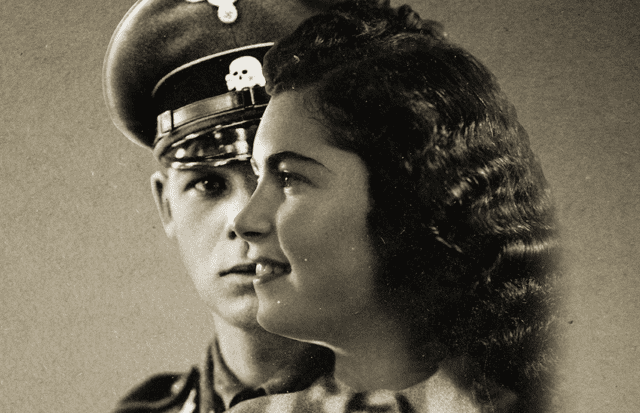
No film at IDFA this year tells a story stranger or more unsettling than that of Israeli director Maya Sarfaty’s feature Love It Was Not, recent winner of Best Israeli Film at Docaviv and screening in Luminous. It’s an account of a love affair, if it can be described as such, between beautiful young Jewish Auschwitz inmate, Helena Citron, and Franz Wunsch, a high-ranking SS officer.
After the war ended, the couple didn’t see each other for 30 years. The oddest twist came in the early 70s, when Wunsch was put on trial for war crimes and his wife beseeched Helena (by then living in Israel) to testify on his behalf.
This is the second film that Maya Sarfaty has made on the subject, following on from her award winning short The Most Beautiful Woman (2016).
Sarfaty first heard Helena’s extraordinary story when she was still a child. She was taught art and ballet by Helena’s niece whose husband told her about Helena’s Auschwitz experiences. Sarfaty was immediately fascinated.
“Through the years, I tried do all kinds of things, writing it as a novel or a fiction film, but the story is so big it always felt wrong.”
Five years ago, Sarfaty heard that a British author was planning a book on the story. The author was married to the SS officer’s daughter Dagmar.
The director made contact with Dagmar, who was also intensely curious about her father’s Auschwitz years. Through her, Sarfaty gained access to the SS officer’s diaries, personal testimony and a revealing but deeply disturbing piece of home movie footage, taken when Franz was an old man. “This was the moment I said, ok, I have the means to tell the story.”
Dagmar came to Israel to meet Helena’s relatives. It was a very intense encounter which inspired the short film The Beautiful Woman. “When I finished it, I realised I had so much material regarding the story itself, so much information. I felt I hadn’t finished and that there were still things I wanted to say.”
Thus began the process of making the full length feature, Love It Was Not.
The Austrian co-producer Kurt Langbein had a personal connection to the material too. His father had been involved in locating Wunsch and bringing him to trial in Vienna in 1972.
In the documentary, sold by Cinephil, Sarfaty makes ingenious use of cut-out photographs. On the one hand, this is a dramatic way of telling a story for which archive footage is not readily available. On the other, it is entirely in keeping with Wunsch’s own obsessive behaviour. The lovelorn Nazi used to put together photo-montages in which he would imagine the life he could have had with Helena if they had been together after the war.
“It was very important for me that audiences would be able to distinguish between real historical documents in the film and these illustrations that are made up. This is the way I imagined it…this is why you can see the hand-made feel of the cuts.”
The title Love It Was Not comes from an interview Helena gave late in her life. There was a bond between her and the Nazi officer. She would almost certainly have perished without him. Her sister would definitely have died. However, their relationship was nothing if not vexed.
Ask the director how she regards Wunsch and she replies: “That is actually one of the main points of the film for me, the ambivalence of his character. Franz Wunsch was an SS officer in Auschwitz. Not only was he an SS officer in Auschwitz…he was a sadistic SS officer in Auschwitz,” the director reflects.
“He was acquitted [in the 1972 trial] but that doesn’t mean he was innocent to say the least…on the other hand, he was a gentleman capable of pure love and compassion who helped Helena – that is something we can look at. Good and bad can live within the same person. This is something we should be aware of today. Helena’s character is also ambivalent as I see it. She is not the typical helpless victim that you imagine. She is a strong woman with a strong desire to survive. She is willing to do whatever she needs to do to survive. This ambivalence is what drove me into the story from the beginning.”





