

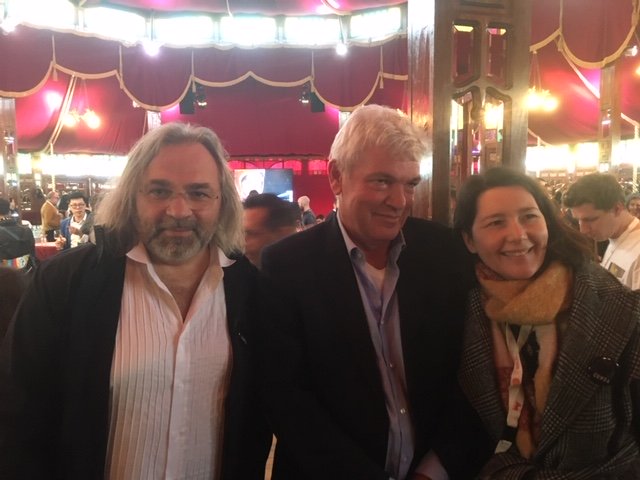
Heino Deckert is trying to remember just when he first worked with Vitaly Mansky, the veteran Russian director whose latest feature doc Gorbachev. Heaven is a world premiere in IDFA Feature-length competition.
“I think it was….Broadway. Black Sea,” the German producer (who is also managing director of Deckert Distribution) says of a film from almost 20 years ago. Since then, Mansky’s work has remained a permanent fixture in the Deckert catalogue.
“It’s a very, very, very long relationship. I always admired him,” Deckert says of the maverick Russian who now lives in Latvia. “He’s a real fighter. I like the way he approaches Gorbachev. He doesn’t say ‘yes, yes.’ He is really asking questions.”
The sales company may have launched sales on Gorbachev. Heaven during IDFA but Deckert suggests “the real outcome [will be] when people in the industry see the film.” The company has, until only the last few days, placed limits on industry screenings to ward off potential mishandling of the property. But now, selected buyers are being shown the film and first discussions are taking place, and there is great interest from both theatrical and TV buyers, notes Deckert Distribution Sales Manager Liselot Verbrugge. In the meantime, the doc will screen at ArtdocFest/Riga (Nov/Dec 2020), the festival that Mansky runs.
As well as the IDFA-selected, films Deckert Distribution is handling sales on Venice Biennale pre-opening film Molecules (Andrea Segre) and the Telluride/Venice Days selection To the Moon by Tadhg O’Sullivan.
2021 titles will include Bellum – The Daemon of War by David Herdies and Georg Götmark (produced by Momentofilm, Sweden), and Roma (working title) by Olha Zhurbia, produced by Darya Bassel of Moon Man (Ukraine).
With around 80 features to his name, Deckert is one of the most prolific producers in the documentary arena, which he makes through his company ma.je.de. (He also produces fiction). The pandemic may have slowed him down but he is continuing to finance major new projects from some of the biggest names in documentary.
One of the new ma.je.de. productions bound to spark curiosity is Victor Kossakovsky’s latest feature Architecton, which Deckert has put together as a German-French-US co-production.
“It’s about architecture and how we want to live. That is the question of the film,” he says of the project which is now close to being fully financed but whose start has been delayed by COVID. “No, it’s not frustrating, but when you have three of these films – and that’s what I have at the moment – if it takes longer (to start production), it may cause an economical problem.”
Another new doc that Deckert is currently hatching is The Gate, directed by German filmmaker Jasmin Herold and Michael David Beamish.
Ask Deckert how he divides his time between producing duties and selling films and he sighs. “Oh, my god, that is a question. I’m just running companies,” he says, but adds that his main concentration (as “everybody knows”) is on production. “On the sales side, Liselot is actually the one doing the daily work for the company…we telephone all the time. We do together the final decisions on which films we take and which we don’t.” He describes Liselot as his ‘right hand’.
Deckert works both with very established directors, such as Kossakovsky and Mansky, and with newcomers like Adrian Pirvu and Helena Maksyom whose documentary road movie Everything Will Not Be Fine is screening in IDFA First Appearances. This is about two characters whose lives are affected by the Chernobyl disaster.
“Of course, we work with younger directors,” Deckert states. He has close relationships with various trusted production companies. If they have talented new filmmakers on their books whose docs they are presenting, Deckert is always open to looking at the work. “It makes life easier if you work with companies that you know.”
Deckert believes that the big new SVOD companies are shaking up the landscape for the better. “They [the streamers] are doing films that public television normally did. Now, public television is under pressure because they see there are other people who do what they normally should do, but in the last 10 or 20 years, they haven’t really had the money to do it,” he explains.
“The other thing that is good is that suddenly the American market is far more interested in the European market,” he say, which is reflected in the spectacular success he achieved last year with the Oscar nominated Macedonian doc Honeyland.
Deckert has worked several times in recent years with US outfits like Participant Media and A24. Until recently, Deckert would gravely warn European filmmakers they had little chance of financing their docs in North America. “That has totally changed,” he says of one of the most significant recent shifts in documentary financing.





