Does anyone own anyone? Does anyone have the right to continue a man’s legacy after his death? Should you be able to create life in order to replace a lost life? Many more ethical issues are raised in In His Image – an honest and austere depiction of the struggles of parents who have lost their sons but hang on to the possibility of somehow keeping them alive.
Israeli filmmaker Tami Ravid starts with a disclaimer: she herself doesn’t have children (yet) but is part of a society where, as she puts it, ‘children are the answer to anything’. This notion is represented in large Jewish families, where five or more children are not an exception.
She also states how semen stays alive for up to three days after a man dies. If you combine these facts, you end up with the premise of this fascinating documentary which follows three families that are holding on to the seed of their deceased sons, who were all serving in the Israeli military.
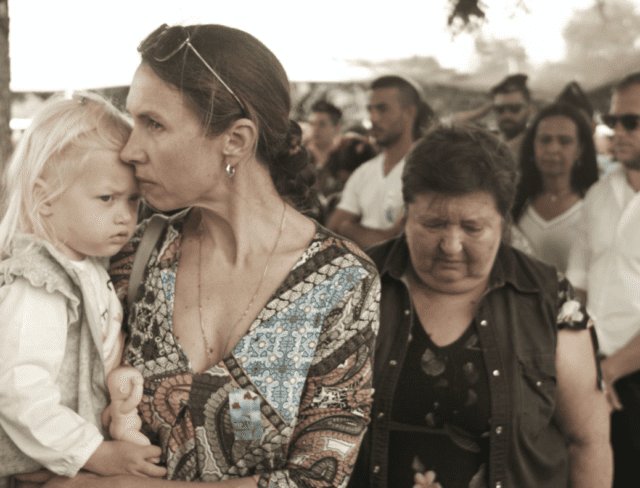
The three are in different situations: Haderet and her husband lost their son Shaked in an accident. He had a wife who owns the semen that was harvested from his dead body, but she refuses to let the parents have it, to create a grandchild, which they feel they have a right to. ‘Something of him is still alive’, the mother says as she’s planting yet another almond tree in his remembrance.
Ludmilla is the mother of German, who was born in the Ukraine and who died in Israel in action. She visits the fertility institute where the mother of her granddaughter was inseminated with the seed of her dead son. She’s bringing a photograph of the little girl, who bears a striking resemblance to her father. Ludmilla fought a long and hard legal battle to have gotten this far. ‘Your child is playing here’, she tells the picture of her son.
And then there’s Inbal, a forty-year-old woman, who’s trying to get pregnant with the semen of Matan, a young soldier who died of cancer. She’s discussing the implications of her possible pregnancy and motherhood at work. ‘You will have something dead inside of you’, suggests a freaked out female colleague. ‘And what will you tell your child? That he was conceived while his father was already dead?’
In His Image will let you reconsider every opinion you thought you had, or even didn’t have – because not many people will have encountered these dilemmas before – and make you look at all angles. Not by letting experts and professionals talk about it, but by just letting the people involved express their desires, sadness, fears and hopes.
The documentary does not judge, but gives ample room to the protagonists and observes them with respect and empathy, following them at decisive moments, like the first examination when Inbal hopes to discover she is pregnant. The strength of the film lies in its lack of sentimentality, although there’s room for reflection during the scenes shot at the National Hall for Israel’s Fallen in Jerusalem – an impressive and very cinematic structure of shiny, white bricks, each of which represents a lost life. Excerpts of a court’s decision sound: ‘No judicial system can make a living from just the body of the law. The body of a system needs a soul’, it says, referencing the case of Ludmilla’s request to use her son’s semen.
Filmmaker Tami Ravid lets you decide whether or not you agree with the court, or with the Tora, which underlines the duty of becoming a parent: ‘God created mankind in His image. He blessed them and said to them, be fruitful and multiply. Fill the earth and govern it.’ It is unclear if Ravid thinks creating life from the semen of dead men is in line with these words. She’s just trying to understand why people would go to such extreme lengths. Why they want people to remember the sons they’ve lost.
Maybe the answer lies in Haderet’s observation, as she’s watching the almond trees bloom on the soil where Shaked lost his life: ‘I can see an entire cycle of life here in the trees and the bees. But it is not his cycle.’