“It’s worth highlighting that this film is not a biography of Eduard Shevarnadze – a prominent and controversial political figure of the second half of XX century,” producer Sergey Yahontov advises Business Doc Europe of the AJB DOC project Eduard, directed by the subject’s grand-daughter Sophie Shevardnadze.
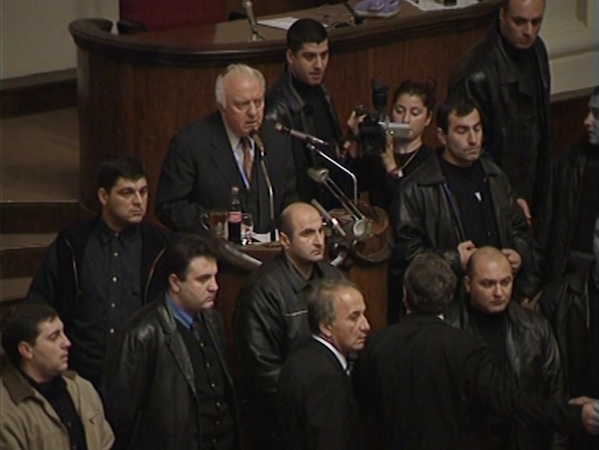
The film will look at Shevarnadze from a very particular angle, ie the events in Tbilisi, Georgia, during three days in late November 2003 as opposition parties refused to recognize the results of the parliamentary elections and called upon tens of thousands of supporters to take to the streets. At this pivotal moment, Shevarnadze’s granddaughter Sophie captured the President’s actions on her student mini-DV camera, managing to record approximately 26 hours of footage over three days of “sheer turmoil.”
Yahontov points out that the former Georgian president was, alongside Gorbachev, the architect of Perestroika, disarmament, the end of the Cold War and the dismantlement of the Berlin Wall. “In 1992, he went on to become the second president of independent Georgia and stayed in power for 12 years playing a crucial role in establishing the Georgian nation’s statehood. During Shevardnadze’s governance, there were, indeed, controversial and troubling episodes in the country’s history. He faced accusations of mishandling the war in Abkhazia, widespread corruption, and an inability to implement necessary economic reforms. Shevarnadze survived several assassinations,” the producer adds.
At Agora Docs (Thessaloniki, 2024), Sophie Shevardnadze explained the film’s origins. “I was a journalism student at NYU…When the proceedings of the revolution started to unravel in late November, I jumped on a plane with my own camera, went to Georgia and began filming everything. I was able to depict the three-day, non-stop storm of the Parliament, the [subsequent] decision-making processes, the possible evacuation of the family members, the reactions.”
“[But] the film really turned out to be – instead of a political statement – a very intimate portrait of a man and his family, and how they reacted to this situation at the end of a very important journey,” she continued.
At Sarajevo producer Yahontov is looking for looking for financing, co-producers, distributors, sales and festivals for his €155,000 budget feature doc (€140,000.00 still to be raised).
“We have little doubt the film will provoke wide interest in East Europe and Post-Soviet territories, where…Shevarnadze still remains well remembered,” he says, adding that his ambition is to deliver to audiences across the world the story of “a King and a Throne, and a family going through a crisis, [themes] which are universal and timeless.” He describes the film’s footage as “full of intense action,” that will “hook” audiences immediately.
Yahontov stresses that the story is narrated from “the perspective of the side that stood back,” a decision which thereby averted carnage as the Rose Revolution played out. In fact, the events of November 2003 in Georgia are referred to as a “bloodless” revolution.
“Such instances have been rare in the post-Soviet republics, both in the past and particularly in the present,” he further points out. “This is a case that we want to share with the world today. In an era where Europe is witnessing conflicts unseen in the past 80 years, and post-Soviet leaders such as Putin (Russia), Lukashenko (Belarus), Aliyev (Azerbaijan) and Mirziyoyev (Uzbekistan) are amending constitutions and suppressing opposition to maintain their hold on power, Shevardnadze’s choice to step away, to sacrifice his own interests for the sake of preserving peace in Georgia, appears as an anomaly, yet the only righteous course of action.”