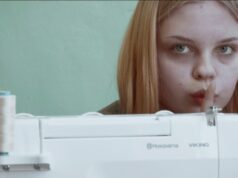
Stylistically dreamlike, emotionally intimate, Srđan Keča’s debut feature, which screens in the AJB Doc Last Minute Cinema section, leads us into the homeless lives of a young girl, her mother and an ersatz grandmother, living in the basement of the never completed Museum of the Revolution in Belgrade.
In Belgrade in 1961, plans were unveiled for a Museum of the Revolution. Meant to commemorate and celebrate the achievements of the Communist Party in the Yugoslav state, it was to be an iconic building, designs for which (by architect Vjendeslav Richter) have survived. But the Museum was never completed. Serbian director Srđan Keča shows archive footage of festivities, presumably announcing the start of construction, and of cheerful workers on the building site. And immediately makes clear this is not going to be a standard documentary. Instead of the expected sounds of speeches, workers and machinery, or Communist songs, or a voice-over providing historical background, we hear wind blowing and the faint sounds of a fire crackling in the distance.
A text states how the utopian building was supposed to ‘safeguard the truth’ about Yugoslavia. That country no longer exists, and its Museum never did. But they did build the basement, which in a way is a Museum in itself. A Museum for an ideal. Just as the modern nations on the territory of the former Yugoslavia have been built on the ruins of a historical ideal, this derelict Museum houses, within its basement walls, the poor and homeless its Revolution once promised to save.
The wind we heard is today’s wind, blowing through the large spaces of the Museum’s abandoned beginnings. The crackling fire warms its occupants. We see an older woman holding a candle close to a girl’s face while teaching her to crochet, the girl fully focused, the older woman laughing, so beautifully lit and intimate that it nearly made me cry. So much love in such a desolate place. It felt close to a dream, a world outside time, disconnected from whatever was happening up there, on the streets of Belgrade.
Keča waits almost half an hour before showing us the girl clearly, now with her mother, in broad daylight, outside on the streets (an earlier daylight scene in the snow kept the playful girl’s face largely hidden behind her hair). Inside, in the softly lit basement, the film had been almost monochrome, painterly, rough edges dissolving in shadows. But outside in the sun, we’re mercilessly confronted with how dirty the girl is, how ragged she looks, how worn-out the old mattress is on which she sleeps.
These are the kinds of images we are more accustomed to, regarding the homeless. They elicit what you could call Pavlovian questions. What happened to land them on the streets? Is there no help for them, or at least for the girl? Is the mother keeping the girl safe, or behaving irresponsibly towards her? Are there drugs involved? Mental health issues? (The documentary gives no indication of the latter two.) This is why the apparent neutrality of such Direct Cinema-styled scenes can be deceptive: it puts us in the mind-set of news reporting and automatically creates certain expectations. That we are going to be informed, so that we can form an opinion. So that we can judge. But this is not Keča’s intention. His film favours emotions over information, empathy over drama.
We do get information. We hear the mother calling her husband, who is in prison and apparently complains about the number of packages she sends him. We see her walking the streets, washing car windows for, presumably, a pittance. It becomes clear that the young girl is not looking forward to her father returning. And that the older woman is not her grandmother, but a much-loved neighbour. And, most dramatically, that the basement is being cleared and they are forced to move to a homeless camp.
But this more traditional kind of information is relatively sparse, scattered throughout the 90 minutes of Keča’s debut feature. The film drifts in and out of the reportage approach, alternating with a more dreamlike state. Where image and sound get disconnected, and where shallow focus, slowly drifting takes, intimate close-ups, moody soundscapes and the absence of any voice-over help us to let go of our ‘news stance’ as spectators and instead engage emotionally with mother and daughter.
It is a stylistically artful approach that probably has its roots in an earlier installation with the same title Keča that made for the Serbian Pavilion at the 2014 Venice’s Architectural Biennale. And feels like it might be close to the psychological state of the young girl on the cusp of adulthood – partly living in what she hopefully experiences as the magical world that the documentary portrays, and partly already very much aware of the difficulties of surviving in the real o
ne.
To be clear, the documentary is at times heart-wrenching. Sometimes the mother seems drained of all energy, and it’s up to her young daughter to get things moving again. A daughter, that is, who is growing up in extreme poverty and desperate and unhealthy conditions. What will become of her? At one moment, as they are walking through Belgrade, she asks her mother what school they are passing. I don’t know, answers the mother, and they walk on. In a later scene, the mother reproaches their elderly neighbour for once having abandoned her own child to social care. How can you carry a child for nine months and then give it away? The neighbour, hurt, answers that at least her child got to go to school.
As the two argue, viewers may feel inclined to take sides. In my case, depending on the reputation of the social institutions, I would tend to favour going to school. But Keča was right, I believe, not to focus so much on these social issues and instead foreground the intimacy and connection between these three people, helping us – or at least, me – to suspend judgement. To introduce their own little world first, in the basement of the Museum of the Revolution, before confronting them and us with the one above. To, whatever else we might think of them, however else we might look at them, ‘safeguard the truth’ that this little girl, whose future looks so grim, was once undeniably raised with love.
Serbia, Croatia, Czech Republic, 2021, 91 minutes
Director Srđan Keča
Production Restart, UZROK
Producer Vanja Jambrovic, Srđan Keča
Script Srđan Keča
Cinematography Srđan Keča
Editing Hrvoslava Brkušić, Srđan Keča
Sound design Jakov Munižaba
Sound Radiša Cvetković
Music Hrvoje Nikšić
This review was originally written for the world premiere of Museum of the Revolution at IDFA 2021.