Isabel Castro’s new film Mija launches on Disney+ this week (16 September) and will therefore be available to an audience of millions. That’s an achievement and a vindication for its director who has spent years working on the project.
The film follows young Mexicans Doris Muñoz and Jacks Haupt, two daughters of undocumented immigrants from Mexico attempting to build careers in the music business in the US.
Sitting in a lavish drawing room in a smart London hotel, Castro tells the story behind the documentary (which premiered in Sundance last January).
“We made the film completely independently through equity and grants,” she says of the painstaking way in which the budget was put together with financing from bodies like the Sundance Institute, SFFILM Catapult, Chicken & Egg Pictures, Firelight, Concordia Studio and many other benefactors. Cinetic is the sales agent.
The director acknowledges she was taken by surprise when Disney swooped to acquire the project following the Sundance launch. “It [Disney] doesn’t have necessarily a track record for acquiring documentaries out of film festivals. When I heard they wanted to buy the film, I just…freaked out!”
Castro realised that the Disney brand would enable her film “to reach a wider audience than I have ever imagined.”
In advance of its streaming premiere, Mija has been seen in cinemas in Los Angeles, San Francisco and New York. “I love seeing the film on the big screen…[but] I really think the way films are watched today are very different from the ways I grew up watching films. To me, the objective really was to reach as wide of an audience as possible.”
There have been many other documentaries and dramas about crossing the border, leaving home, dealing with people smugglers and facing down unsympathetic officials and cops. Castro, though, is coming at the subject with far more depth than you’ll find in most other immigrant tales.
“In the last few years, I feel there is more and more storytelling around immigration…I think a lot of those stories are centered on the immediacy of the trauma of immigration. With this story, what I wanted to show – and what I haven’t seen as much – is the way the trauma is inter-generational,” the director states. “I also wanted to show the more nuanced emotions of that. To be an immigrant, to be the child of an immigrant, comes along with a whole series of emotions.”
This, the director adds, “is a story about immigration…but I also wanted it to be unexpectedly about immigration.”
Mija is also a movie about two young women trying to carve out careers in the music business. Doris Muñoz is first seen as a successful music manager, looking after a singer called Cuco who has a fast-growing fanbase. Doris is earning a six figure salary. As the film quickly reveals, her life is still precarious. Family members depend on her. When she splits with Cuco and then the pandemic hits, she takes a rapid fall.
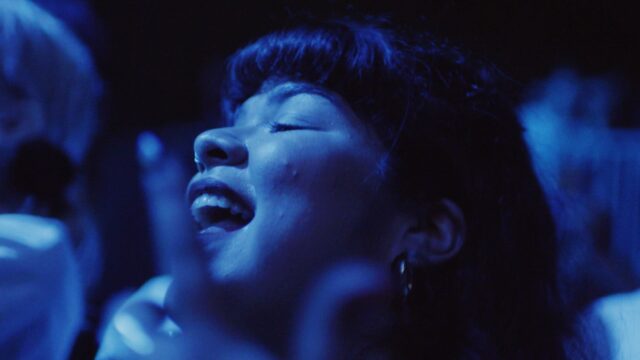
Castro started filming in August 2019. She wasn’t sure at that stage she wanted to “commit to the long road” of making a full-length documentary. “Every time you start a new project, it is kind of like starting a new relationship. You really have to explore what that looks like.” However, after spending time at a Cuco concert, she was ready to take the plunge. “It was just an ocean of brown kids, most of them singing in Spanish,” she says of the fans at the gig. Their passion inspired her. “There was just this feeling of solidarity – a feeling which I didn’t have when I was growing up, a shared understanding of what it means to be immigrants or children of immigrants in the United States.”
Doris was excited to be one of the subjects of the documentary. “She was really inspired by the opportunity to create something she would have wanted when she was younger. One of the things we bonded over was the shared goal.”
Jacks is a talented young singer-songwriter from Dallas. Doris discovers her on Instagram. Thanks to Doris, she has the opportunity to leave her home town to pursue her dreams.
While following the two women as they pursue their music careers, Castro also shows the “lives of their families back at home.” Their closest relatives are applying for green cards.
“I just filmed all the time,” Castro explains her approach. She grew very close to her subjects. Like them, she was a young Latina. She was making the documentary with a tiny crew. Sometimes, she herself was the only one filming. “I saw so many different parts of myself in Doris’ experience or Jacks’ experience.”
Doris and Jacks, then, weren’t just the protagonists in the documentary. They fast became her close friends too. She spent Christmas and Thanksgiving with Doris’ family. That closeness posed challenges. “It is a process of constantly reminding not just them but myself of what our roles are. Oftentimes, those are difficult conversations. There are so many different ways in which you can get involved in somebody’s life. You really have to navigate those lines on a case by case basis – and that is really challenging.”
Castro is an experienced journalist who has worked with The New York Times and VICE. On her assignments with such organisations, “the roles [between filmmaker and subject] are a lot clearer and I am a lot stricter about enforcing them…you come into people’s lives and you have to be persistently disciplined about the ways that you engage,” she reflects. “It is all very confusing.”
The director herself has both US and Mexican citizenship. “I got naturalised when I was 17. For me, the biggest similarity with Doris’ story and Jacks’ story is just the feeling of guilt and pressure to succeed. My parents made a lot of sacrifices to come to the United States.”
Castro’s father had studied theatre as a young man but ended up working in banking instead. “Every decision my parents made in their lives has been in service of providing me with opportunity,” the director acknowledges. “I feel the weight of that in every decision I take and every career step I take.”
Castro admits that she was “scared” of not living up to her parents’ expectations. She wasn’t sure she could make the grade in “cutthroat, difficult” professions like photojournalism and filmmaking. Now, though, with her film screening to acclaim in Sundance and about to launch on the Disney Channel, her parents are understandably delighted. “It is not necessarily that they doubted me but they wanted me to have a stable, fulfilling life,” she reflects on her success. “They’re not just proud but there is a feeling of immense relief!”