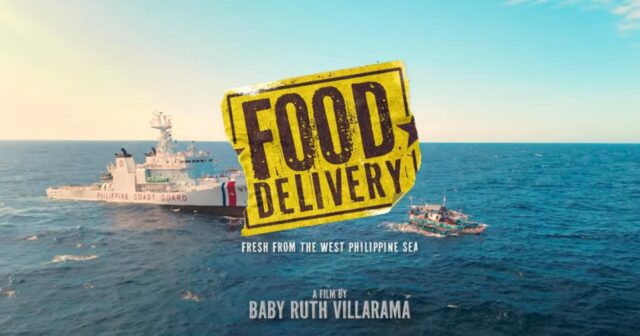
It’s not unusual for documentary filmmakers to antagonise their subjects, or for their films to provoke heated debate. Nonetheless, Filipino director Baby Ruth Villarama didn’t expect to have a global superpower breathing down her neck just because her feature, Food Delivery: Fresh from the West Philippine Sea, reveals how the Chinese have been intimidating Filipino fishermen and soldiers delivering food to local islands.
The film is now an Oscar contender thanks to it winning the Tides of Change Award at the Oscar-qualifying Doc Edge Festival in New Zealand. Nonetheless, as the director tells Business Doc Europe, this has been a very difficult project to launch.
“I did not ask for this personally. Who would want to make a film that would go against a superpower like China? But where I was presented with the truth, the lived experience of our fisherfolk, the very people who are working in quiet dignity, and when I realised there are actual threats to our freedom and our food security, we had no choice but to embrace the story and to tell it as humanely as possible,” Villarama states.
Her hope is that the Chinese government will see the “humanity we are trying to express.” This isn’t a polemical movie attacking the Beijing authorities. It’s an observational maritime documentary which just happens to have footage of the Filipino boat on which the director and her crew were aboard being rammed by the Chinese coastguard.
“I am not anti-China. I have Chinese blood in me. We have a long-shared history of pre-Hispanic colonisation. I’d like to think there is a mutual respect of China and Filipino culture shared for centuries. But then, when the Chinese government starts to harass our people and starts taking our ancestral islands, then there is a line that has been crossed,” Villarama continues.
“We are being divided by a false narrative, a concocted truth. They [the Chinese] are buying islands. They are buying people. They are grooming politicians. They are buying corporations. We can see that. If we don’t protect what we have, we might wake up one day losing everything.”
The circumstances surrounding the intended premiere of Food Delivery verged on the surreal. Villarama was rushing to complete her doc in time for the CinePanalo, a festival organised by supermarket Puregold (one of the backers of the film). March 14 2025 was the date the movie was supposed to screen.
“We had wanted to shoot more, but funds were exhausted and the festival was there, waiting,” she recalls. Late at night, two days before the launch, the director was suddenly told her film was being pulled from the festival, “due to external factors.”
Self-doubt crept in. Villarama began to wonder if she had made a bad film. She had tried hard to make the movie accessible and understandable to the children whose soldier fathers were stationed on, or travelling to, the disputed islands. At first, she felt she had let both the soldiers and the fishing community down. The story they had worked so hard on wasn’t going to be told. Villarama was “devastated” on their behalf as much as her own.
A few months later, in June, Auckland-based Doc Edge agreed to take the film – but was also put under pressure not to show it. The festival responded by publishing the email it had received from the Chinese embassy accusing the film of being “rife with disinformation and false propaganda.”
It stood up for its editorial independence and right to show the films it wanted. Food Delivery won the award and is now back in the public eye as an Oscar contender as a result.
However, nine months after its planned world premiere was scrapped, Villarama and the team at production company Voyage Studios, including producer Chuck Gutierrez, are still spending “the majority of our time figuring out how to navigate this invisible censorship that has been happening.”
The Filipino government has given the film a PG rating which should make it easier to show in cinemas – but has otherwise been “passive-aggressive” about a project that has caused so much political tension already.
One cinema in the Philippines screened the film in August. The documentary has also played in Taiwan. The international roll-out is also continuing – and there will be screenings in London in the coming week (see below) – but it has been a slow roll-out.
Meanwhile, thanks to all the controversy over censorship and cancelled screenings, little attention has been paid to Villarama’s artistry in making a documentary almost entirely at sea.
“A horrid experience!” the director looks back on a shoot that included more than its share of seasickness. “The sea is very brutal. The waves are on constant motion,” she adds of the challenge of keeping the camera stable amid continuous upheaval.
In her darker moments, the director thought of the legendary BBC natural history presenter who, in his 90s, still managed to make his recent film, Ocean. “He’s like our North Star! If David Attenborough can make a film in the middle of the ocean at his age, then we don’t have any right to complain.”
But, yes, it was “tough.” With the Chinese coastguard shadowing the Filipino boat she was on, she was nervous what might happen if it sank. “I am not a good swimmer. I can float – but I am not a good swimmer!”
The filmmakers spent 60 days in all at sea, although not all in one stretch. Having spent that much time on the waves, Villarama says she has renewed respect for the sea. “Not just for the sea but for the people navigating it on a daily basis, the wisdom these people have on how they navigate the waters…they can predict when it will rain and when the wind will arrive.”
The film crew brought their own food on board but, most of the time, they were eating freshly cooked fish – tuna, swordfish, salmon. The cook on board always got the biggest share of the food – and, Villarama reckons, deserved it. There were also times when she was able to relax, to swim and to enjoy the beauty of the seascapes.
The director is “in the middle” of making another documentary, this time about restorative justice. Prison story Touch the Colour (working title) follows two women serving life in jail for taking care of a missing boy . She has been working on the project for five years and reckons she would have been almost finished by now – if it hadn’t been for all the din around the launch of Food Delivery.
Food Delivery screens at SOAS University of London, Sat 6 December 6pm, at BFI Stephen Street London, Mon 8 December, and at Rich Mix, Bethnal Green, Wed 10 Dec, 6.15pm.