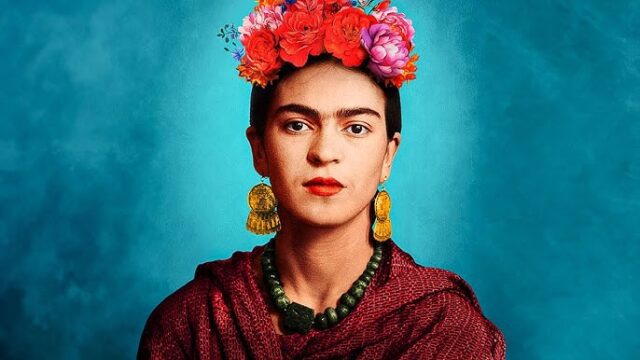
Peruvian debutant director Carla Gutierrez hadn’t seen any of Frida Kahlo’s works until she went to university in the US, but such was their bewitching power, there was no unseeing them once encountered. For Gutierrez, Kahlo’s paintings offered succour and inspiration, even with their brutally honest depiction of a life defined by physical and emotional trauma, and created against a backdrop of increasingly complex geo-politics.
Indeed, the first painting of Kahlo’s that Gutierrez ever saw was ‘Self Portrait Along the Borderline Between Mexico and the United States’ which underlined the grotesque economic inequality between the two countries.
“Even though everybody talks about her art as so fantastic and Surrealist, to me it felt very realistic and I just saw myself – I felt like I had company through that time,” she says of Kahlo’s appeal and influence. “I just saw my own experience and my own feelings, and I was just missing my country so much.”
Likewise, Gutierrez was deeply moved by Kahlo’s ‘Henry Ford Hospital, 1932’ which graphically depicts the artist’s miscarriage. “I had one myself…I mean, women have miscarriages all the time, and a lot of them are very early in the process of pregnancy. Mine wasn’t as dramatic as [Frida’s] but I felt really lonely through that experience and [appreciated] just the fact that she had put that experience on a painting in a really kind of literal way.”
“I felt at different times I’ve had that very visceral connection to her art, and I’ve been very grateful for it,” the director adds.
Quoting directly from Frida Kahlo’s letters and diaries, the film tells of the artist’s childhood with a deeply Catholic mother who insisted on daily Rosary sessions, and an atheist father who was also an artist and whose box of paints Frida craved as a young girl.
She trained to be a doctor in a segregated school and so dressed as a man, joining the mischievous Los Cachuchas political group which was determined to wreak social havoc wherever possible. But when she was 18 she was involved in a horrific life-changing bus crash in which a handrail went through her “like a sword through a bull,” we are told in the film.
In hospital her mother devised a wooden frame and mirror configuration that enabled her to paint both self-portraits and portraits of her friends. Kahlo also began to identity with the great Mexican revolutionary Zapata, who led the peasant’s revolution of 1910, and she embraced Communism. “I feel the pain of the oppressed,” she writes in her diary.
Later she met the Mexican artist Diego Rivera with whom she fell in love. Their bond was tight but their relationship was torrid, each indulging in affairs. Kahlo enchanted but eventually tired of the newly arrived Russian émigré Leon Trotsky, and had tristes with both women and men. Rivera was approving of her lesbian affairs but was wildly jealous of her affairs with men.
When he started an affair with Frida’s sister Cristina, she left him, at which point she experienced an epiphany. “I’ve wasted my best years being dependant on a man without doing anything for myself,” she says, before she created numerous new works, most highly reflective and graphic self-portraits.
All the time in the film, black and white archive is embellished with Frida’s rich colour palette, and many of her paintings are animated (in Kahlo style) up to the point of their eventual completion.
Her work was brilliant, colourful, intensely personal and totally unique, and visually akin to what the European Surrealists were creating at the same time (even though she had never heard of the movement). When he came to Mexico, Surrealism’s principal theorist André Breton encountered “a fairy-tale princess with magic spells at her fingertips.” But whereas the Surrealists painted their dreams, she painted “her reality,” she writes in her diary.
What’s more, while New York audiences flocked to a 1936 exhibition of her work, buying her paintings by the dozen, dilettante Parisian audiences remained aloof and non-engaged, buying nothing. Even the exhibition of her work that Breton organised was a half-hearted affair, populated as much with cheap baubles he found in Mexican tourist shops as with her artworks. “These people make me want to vomit,” she disdainfully writes of the bourgeois, decadent, penny-pinching culturati and literati she encountered in France. “They poison the air with theories that never come true.”
Kahlo remarried Rivera, but on a no-sex basis as she felt a “psychological barrier after his infidelities,” and insisted on a 50/50 division of all financial outgoings. But her health diminished, and her leg had to be amputated, which led to depression and a sense of being “trapped in this house of oblivion.” This could only be alleviated by painting – “painting completed my life,” she writes – and the mounting of a 1953 solo exhibition of her work in Mexico, to which she arrived in an ambulance and attended both bed-bound and mute. She died a year later aged 47 in Coyoacán, the same borough of Mexico City where she was born.
Like many male counterparts, such as Van Gogh and Vermeer, it was only after her death that Frida Kahlo received the full recognition that her talents deserved. Director Gutierrez argues that this came only in the 1970s with the feminist movement, one of whose core tenets was that the ‘personal is political.’
“She was in a way kind of wanting to only paint what she knew, what she needed to get out of her system,” says Gutierrez of the artist, whose main body of work was created ostensibly in the first half of the 20th Century. “It was so personal and it was so intimate that people didn’t pay attention to it because she wasn’t catering to what other people were expecting art to do.”
Forty years later in the 1970s, the social and political climate had changed radically. “It’s okay to talk about our bodies…and it’s okay to talk about our pain and our crying and not just be the support system for everybody else right at home…just being moms and being in this very personal space that we can never talk about. And I think that that’s why she became such a discovery and such a symbol. I think the ‘personal is political’ is a big aspect of her work.”
In a film running to 87 minutes, and spanning one of the most tortuous periods in human history, it is inevitable that much is set aside, such as Kahlo’s interest in the Spanish Civil War, the assassination of her former lover Trotsky and the fascination she later developed for Stalin. “I really wanted to concentrate on the emotional motives of her sense of politics, of her sense of justice, of her sense of inequality, especially economic inequality, her relationship with the poor people in Mexico, but also her observations about economic inequality in the United States and consumerism in the United States,” says Gutierrez of her approach in the film.
That said, we get a strong indication of anti-Communist sentiments in the US after Nelson Rockefeller ordered the destruction of a mural he had commissioned Diego Rivera to paint in the Rockefeller Centre. The industrialist had not reckoned on the pro-Socialist themes that Rivera was likely to introduce to the work, even to including a portrait of Lenin.
Gutierrez further underlines the film’s core thematic line, to illustrate the development of Kahlo as an artist. “We wanted to make a film about a woman who made the choice not to contain her own voice,” she says. “The structure facilitated and supported that theme.”
And how does Gutierrez describe her transition from editor to director on Frida? “It was a surprise and really a beautiful, beautiful process to learn how to really rely on my team and find ways to build trust, but also give them a lot of space for experimentation,” she responds of what seems to have been a highly collegial and happy experience for all concerned.
“My supervising editor [had] so much to do with the edits and the story of the film. My creative producer really developed the creative ideas early on. It’s really a team. I’m nothing but the sum of all the team’s parts, and that’s how I would love to continue to work.”