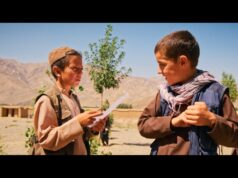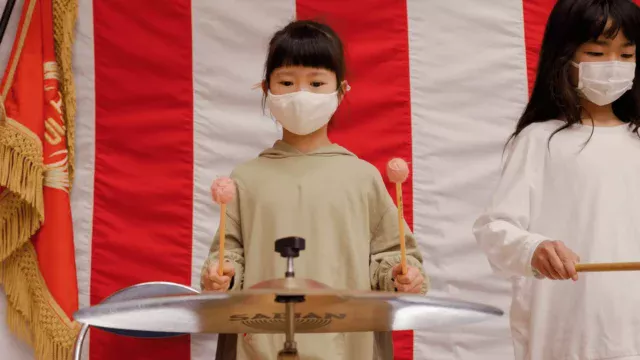
As a class of six-year old first-graders at a Japanese elementary school come to the end of their first year, they are given the opportunity to perform Ode to Joy for the new cohort of first graders. The children are very excited to be given this responsibility. And what’s more, it will be the fun, noisy instruments they’ll get to play, like drums and cymbals. But they’ll have to compete against fellow classmates to win the right to perform.
Ide, a little boy, gets through first time. His timing is good and he hits the bass drum with confidence.
But Ayame is not so confident on the drum. Her timing and counting are off. She doesn’t get through and is very upset, as is a friend of hers in class who has supported her throughout.
She is, however, given a second chance, on cymbals, and this time she is successful. But this is just the start of her worries, because there is an important thing called practice that must be adhered to.
At a later rehearsal, the music teacher congratulates the class: “Your hearts are becoming one. I can hear it. But those who are not practising are ruining that togetherness.”
And Ayame knows it is her that he means. And she is distraught, in floods of tears, feeling under pressure, afraid of being scolded, despite the loving support of a female teacher. Can she raise her performance levels so that the collective endeavour isn’t affected, even enhanced by her contribution?
Throughout, the film presents a study in harmony, as personal achievement is balanced with the objectives and needs of the collective, as demonstrated by the children’s behaviour, application and achievement.
“I like to think I was that little girl [Ayame] in my film,” Japanese/British director Ema Ryan Yamazaki reflects to Business Doc Europe on her background. “Because I went to Japanese public elementary school for six years from the age of six. And it was really when I was an adult, looking back on why had I become the person I am, that I realized so much of it I attribute to what I learned in those six years, the foundational values of what was expected and the ability I could have if I worked hard to accomplish things. I really learned in those years.”
She remembers how, in school, each child was taught the importance of taking responsibility, even from first grade. “A certain person will be in charge of turning the lights on every morning, opening the window, or eventually you’re given a task being part of an orchestra where you can choose to have a big or small part in a group, and you’re held responsible for it. You learn who you are through your relationships with the people around you, how you belong within the community. I think this is quite different from what I know about the western world where I think first you’re asked…how are you unique? [In Japan] it starts with the individual being part of a group. You’re practising to be part of society already.” Elementary schoolchildren even clean their own classrooms.
This sense of civic responsibility continues into later life and across Japanese society in general, Yamazaki argues. “Our trains run on time. There’s no garbage on the streets. There’s a consideration for others where you won’t really find loud chatter in public places. And I like to say Japanese people are not born that way. We’re trained to become these types of people that make this society, which I think is why schooling is so important and it’s all connected. And I think those Japanese traits, you can see all of them building at this school age.”
After elementary school, she attended international school in Japan through to grade 12 where school cleaners were drafted in to clean up after the kids, Yamazaki found to her shock. Then she set off for New York to attend NYU. In the US, the further difference in culture could not have been more pronounced.
“In Japan, if you’re quiet and attentive and listening and polite, that is enough for you to look successful in school and have good grades. In a place like New York, if you don’t speak, you didn’t exist as a person,” she says. “Once I buckled down and was willing to be my own self instead of relying on others in the way I’d learned earlier on in my life, I feel like I figured out how to be a New Yorker.”
Instruments of a Beating Heart was shot during the last two months of an entire school year that is chronicled in Yamazaki’s feature doc titled The Making of a Japanese, sold by Autlook. She had been talking with New York Times Op-Docs and knew that “I could make a great short film just about this one story. Whereas in the feature the whole school is the character with many, many, many people in the film, this [Instruments] was a kind of secondary spin-off that came about because of this particular story.”
So how does the sense of collective endeavour that Yamazaki developed at an early age in elementary school inform her approach to the business of filmmaking?
“I think it’s inherent in me, and I think the strength of many Japanese people is, again, the ability to know how to work with each other,” she answers. “Not because, in a negative way, you’re forced to do it. But because we have learned from an early age the magic that one plus one is more than two. You see that, I hope, in the final orchestral performance of these young kids, the way they run out knowing they’ve accomplished something together – that is kind of my DNA, that’s what I repeatedly learned. But I know that combining strength as a group can produce results beyond anything I could do myself.”
“I just feel like everything is embedded in those early school years education,” Yamazaki signs off.