

Something remarkable happened during the premiere of Brandon Kramer’s Holding Liat at the Berlinale last year (where the film won Best Documentary). The feature documentary (sold by MetFilm and now on the shortlist for the Oscars) follows the family of Liat Beinin Atzili in the aftermath of her abduction during the October 7 2023 Hamas attacks on Israel. In particular, it shows how her parents Yehuda and Chaya Beinin campaigned tirelessly for her release.
“There we’re so many people telling us not to make this film, not to tell this story,” remembers Washington DC-based filmmaker Kramer of how he and his producer brother Lance Kramer were warned to avoid such contentious subject matter. They were trying to bring an intimate, humanistic perspective to the Israeli-Arab conflict while telling a story in real time, about a woman then still in captivity in Gaza. Liat, who was released after 54 days, didn’t know at that stage that her husband Aviv had been killed on October 7th.
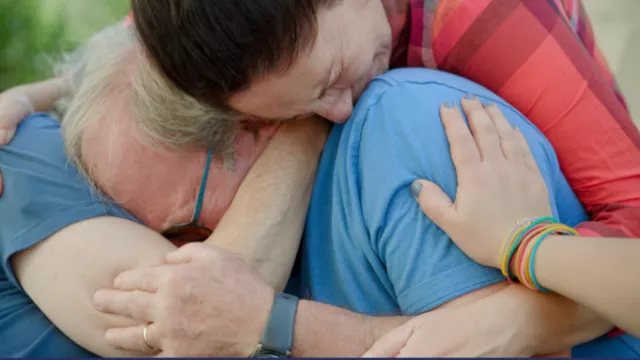
At the Berlinale Q&A, the first audience member to speak was a man from Lebanon. He stood up, raised his hand, asked to come on stage, and hugged Liat and the members of her family. An audience of 600 people burst into spontaneous applause.
Since then, the film has travelled to over 30 film festivals, generally eliciting similar responses. The director has the figures at his fingertips – there have been over 100 packed screenings across 18 countries within 50 different cities.
“That kind of experience of connection across lines of difference, opening up lines of empathy, has been happening at screening after screening,” Kramer notes.
Holding Liat is due to open in the US on January 9 at the Film Forum in New York.
The brothers already had family ties to their subjects, and had visited the Beinins in their kibbutz in Israel. Nonetheless, Liat herself acknowledges she was surprised when she was released and discovered the film was being made.
“It took me a while to understand what it meant,” she says. “I didn’t understand that our story was of interest to anybody other than my family. That took a long time to understand and for it to really sink in how much my family had been in the public eye.”
The former hostage says the filmmakers displayed exemplary sensitivity toward her and “the situation I was in.”
“My father, he’s not as pushy as he comes across in the film but he did point out to me: ‘Liat, you are a history teacher. You have to understand how important it is to document this. This [the film] is for your grandchildren, this is for your great-grandchildren,’” she remembers how Yehuda explained the significance of the documentary to her.
Now that the film has been completed, Liat expresses her delight at how it has turned out. “I am so glad I trusted Brandon’s team with our story…I couldn’t have chosen better people.”
The documentary ends with Liat reflecting on advice her late husband once gave her about acknowledging the experiences and suffering of those “beyond the fence.” She says to Business Doc Europe that overcoming bitterness and vengefulness “has been a huge part of my kitting my life back together.”
Since her release, Liat has striven to remain the person that she was, with the same beliefs and values. “It is possible for me as an individual to go through the experience that I went through but still believe in other people and believe that there can be kindness…people can still hang on to their humanity even in very, very difficult situations.”
She adds that her captors were “able to relate to me as a human being, and I think that it is an obligation for me to do the same.”
Liat is part of the Parents’ Circle, an organisation for both Palestinian and Israeli families who’ve lost loved ones during the ongoing conflict but who’ve come together to call for peace.
“They’ve been partnering with us as we have been showing the film all over the world,” says Kramer.
Given the huge emotion and polarisation around the Israeli-Arab conflict, the director admits that there has been initial suspicion among some viewers that the documentary might be taking sides.
“We are living in a moment where pain and suffering are all too often used in the world, and in media particularly, to justify and perpetuate anger, divisiveness and violence,” he says. “But universally, every single time somebody sees the film, that fear has been dropped. People walk into the theatre with maybe their shoulders up, and the second the movie starts, as they are grounded in the humanity of Liat’s family, that fear dissipates…there’s something about watching one family that lets your guard down and allows you to have a conversation and a connection that maybe is harder to do before you see the film.”
Since the Berlin premiere, the documentary has sold widely. It was recently shown on BBC Storyville and has had theatrical releases in other territories including France and Spain.
However, Holding Liat was made without support from major organisations. Filming started only “a week or two” after Liat was taken hostage. No big studio or streamer has yet come in for it.
“Still there is fear around this issue. You’ve seen it not just with our film. We’ve seen it with No Other Land [the Oscar-winning documentary about settler violence and the destruction of Palestinian homes in the West Bank}.”
Kramer met Basel Adra, the Palestinian director of No Other Land, on the festival circuit, and compared notes with him. “His film won an Academy Award. Audiences across the world are flocking to see that film – and yet still it has trouble with distribution.”
That’s why Kramer and his team (including producer Darren Aronofsky) are overseeing the US release themselves, working closely with non-profit organisation, The Film Collaborative. Bookings include the Film Forum in New York, the Laemmle in LA and other notable art house venues across the country.
“We’re still hopeful a streamer will come no board to bring the film to audiences. We know for a fact that the demand is there but we are not going to wait…this is a story that can bring people together, not pull them apart.”
As for Liat herself, she has supported the release while, at the same time, trying to protect her privacy. working to rebuild the kibbutz Nir Oz after the ravages of October 7th and continuing to teach (she is a specialist in Holocaust Studies).
“For me, over the past two years, the most important thing has been to build my life again. I think I have been co-operative. When Brandon says ‘Liat, it will be very meaningful if you come,’ then I come – when it is important, I show up!”
As a history teacher herself, Liat acknowledges it is disconcerting to find herself caught up in events that historians are bound to study for years to come.
“I had a lot of discussions about history with the captors. Academically, that was a mind-blowing experience, to discuss historical events from our different points of view, and see how I relate to certain historical events and how these people in Gaza relate to them,” she says. “I would very much like to be involved in how this is taught in the future.”





