Richard Ladkani’s feature documentary Yanuni has screened at well over 30 festivals since its premiere in Tribeca last summer, winning many awards in the process. That is why it is no surprise that the Austrian director’s film is now on the Oscar shortlist even before securing North American distribution. Sales are handled by Submarine and CAA.
Yanuni, produced by Leonardo DiCaprio, profiles the remarkable Juma Xipaia, an Indigenous leader from the Xipaya people in Brazil who, in her early 20s, became the first woman chief in the Middle Xingu region. Since then, she has campaigned ferociously to protect her community in the Amazon from exploitation by miners, foresters and anyone else looking to pollute and destroy the ecosystem. She has also survived intimidation and multiple assassination attempts.
“For us, it was always about supporting the indigenous people; getting this indigenous story to the world, and not giving up just because we hit a very bad year on the distribution market,” Ladkani says of an awards campaign which has already clearly caught the eyes of AMPAS voters.
“If we lose the Amazon, then we will all lose. That message of making people understand we are all united, and that indigenous people are fighting our war, is what we wanted to give attention to. Our supporters didn’t come on to win an Oscar. They came on to bring change,” he continues.
This is Ladkani’s third feature in partnership with DiCaprio, and they are currently working on a fourth, about legendary conservationist and anthropologist, Jane Goodall, who died last autumn.
“We came together through a common interest which was meaningful change,” Ladkani says of a collaboration which began with 2016’s The Ivory Game, about the ivory trade and the crisis for elephants, and Sea of Shadows (2019), which looked at the destruction of marine habitats and the threat to the ‘vaquita,’ the smallest whale on earth.
DiCaprio may be involved but the director emphasises that the “real star” is Juma herself. When she met DiCaprio at the COP26 climate conference in Glasgow in 2021, the Hollywood actor was immediately inspired by her. “He connected with Juma like you cannot believe.”
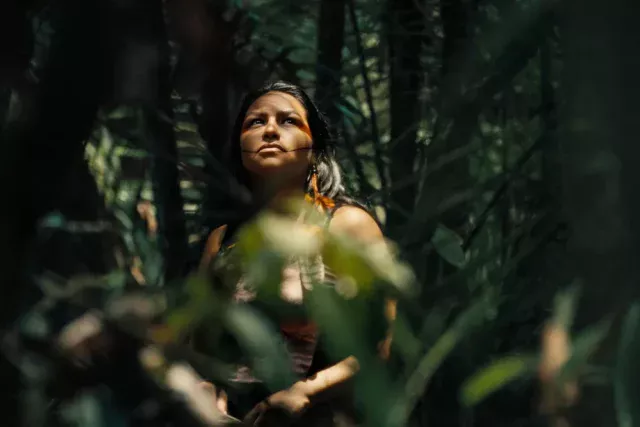
The documentary begins in simple but very striking fashion with a lingering close-up of Juma’s face. She is looking intently at the camera from underneath her ‘cocar,” her feathered headdress.
When the director first met his subject, Juma gave him a long, hard stare. “That’s the back story of that [opening] shot. She looked at me to understand if my soul was clear, and my intentions were well meant. I’ve never had a person who could see through me and see my soul, connect to me, on such a deep level, just by looking. She has this very intensive way of fixating you and drawing you into her sphere and world…she was seeing me and I was seeing her, and we had this moment that just went on and on.”
The shot at the start of the film comes from Ladkani’s first formal interview with Juma, conducted in 2021 in Glasgow. He had multiple questions for her but, in the end, cut out her answers, concentrating on her face instead. “I didn’t use any of the interview. I just used that shot because it symbolised her character, her soul, her way of communicating with the world.”
“For me, this film is centred around her. This is not a topical film. This is not a film about the Amazon. This is a film about indigenous resistance told through the eyes of this amazing woman…she should become a household name because she is so powerful and poetic – she was born to be a leader, born to be a resistance fighter.”
Whenever she speaks in public, Juma has the same routine. Before starting her address, she will look out from under her “cocar” at the room and take the measure of her audience. The headdress protects her from “bad energy” and also allows her to sense the mood around her.
The film has archive footage of Juma as a young teenager. She knew even then that her life, as she puts it, “will be one of struggle.” She was already aware that “pain, resistance and fighting” lay ahead.
Making Yanuni gave Ladkani a personal insight into two wildly contrasting aspects of life in the Amazon. On the one hand, he was able to experience the full glory of the natural world.
“The forest changes you for sure. If any day you decide to go down into the Amazon, and you’re led by the indigenous people down to the virgin forest, you will have an experience that will change your life. It is so powerful to be among this humongous beauty of pure nature. You feel an energy that is coming from mother nature and you understand that everything in this forest is alive,” the director rhapsodises. “You understand this is what we need to protect…we need the functioning beauty of the forest to sustain us all for centuries to come.”
The flipside is the rampant destruction of the forest by outsiders. Ladkani joined Juma’s husband Hugo Loss, an official in Brazil’s environmental protection agency, on terrifying armed raids of illegal mining camps. Loss warned him that he was coming at his own risk and that his chances of making it back safely were only 50%. “Juma tried to talk me out of it because it is too dangerous.”
The director talked through the risks with his wife and producer, Anita Ladkani. They had dealt with ivory smugglers and Mexican drug cartels in previous films and eventually decided that Ladkani “needed to go all in.” The film would be missing a key component if it didn’t show the devastation and pollution wrought by the miners, prospectors and illegal foresters.
On one of the missions, Loss’ boat gets tangled up with a smuggling ship which is about to explode. It’s a moment of extreme panic but Ladkani still managed to keen filming. (“That’s something I learned from my many years of being a cinematographer…I was ready to jump into the water if I had to!”)
This wasn’t an easy film to structure either. It is filmed over several years leading up to the election in 2022/2023 when Luiz Inacio Lula da Silva was re-elected Brazilian president and right-wing former military officer Jair Bolsanaro, notorious for his persecution of indigenous people, was finally ousted from power. At that point, Juma joined the government, becoming secretary for the promotion of indigenous rights.
During much of the making of the film, Juma was also pregnant, expecting her second child. There are two currents to the film, one dealing with her political struggles, and another focusing on family, parenthood and renewal. She is also a producer on the documentary.
“This was her film. She made sure we were able to film in highly protective areas for outsiders. You can’t just turn up with a camera and film inside the territory or inside the ministry, so Juma made sure we had the access and that also we were truthful about what was happening in her life,” the director says.
The doc ends with the birth of Juma’s daughter, and the end credits reveal that she has now left the ministry to return to her home territory. “You see in the film that she is not happy with her children growing up in a capital city,” the director explains why she wanted to go back home and continue her fight from there. (One advantage of her leaving the government is that she has been free to travel with the documentary).
“She always says this is for all the indigenous people: ‘I am out there, fighting the war for us, and this film has given me the tools I needed to get our message out and our voices heard around the world.’”
As for distribution, Ladkani is confident that the film will eventually find a good home with one of the big streamers or global distributors. “It is taking much more time than I ever anticipated but there is momentum with the [Oscar] shortlist…”
Obviously, Ladkani could never have predicted what was going to happen during the making of the documentary about Juma – but he knew there was bound to be drama. “I had no idea what I was getting into, just that being close to her would be a huge adventure!”