Frederick Wiseman can’t remember what he ate the first time he went to Le Bois Sans Feuilles restaurant in Ouche, France, but knows it was good.
At the end of the meal, the 93-year-old director told the chef César Troisgros that he’d like to make a film about the place. César’s response has already become part of contemporary documentary mythology. He disappeared for a moment to consult Wikipedia, realised his guest was a legend of the film world, and quickly agreed to let him go ahead with his project.
“It’s very rare that I eat in a 3-star restaurant and I can’t turn off my documentary filmmaker eye. I hadn’t planned to do it but I just blurted it [the idea] out and I was happy when he said why not,” Wiseman says of the impulse that led him to make his mouth-watering four-hour epic about the family owned La Maison Troisgros. Now, having received its premiere in Venice in the autumn, Menus-Plaisirs – Les Troisgros is an Oscar contender.
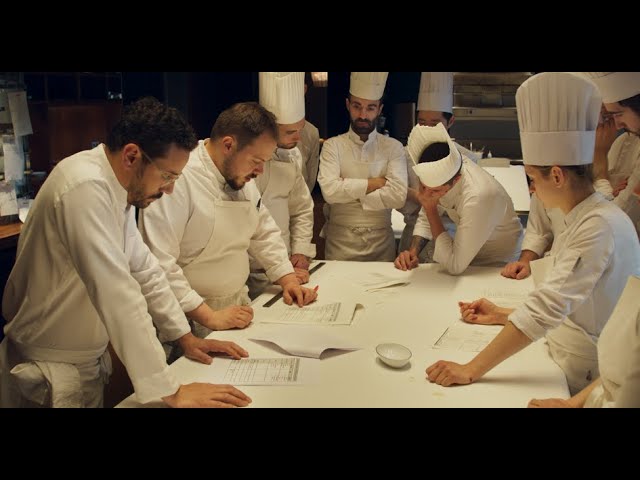
The film (produced through Zipporah Films and sold by The Party Film Sales) explores the inner workings of the three restaurants run by the Troisgros family.
Over the last half century, since he made his name with Titicut Follies (1967), in which he exposed the cruel treatment of patients in a hospital for the insane, Wiseman has ventured with his camera into all sorts of institutions: museums, public libraries, boxing gyms, colleges, strip clubs, city halls and theatres. However, filming in busy restaurants required levels of resourcefulness even he has rarely had to find before.
“The challenge, particularly in the kitchen, was to stay out of the way of the chefs because they move very fast and not always in predictable directions and not always at predictable times. We had to be aware of not only what was going on and what we were shooting but to be ready to move when they moved, not only to get the shot but to stay out of their way so they wouldn’t trip over us,” Wiseman recalls.
40% of the shooting was done in the kitchen, “That’s 40% of 140 hours,” he confides of what was another of his epic documentary productions. Wiseman likes to have a lot of material which he then moulds together during the post-production. “Obviously, it [the kitchen] is the centre of the operation. I wanted to get it right and to have the material to do a good job in the editing.”
Wiseman “adores the editing.” For him, it’s the most pleasurable part of the process. He is a patient man who likens himself to the sculptor who finds the statue under the stone. “I find the film under the rushes.”
Not that the documentary is entirely set amid the pots and frying pans. Between stints in the kitchen, we see Cesar, his brother and father at market or visiting their suppliers in the countryside. The landscapes look bucolic. It never seems to rain.
“Obviously, I needed those shots to show where they were located but I also needed the transitions between various places…to the cheese factory or the vineyard or to the cattle farmer. Those shots served a variety of purposes. They gave a sense of the countryside where the restaurants are located but also serve as transitions to avoid the confusion of jump cuts from one restaurant to another.”
There are several sequences featuring the diners. “I thought that was going to be the great problem with the shooting of the film – I wouldn’t have any trouble in the kitchen because I had permission from the chefs but that I would have trouble in the dining room. In fact, I had none. Nobody I asked who was a guest in the dining room objected to being filmed.”
As in most Wiseman films, the director doesn’t introduce his characters by name or provide subtitles or commentary explaining the setting. He plunges viewers right into the middle of the world he is depicting. He didn’t know in advance that he had stumbled onto a family dynasty story. Michel is the patriarch. César is his son and successor.
“I just lucked out,” Wiseman reflects. “Sometimes I am lucky. It’s not only a question of being lucky…I also have to recognise what I have got after I have been lucky.”
Wiseman’s fascination with food and fine dining stretches back to the mid 1950s when, as a young man, he first started having fantasies about Michelin 3-star establishments. “I yearned to eat in one,” he recalls of the period when he was living in Paris on $125 a month on the G.I. Bill. He saved up and managed to eat once at Lapérouse, one of the city’s most famous restaurants. “I am a typical gourmand. I like to eat well but I normally don’t have the money to eat in 3-star restaurants.”
His stint in Paris in the 50s gave Wiseman a lasting affection for France where he is now based. He had lived in Boston for many years but decided that he could lead a richer and more interesting life in France – so he moved across the Atlantic.
“What I enjoyed was all the obvious things,” he lists the food, the theatre, the dance performances, walking around the city and visiting museums.
The restaurant world depicted in Menus-Plaisirs – Les Troisgros is a long way removed from that found in recent US TV dramas and movies. What stands out is the Zen-like calm of the chefs. Wiseman’s friends have told him about all those American movies in which the chefs “yell and scream,” but that wasn’t what he encountered in Rouanne. Kitchen sorcerers like Michel and César “direct things by a gesture, a movement of the hand or wink of the eye. The people are accustomed to working together. They all know their jobs. They all have their stations. The kitchen is extremely well designed. It’s contrary to their nature to yell and scream. They’re calm, real nice people. That’s what I found and that is what you see in the film.”
Nor was Wiseman put off by the eye-watering prices the restaurants charge their customers. “It’s just the nature of the world. Some people can afford it and some can’t. Do I regret that not everybody can eat there? Of course. [But] I don’t have any ideological objections to the existence of the restaurant. I thought Michel and César really are great artists. They are not only concerned with the taste of the food but the look of the food on the plate. They inspect every plate before it leaves the kitchen. I admire that kind of achievement and that level of imagination and competence – and that the world is unjust, I discovered a while ago.”
And, yes, the parallels between the chefs and the filmmaker are obvious. “In an abstract sense, I work hard, they work hard. I try to make a film that works at a variety of intellectual and aesthetic levels. I like the film to look good, to be comprehensible and intellectually demanding. They like to create interesting combinations of tastes which they present in an aesthetically pleasing way…I think all people involved in one art form or another in the abstract have the same issues.”
Wiseman likens the work in the kitchen to ballet or theatre. It is beautiful but ephemeral. “It disappears as it is performed and it is never the same each night.”
The chefs work long, gruelling hours – and so did the filmmaker, chronicling their lives. One consolation for Wiseman, though, was that he ate with the chefs every day (“which was extremely nice.”)
Earlier this year, the chefs came to Paris to see a special preview of the documentary. “I wanted to show it to them on a big screen.” They liked the film and have supported its release.
Having finished the movie, Wiseman remains as interested in food as ever. “To eat well in Paris, you don’t have to go to the fancy restaurants. There are a lot of medium-priced restaurants where you can get a very good meal for between €30 and €40, which in itself isn’t cheap but you don’t have to spend €150 or €350.”
The veteran filmmaker, who turns 94 on New Year’s Day, doesn’t have a new film currently in the pipeline [although there may be one in the spring if his energy is up to it] but his cultural life remains as rich as ever. He goes to cinemas to watch “golden oldies” (for instance Ernst Lubitsch classics like Ninotchka and To Be Or Not To Be). He still reads exhaustively too and watches tennis and basketball for recreation. To his regret, he confides, he has had to stop one of his favourite pastimes, skiing, quitting two years ago at the start of his 90s.
One reason Menus-Plaisirs – Les Troisgros has entranced critics and audiences is that it depicts a world far removed from wars, the pandemic or political strife.
“It is not why I made the film but it certainly occurred to me after spending seven weeks there and 10 months editing it,” he says of the tranquil world he evokes.