

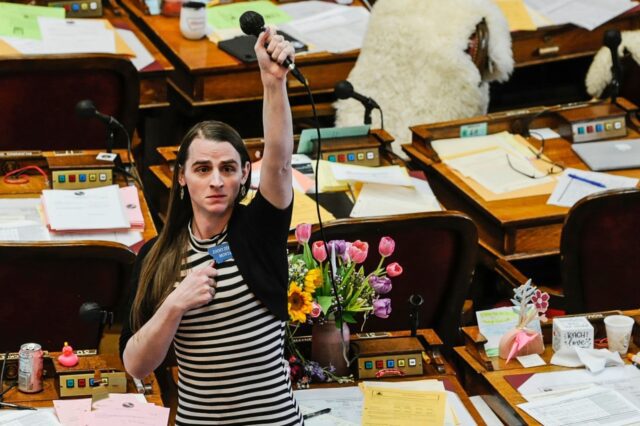
In April 2023, transgender politician Zooey Zephyr was expelled from Montana’s House of Representatives after telling errant Republicans that they would have “blood on [their] hands” if they supported legislation prohibiting gender-affirming medical and surgical care for minors.
Before the expulsion, scores of Zooey’s supporters had gathered in the public gallery to protest at her gagging by Speaker Matt Regier, who had taken offence at the remark and had tried to have her censured. As Zooey silently held a microphone above her head (“encouraging an insurrection” according to the conservative Montana Freedom Caucus) the police cleared the gallery, making a number of arrests in the process.
The trans politician may have been expelled from the chamber, but not from the building, to the frustration of her political opponents, and so she set up a de facto office in the café, sticking a post-it note signed ‘Seat 31’ on one of the benches.
In her award-winning short film, shot over one incendiary week, award-winning Kimberly Reed follows Zooey as she faces down her Republican opponents (and some of their vociferous wives), at the same time celebrating trans and queer identity both across the State of Montana and within her own personal orbit.
“I’m interested in small microcosms of story that unpack much larger worlds of complicated social issues that we are on the verge of grappling with,” Reed tells Business Doc Europe. “And a lot of times that happens in my home state of Montana which, though I no longer live there, I stay in very close touch with. I follow all the issues and find sometimes those impactful seeds of stories [that have] the ability to demystify complex issues.”
This was the also case with Reed’s Dark Money (Sundance, 2018), also set in Montana and which concerned the effects of corporate money and influence on the American political system.
“When I saw the news starting to break about the way that Zooey was being treated for the things that she was saying – because she was elected to say things on behalf of her constituents – it was important,” Reed adds of her decision to follow events within Seat 31. “I saw the story taking shape. I had access to it. I knew the right people. I was pretty confident because I’m a trans woman from Montana approaching another trans woman from Montana, that we would be in alignment in these things, and it wouldn’t take too long to convince Zooey…that telling her story would bring a lot of awareness, not just to the injustices that were happening to Zooey, but to trans folks around the country in general.”
Not that Montana was always a hotbed of Republicanism. When Reed was growing up in the state, it was “more purplish,” she says. The place had an “anti-authoritarian, maybe even libertarian” vibe which determined that folk were happy to be left alone to get on with their own lives without having to engage with “these national politics.”
“My point is it’s really changing from the state that I grew up in, and that kind of breaks my heart. This sort of ‘live and let live’ attitude has shifted more into one where national politics are exacted upon others at a local level for revenge. So, it has become much uglier.”
Donald Trump opened this “Pandora’s box of ugliness,” Reed suggests, in the process legitimising similar behaviour by others in his party by removing the “factor of shame,” she further observes. “At the same time, I think he’s not the root cause of it. I think he’s a symptom of this growing political division which we see in Montana and we see in the US. We’re also seeing it [now] peppered around European countries as well.”
The film, which is screening on the New Yorker platform – “a great prestigious spot to land in, and it just gives so many people, so many more people access to the film” – packs much into its short 15-minute duration, addressing both State and gender politics, and life within Montana’s vibrant queer community. What’s more, it presents a touching romance as Zooey contemplates marriage to her partner Erin, a journalist and core transgender rights activist.
“It was always pretty clear that this had to end as a love story, that love was going to win out,” says Reed. “That is in part because that’s just how Zooey is. She’s pretty indomitable and resilient, and she keeps the focus on joy…And so I wanted the film to reflect that. That’s also how I tend to see the world.”
“Also, I don’t know, all the trans folks that I talk to in media, or people who make or consume media, are just pretty tired of the stories that only talk about our suffering and our hardship,” she adds. “I don’t want to pretend like that doesn’t exist and we don’t need to talk about that, but does it need to win the day? I don’t think so. I think it’s much more accurate and much more interesting to reflect these stories that still triumph [with] love and joy and support, and the indomitable nature that many of us have.”
At one point in the film, Zooey’s bench in the parliamentary café is commandeered by some of the “mean wives” of Republican legislators, in order to disrupt her work day. Thankfully, she had other errands to perform, one of which was to drive to a UPS warehouse to pick up a package.
“And that package contained a wedding ring, and we did not know that was going to happen. So we rolled with it. It becomes a core to the story. When something like that happens, you start seeing that this is a love story, that this is where this is going,” says Reed of the film’s change in tack. “And so maybe it was luck, maybe it was a little bit of experience and having a good nose for the story where it was going to go. But that was just a delightful turn of events that I think we were able to convey in the film. And I hope that people are delighted by it too.”





