

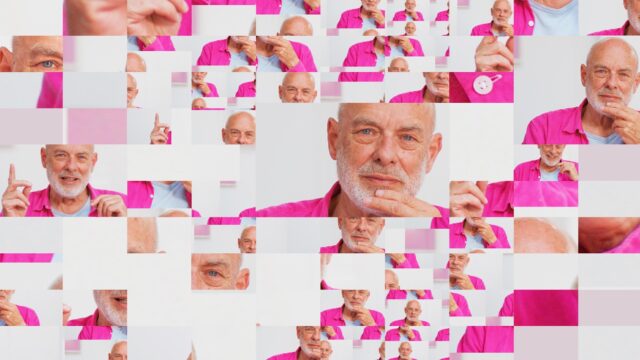
Brian Eno is a revered musical guru – artist, musician, producer and all-round renaissance man. The English polymath, who is now 76, played synth for glam rock band Roxy Music in the 1970s; he has collaborated on some of the greatest ventures by David Bowie, U2 and Talking Heads while also working on dozens of solo projects. Now, he is profiled in Gary Hustwit’s Eno.
The film, produced by Hustwit and Jessica Edwards and made through Film First and Tigerlily Productions with backing from the BFI UK Global Screen Fund, is sold by Submarine. It is currently on the Oscar® shortlist for Documentary nominations.
Other artists and filmmakers tend to have very discernible artistic signatures. With Eno, you never know quite what you are getting. He is a creative disruptor who always pushes himself and his collaborators to try new things.
“He intentionally changes his creative approach. For any projects he does, he will try something different,” Hustwit observes of his restlessly inventive subject. “He changes his own process and his own approach intentionally.”
The movie is entirely in keeping with the Eno ethos. Using generative software he designed together with digital artist Brendan Dawes, Hustwit has made a documentary that draws on Eno’s vast archives. The film, though, is in a permanent state of flux, with endless possible variations. There is no definitive cut. Instead, different audiences get to see different versions.
Certain elements are constant. The opening scene with Eno in his studio and the closing with him in his rose garden never change. Hustwit describes these moments as the film’s “book-ends.” He estimates that 25%-30% of the film recurs every time. It’s the bits in-between that are shuffled endlessly.
Depending on which version you watch, you might see lots of material about Eno’s collaboration with, say, Talking Heads, or you might watch a cut in which the band hardly feature at all.
“There is never one story about anyone. I could do a six-hour series about Brian and we still wouldn’t scratch the surface of everything he has done,” Hustwit says. “We wanted to make a film that could change so that you could see different aspects of the person we are profiling in different versions…you as the viewer are putting together the narrative.”
“Why do films have to be the same every time we watch them?” the director continues. “That goes back to [early film pioneers] the Lumiere brothers, and film as a physical medium that had to be in a line of celluloid and cycle through cameras….Now that everything is digital, we don’t have this constraint, but we are so used to telling stories this way.”
In short, Hustwit wanted to crack open the traditional documentary form.
Audiences have lapped the concept up. Since its release in the summer, Eno has grossed over $1mn in the US alone. “People were coming back four, five, ten, even 20 times to see different versions of the film…”
The initial New York run was at Film Forum and the film stayed there for 12 weeks, selling out shows throughout. From late January onward, the film will be available to stream through Anamorph, the AI tech company and platform set up by Dawes and Hustwit.
The director has noticed viewers at every screening taking copious notes, writing down nuggets of Eno’s homespun philosophy about creativity, science, the inner workings of the human brain or how to save the planet. (Some of the ideas he touches on in the movie are explored further in Eno’s new book, What Art Does).
Eno himself has seen the film (or versions of it) four times. “He likes it because it accomplishes what we set out to do. It can be different every time…it [the film] does function as a masterclass in a way. It’s a very unconventional masterclass but in everything he [Eno] is doing in the movie, no matter what version you see, there is something that you can learn.”
But, yes, the licensing challenges were daunting. The filmmakers couldn’t get reductions in fees just because of the many different versions of the documentary. “They still want us to pay the full thing…but Brian is involved in all this stuff and so there is so much goodwill and so many people wanting the project to get out there. We got treated very well by people like Universal and others who believed in the experiment of the film.”
Eno comes from a family of Suffolk post office workers. Not that the film delves at all deeply into his background.
Hustwit had approached him initially to do a conventional documentary but Eno was having none of it. “He said no. He said he doesn’t like bio-documentaries. He doesn’t like most music documentaries. It’s always one person’s version of this other person’s story – and he didn’t want to be in somebody else’s story. This way was the only way I could get him to agree to do it, and I think he really wanted to do it because he wanted to be part of this first generative feature film experiment.”
In person, Eno turned out to be remarkably genial and easy-going. His sense of humour took Hustwit by surprise. The director, who admits he was “a little bit intimidated” before he started the project, simply didn’t expect his subject to be quite so funny.
“I don’t take myself too seriously…I let the conversations flow. We talk about whatever Brian wants to talk about,” the director explains his freewheeling approach.
At one stage, the director and the musician are shown having tea together in Eno’s English country garden. Eno potters around, looking for insects under leaves – and is delighted to find some beetles.
The project was filmed over a period of three years. Hustwit’s only stipulation was that every discussion would be focused around the “idea of creativity.”
“He [Eno] loves to talk about that stuff and so the conversations are fun. If you hear the raw tapes, I am talking just as much as Brian is talking…he is genuinely a nice person to talk with.”
Hustwit has led a rich artistic life of his own. He is a visual artist, publisher and distributor as well as filmmaker. His previous works include Helvetica (2007), a film about a font, and Rams (2007), about German industrial designer Dieter Rams (and for which Eno provided the soundtrack).
Eno owes Hustwit and his colleagues a debt of gratitude – they went through his vast archives which stretch back over 40 years. “There hadn’t been a lot of attention paid to cataloguing that stuff…that was also one of the things when we approached him about the project. We said ‘we’ll go through your archive. We’ll digitise it, catalogue it and restore it.’ That was a fringe benefit I guess.”
Intriguingly, an early version of the project that showed at the Venice Biennale, exhibited in October 2023 before the official’s films Sundance premiere in January 2024, lasted an astonishing 168 hours.
“People came and sat on bean bags and watched hours of this thing,” the director says of the epic version. The film, now on the Oscar® trail, clocks in at a more manageable 100 minutes…whatever version you watch. However, the director is continuing to tinker and to add to it, even though its official world premiere was almost a year ago.
“The whole idea that the film is done and nothing can happen to it – that’s obsolete,” Hustwit says of a project that will always continue to mutate and evolve.





