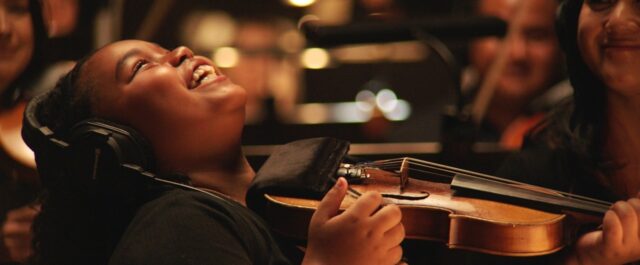
It’s a magical place, a warehouse in LA which many have likened to Gepetto’s workshop in Pinocchio. Broken musical instruments are brought here in their dozens and crafts people put them back together again. In their latest film together, The Last Repair Shop, made through Breakwater Studios, Ben Proudfoot and Kris Bowers go inside the workshop which ensures that school kids without money can continue to play their violins, trumpets and pianos.
The general manager is Steve Bagmanyan, a genial, laidback piano tuner originally from Azerbaijan. He is the master of ceremonies, introducing the viewers to the various experts who do the mending.
Towards the end of the film, Bagmanyan shares startling revelations about the horrific experiences his family endured at the end of the Soviet era and about his early life in the US. Three other interviewees from the repair shop, Dana Atkinson (strings), Pat Moreno (brass) and Duane Michaels (woodwind), talk equally frankly about their life stories.
Early on, some of those working in the shop were suspicious about the filmmakers. They hadn’t been happy with media coverage of their work in the past, in particular newspaper stories suggesting the shop had a huge backlog of repairs to complete and implying it was run inefficiently.
“When I went in there, that was what they were thinking about, the backlog which had since been totally fixed,” Proudfoot remembers. He met the craftspeople, made his pitch and quickly realised that not all wanted to participate. However, Dana, Pat, Duane and Steve turned out to be perfect interviewees – wise, warm and very perceptive about the benign effects of their work.
During the making of the documentary, one of the directors discovered that his links with Steve stretched back two decades. Bowers is also an Emmy award-winning composer and pianist whose film credits include Green Book and King Richard but years before, when he was a kid, he had been at LA schools which relied on Bagmanyan to repair their musical instruments.
It was at school that Bowers, who started playing piano at four, first really discovered his musical vocation. He remembers an orchestra coming to perform and describing the sections “based on John Williams music. That was the first time I really started to register film music. I remember them showing us the bass section by playing Jaws or the French horn section by playing Star Wars.”
Proudfoot also grew up in a musical family. Even before entering his teens, he wanted to be a composer – but his abilities didn’t quite keep up with his aspirations. “I’ve always loved music and appreciated it although I have had to grapple with my limited personal talents in the space.”
The documentary makes continual comparisons between the players and their instruments. Proudfoot talks about the theme of “being broken and repaired…it’s hard not to review footage of someone putting a quarter scale violin back together and not to think about the quarter scale little human. I think that is what makes this film tick at its core.”
Just as the craftspeople treat the instruments with great delicacy and care, the school system looks to do the same with the children in its charge.
“Kris and I have both been overwhelmed by people’s emotional reaction to this movie. I think part of it is that it is [set in] this very fragile, vulnerable world of precious objects and precious people,” Proudfoot says.
Bowers talks of the “reminder for these children that beautiful music can still be made from something that has been banged around a little bit.” He describes an incident in his own life when he and his wife were giving their daughter a bath and noticed a scar on her body. His wife was upset but he saw it as a natural part of growing. “The best musical instruments actually are the ones that are the oldest, not the newest, and have been worn, played, repaired, fixed and all that.”
“The difficult moments they [the kids] go through, the marks that are left on their psyches and emotional histories, are actually things that will make them fuller, richer, deeper humans,” Bowers continues.
The characters repairing the instruments all seem to have a Zen-like calm in their approach to life.
“I’ve made a lot of films about craftspeople and I find that that is an incredibly common combination – the craftsperson as philosopher,” reflects Proudfoot (who won an Oscar for his 2021 short doc The Queen of Basketball and also co-directed with Bowers the Oscar-nominated A Concerto is a Conversation). “I don’t know if it is just [having] a lot of time to cogitate, process and work things out in retrospect as you are doing things with your hands – or if it is that kind of person and thinker who is drawn to the quiet workshop work of fixing things…and it’s great for filmmakers because there is no better objective correlative than a beat-up saxophone when talking about having gone through the trials and tribulations of life.”
Bowers and Proud split directing duties down the line. The former did the interviews with the students while the latter spoke to the craftspeople. Both have a flair for improvisation, Bowers as a jazz pianist and Proudfoot as a magician. They’re open to new ideas even when they are outlandish and offbeat.
Bowers’ music was integral to the way the film was shot. “It’s like a chicken and egg process where the writing of the music was inspired by the way it would be shot and obviously the way it would be shot was influenced by how the music was written,” the filmmaker/composer explains.
“We seem to be able to encourage each other when the other person has a strong idea about something – and unstick the process when the other one is stuck,” Proudfoot chimes in.
Not that this was an easy project. The duo spent four years making it. Early cuts were far too long. (Proudfoot specialises in “humanist short documentaries” and makes it a point of principle that he doesn’t take up more of his audience’s time than he needs). The two directors wouldn’t give up. Both were determined to “do right” by their subjects. This wasn’t an obviously commercial project but neither was prepared to compromise on quality.
Now, following a triumphant premiere in Telluride, LA Times Studios and Searchlight have acquired the film and it is an Oscar contender. It will be released on Disney + and Hulu in the New Year and is likely to find a huge audience, even folks without an ear for music.