

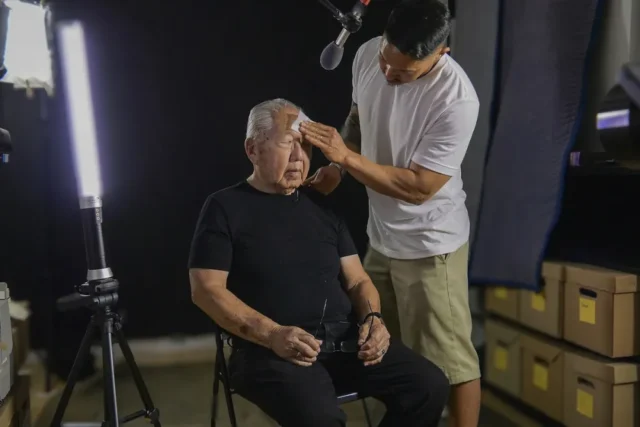
Manzanar is a name that can evoke terror and anger – and it figures prominently in Tadashi Nakamura’s Oscar-qualifying feature, Third Act. The film (which premiered in Sundance) is an intimate and loving portrait of Tadashi’s father, the pioneering Japanese-American filmmaker, Robert A. Nakamura, often called “The Godfather of Asian American film,” and who died earlier this summer.
Manzanar is the concentration camp in a remote part of northern California, close to the Sierra Nevada mountains, where Robert was interned as a child as one of the many thousands of Japanese Americans locked up by FD Roosevelt during the Second World War.
When in later years, Tadashi visited Mammoth Mountain and Manzanar with his father to go fishing, Robert would tell him in a matter of fact way that this was the place he was incarcerated.
“I always knew the history. I always knew my family was there and I almost took it for granted. I think the emotion didn’t really hit probably until I was in college,” Tadashi reflects. “I think that has always been my dad’s place. Maybe, now that he has passed away, I might go more, to remember him and be with him…but I don’t feel compelled to go every year like a lot of other people.”
As an undergraduate, Tadashi studied under his father (who was a distinguished teacher of Asian American studies and film and television at UCLA, as well as a filmmaker). He later became his teaching assistant – and his father was the executive producer of his first three short films.
“Both formally and informally, it definitely was this master-apprentice relationship,” he says of how his father mentored him. “Not only were we making films together. I began teaching his class with him.” Tadashi has become the director of the Media Arts Centre at the Japanese American National Museum, a position his father used to hold.
As a youngster, Tadashi never felt pressured to follow his parents into filmmaking or the arts. He was far more interested in sport. Nor did he feel neglected by his father. Third Act isn’t therefore one of those documentaries chronicling family bitterness and resentment.
“I always joke that I’m the first filmmaker to make a film about his parent that he actually got along with,” the director says.
That said, there is father-son tension in the film – but it is between Robert and his own father, a gardener and judo black belt who made huge sacrifices for the family. Robert still sometimes felt ashamed of his father because he hadn’t fully assimilated to US society – and then felt extreme guilt about his own feelings of shame.
The documentary exposes the racism Robert and his family endured. Their version of the American dream risked turning very sour. “Because of my family’s history, when the US flag is starting to wave, to me that doesn’t evoke any pride, that invokes fear,” Tadashi says. “That means there is an ‘us’ and ‘them.’ Historically, and in the present day, our family has always been a ‘them.’”
And, yes, Trump’s anti-immigration policies can’t help but evoke memories of that wartime period when there was mass internment of Japanese Americans. “Especially now in Los Angeles, with ICE raids going on,” says Tadashi, recalling a story of when somebody deliberately ran into his grandfather’s truck. “Now, there are people running into trucks, but they’re masked men with guns.”
Tadashi is fourth generation Japanese American and doesn’t have any family he knows of in Japan. “I actually always felt I didn’t have a country in a way.” He never felt particularly proud of the US, he says. Nor does he identify with Japanese imperial history or its “present culture.” His real connection is with the people he grew up with in Los Angeles.
Third Act was filmed over seven years. It doesn’t shirk from showing very intimate aspects of its subject’s life. Early on during shooting, Robert was diagnosed with Parkinson’s. Over the period of production, his symptoms became more severe. He also suffered recurring bouts of depression almost certainly linked to his childhood incarceration in the camp and the racism he experienced.
“Initially, we set out just to make a simple biography of my dad, a portrait of an artist celebrating his achievements and career…but anyone could make that biopic. What is the film that only I could make as his son, in that moment? That was an open-ended question and the challenge.”
Tadashi wanted his father to “feel good” about the film. In turn, his father wanted the film to help his son, “to further your career,” as he told him. Robert lived long enough to attend the Sundance premiere, which was an emotionally charged event.
Now, the director says the documentary is helping him in his “grieving journey,” forcing him to “think about and articulate his feelings publicly…Showing the film, talking about him, has actually been very therapeutic. As personal as this film is. I’ve realised how universal its tenets and emotions are.”
As we see in the film, father and son were regular attendees of UCLA’s home American Football games at the Rose Bowl. Tadashi and his own young son continue to attend games.
“Unfortunately, our team was not very good this year. But I think my son, because he has watched the film so much, understands it is more than just going to a football game. There is history, tradition,” the director reflects. “We don’t go to the cemetery to visit my dad and think about him, but when we go to the Rose Bowl, the football games, that’s when we think about him…”





