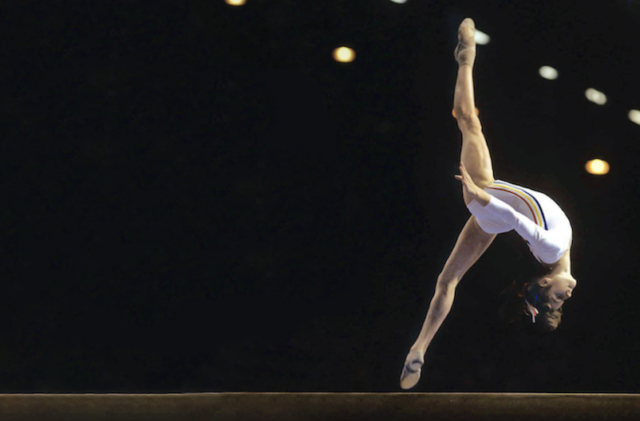
At the 1976 Olympic Games in Montreal, Romanian gymnast Nadia Comăneci achieved what many assumed to be the impossible. She scored a perfect ten on one of the apparatuses (the asymmetric bars) and was thereafter considered one of the greatest athletes who ever lived. But with enormous success came unwilling elevation to icon status, and a propaganda tool for the Ceaușescu government.
With access to confidential Securitate documents, the feared secret police of the Romanian communist regime, the film reconstructs how the world’s most famous gymnast “was progressively transformed into a cog in the dictatorship’s repressive machine.” Until a night in 1989 when she fled both the country and a regime that was very wary of her increasingly dissenting voice and potential for disobedience.
The feature doc project Nadia Comăneci and the Secret Police, directed by Simone Manetti and based on a book of the same name by historian Stejărel Olaru, is presented at the 30th Baltic Sea Docs.
“For the audience, the value of the project lies in turning upside down a story that everyone believes they know,” producer Raffaele Brunetti of Rome-based B&B Film tells Business Doc Europe. “Nadia Comăneci is not presented as the icon who achieved the first perfect 10 in the history of gymnastics, but as the involuntary protagonist of a state surveillance system. [It] is a spy story that intertwines sport, power, propaganda and personal freedom.”
He points to two unique characteristics of the project. “The first distinctive element is
the strength of the character: Nadia is a global icon, recognisable across different generations, but the film aims to show what lies behind an apparently perfect image. The second is access to an exceptional amount of material: more than 25,000 pages of Securitate documents, through which we can reconstruct from within the system of control that surrounded Nadia.”
The team is aiming for delivery either in the Olympic year of 2028, or the following year which marks the 40th anniversary of the fall of Ceaușescu’s regime. “The gender element is another strong point of appeal. The film places a female protagonist at its centre and explores the construction and control of the female body within a political and sporting system,” says Brunetti.
Award-winning filmmaker Simone Manetti brings a lot of heft to the production, Brunetti underlines, in terms of his solid experience in investigative documentary and in constructing high-tension stories, as evidenced by recent works that include The Giarre Murderers, The Young Berlusconi and Achille Lauro – The Terror Cruise, all made with B&B Film.
“His experience in working with archival material and narrative structures close to crime and investigative storytelling is particularly consistent with the nature of this project,” says Brunetti.
“From a production point of view, the project rests on a solid foundation. B&B Film has more than twenty years of experience in international documentary production and a long history of co-productions with European and international broadcasters and platforms,” the producer continues.
Co-producer VFS Films is a Latvian partner with strong experience in documentary filmmaking and international co-productions. The two companies have already worked together on The Rossellinis, Tango of Life and Roberto Rossellini – Living Without A Script, the latter winner of the Audience Award at the Rome Film Festival, the David di Donatello for Best Documentary and the Nastro d’Argento.
Brunetti tells how the film will be built around three interwoven narrative strands: Nadia Comăneci’s symbolic trajectory, the Securitate surveillance system, and the contemporary journey of Stejărel Olaru.
“We follow Nadia in her transformation from sports icon into a body under control, observing how the propaganda apparatus manipulated her image and her freedom,” he says. “Her part of the story is told through archival footage, documents and testimonies.”
“The Securitate will emerge not as an abstract entity, but as a concrete network of informants, agents, reports and transcripts,” he adds. “Control takes shape through authentic documents, recordings and reconstructions.
The present-day part of the story is “entrusted” to Olaru, who searches through the archives, examines the material and returns to key locations. “He will be filmed discreetly, in a stalking style, without frontal interviews,” says Brunetti. “His voice (interior, reflective) will form the narrative backbone. Some encounters with witnesses will emerge as active dialogues, rather than static testimonies.”
Archive footage will show sports (competitions, ceremonies), propaganda (official images of the regime) and period material (interviews, television appearances, investigations). “Generic footage (atmospheric images not directly related to the protagonists) will be used sparingly, to evoke environments and moods and to reinforce the visual tension,” says Brunetti.
The producer further outlines his strategy for Riga. “Our objective is to engage with broadcasters, platforms and distributors about the project. We are interested in making the most of the combination of sport, history and investigative thriller, and in identifying territories and audiences that could represent potential markets for the film.”
“We also want to use the market to test the project before the production phase: to understand which elements of the story emerge most strongly, refine the visual language, and identify new partners who could contribute to the film’s production and international circulation,” he signs off.