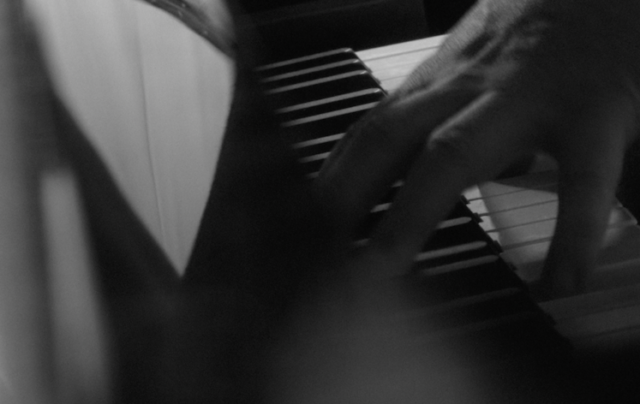
D might be for doc, but P is for piano, as evidenced in Vladimir Loginov’s latest opus that chronicles the instrument’s construction, from the felling of a tall pine in an Estonian forest to the tinkling of its ivories in a concert hall. P might also be for Pärt (Arvo), the illustrious Estonian whose “personal reflections on sound and silence” are weaved into this highly visual journey. For their film, the filmmakers gained exclusive access to the unreleased audio diaries of, arguably, the world’s most famous living composer.
“P is a rare, sensory exploration of how sound is born long before a single note of music is played,” producer Janika Möls (Korraks Film) tells Business Doc Europe. “The film completely dispenses with talking heads, traditional interviews, and background music. Instead, the raw industrial rhythms of the workshop—hammering, wood-carving, metal casting, and internal vibrations—form the film’s actual music.”
She further describes P as a black-and-white visual poem, one that resonates visually with the piano’s monochrome keys. “We use artistic lenses with subtle distortions and refractions to strengthen the poetic quality of the film and to capture the fragile, almost weightless nature of each moment.”
“At the same time, we contrast this visual delicacy with the brutal physical power of certain images and sounds,” she adds. “We see trees being cut down, heavy materials being shaped, and a glowing metal frame being cast at a metallurgical factory. This contrast between airiness and physical force is central to the film’s cinematic language.”
The film’s soundscape will, understandably, form a core element within the documentary. “Sound is just as important as the image. Using only real sounds from the different stages of production, we create an audiovisual symphony,” says Möls. “There are no dialogues. Only, occasionally, the voice of Arvo Pärt emerges from his exclusive audio diaries. His voice works like a tuning fork, bringing order to the chaos and creating harmony within the film. This ambitious cinematic vision is possible because of our exceptional creative team.”
P also promises to be a film in which virtuosity and the highest standards of workmanship are in evidence. “Vladimir recently discovered the amusing term ‘competence porn’ — a growing genre built around the pleasure of watching highly skilled people at work,” says the producer. “I like this expression because our film observes extraordinary craftsmanship in great detail. But he would describe our particular genre as ‘poetic competence porn,’ a film in which technical mastery becomes poetry.”
The film’s approximate budget is “a lean, realistic” €150,000, of which three-quarters is already in place via the Estonian Film Institute and Cultural Endowment. “Produced by Korraks Film, the project combines the logistical discipline and financial precision of high-budget commercial production with uncompromising artistic integrity,” says Möls. “The remaining financing gap is very specific and targeted primarily toward specialized sound post-production…specifically one with strong sound design infrastructure to collaborate with our sound designer Dmitry Natalevich.”
“With 75% of our budget already secured through national funds, we offer co-producers an accessible entry point into a high-profile, internationally resonant art-house project,” she underlines.
The film is currently in mid-production, with 50% of filming completed across Estonia, Finland, and Germany. “Hand-crafted instrument making is a rare, disappearing art, and we are locking in our post-production sound partners right now at Baltic Sea Docs to prepare for our final shoot and post-production pipeline heading toward a 2027 premiere,” says Möls.
In Riga, and later at Finnish Film Affair in Helsinki, Möls and director Loginov will be initiating conversations with international sales agents and festivals to get the film onto the A-list circuit, also to connect with TV broadcasters and platforms looking for “bold, poetic art-house documentaries.”
“Where does music begin? How are the sounds born that later transform into music? Can every sound be part of a harmonious musical work?” Loginov asks in his film notes.
“Estonia is historically a very musical country, and this musical essence is strongly tied to—or perhaps even based upon—the understanding and experiencing of nature’s harmony. The roar of the sea, the creaking of pines, the rustle of leaves. Natural minimalism is expressed at the highest level in many works by Estonian authors, such as the music of Arvo Pärt,” he adds.
“One of the oldest piano factories, Estonia, is located near the city center. Once, Estonia had around 100 factories producing pianos and grand pianos. I am interested in tracing the entire journey of creating this instrument: starting from the trees growing in the forest that are selected and felled, to the ore melted into metal for the piano’s heart and strings, up to assembly, tuning, and the birth of the final sound.”