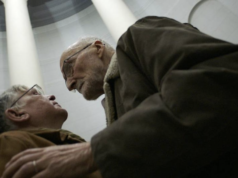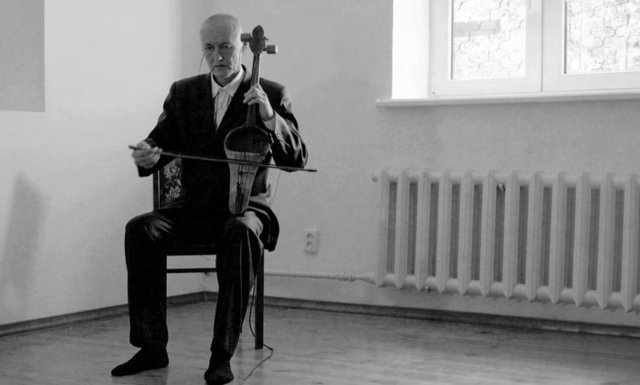
In Cords of Bliss, Janyl Jusupjan her older brother, a musician who has lived with serious hearing loss since childhood, yet one of Kyrgyzstan’s most respected musical performers, as he prepares the next generation of musicians. The film becomes an unexpected journey toward healing decades of silence between brother and sister, read the project notes.
“The film is not intended as a conventional portrait of a musician or a film about safeguarding an instrument,” Jusupjan tells Business Doc Europe. “The music gives us a way into a much more intimate story about two siblings trying to understand one another later in life. There is nevertheless a particular cultural urgency surrounding Bakyt and the kyl-kyyak. Its transmission became extremely fragile following the disruption and suppression of traditional culture during the Soviet period, and today some of these older practices are facing another kind of pressure with the growth of Islamic fundamentalism.”
There are, the director adds, very few people with Bakyt’s depth of embodied knowledge of the instrument, its repertoire, history and methods of teaching.
“What he carries cannot simply be reconstructed from an archive. For audiences, I think the uniqueness comes from this collision between something very specific – a little-known musical culture in Kyrgyzstan – and something completely universal: the impossibility of fully knowing someone within your own family,” the director continues.
“The film moves continually between the public Bakyt – musician, teacher, researcher, bearer of tradition – and the much more fragile and complicated person I know as my brother,” she says. “His hearing has also profoundly shaped his life. He grew up with serious hearing difficulties, experienced separation from the family as a child, and has often responded to the world through withdrawal and silence.”
“For film partners, the project offers unusually intimate access accumulated over several years,” she adds. “I am not entering Bakyt’s life as an outside observer. The family relationship is part of the dramatic situation of the film itself. The camera changes our relationship, sometimes creating closeness and sometimes resistance. That tension is important to me, because the film is also asking what happens when you begin to look seriously at someone whom you thought you already knew.”
Jusupjan has made several feature documentaries from Central Asia, often shot over long periods and under difficult production circumstances. Her Atirkul in the Land of Real Men premiered at IDFA in 2023. “My work has consistently grown out of long-term relationships with people and places rather than short production visits, and Cords of Blisscontinues that approach.”
“Another important strength is that a substantial body of material has already been filmed. We are not presenting only an idea at an early development stage. At the same time, significant filming still remains to be done. Some of the earlier material is important for its intimacy and history, but the film now needs further filming at the cinematic level I want for the finished work.”
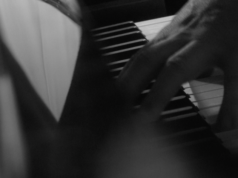
She describes the film’s visual presentation. “Cords of Bliss is being built through observation rather than explanation,” she says. “I am interested in the small physical details through which a person reveals himself: the movement of Bakyt’s hands on the kyl-kyyak, the tension in his body while listening, the way he corrects a student, the pauses before he answers, his silences, his humour and moments when he simply refuses the camera.”
“Music is naturally central, but I do not want to use it merely as illustration. I am interested in what happens before a sound is produced – concentration, bodily effort, touch, hesitation – and what remains after it disappears. Lessons, repetitions, corrections, mistakes and silence can be as important cinematically as finished performances,” Jusupjan adds.
She is filming in ranges of different environments, whether intimate family spaces, during performances, on journeys, or within villages and mountain landscapes in Kyrgyzstan. “The landscape matters, but I do not want Kyrgyzstan to become an exotic backdrop. The mountains and nomadic culture belong organically to Bakyt’s world and to our family history. The visual approach combines close observational filming with wider moments in which a human figure is placed within the physical environment.”
The production has already gained support in Kyrgyzstan, including the Kyrgyzfilm National Fund, and via the Chagaldak Production company, and the director has invested “substantially” in the project herself,” she tells BDE. “We are now looking to build the international side of the financing and establish the right European co-production partnership. The overall ambition is realistic: this is a character-driven creative documentary rather than a film requiring a large industrial production structure, but it needs strong editorial and post-production partners to bring the accumulated material to its full cinematic potential.”
“For me, the business plan and the artistic strategy are closely connected. I am looking for partners who understand that the value of the film lies precisely in its intimacy, duration and cultural specificity, and who can help us bring that very local story to an international audience without simplifying it.”
“I do not see the pitch as the end of development,” Jusupjan signs off. “For me it is part of the process of finding the people with whom this very personal film can grow into its final form.”