

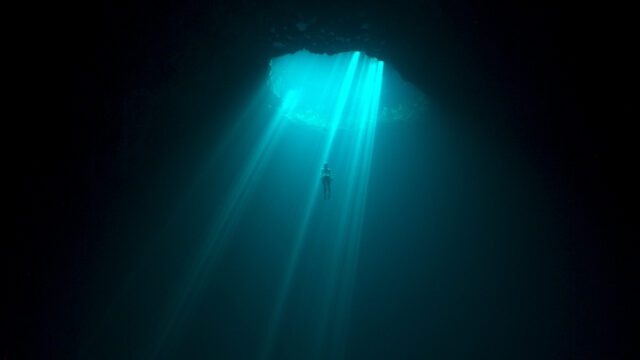
Freediving is among the most intoxicating of endeavours, whether in terms of participation or our observation of it on screen. It is also indescribably dangerous, at times demanding that divers submerge to depths of over 100 metres with one breath, returning to the surface sometimes more than four minutes later. Just mentioning the name of one deadly potential effect on the body – lung squeeze – is enough to strike terror into most folk.
One exponent of freediving is the great Italian Alessia Zecchini whom we see at the beginning of Laura McGann’s highly lauded Netflix doc The Deepest Breath, which world-premiered at Sundance 2023. In one continuous take, Alessia descends 101 metres in pursuit of a world record. Four minutes later, at the top of her ascent, she blacks out, her eyes open but registering no sign of life. For all intents and purposes, she seems dead. As her father comments in interview, “the price you pay is so high.”
But there is one person on hand who makes sure she remains alive, and that is Irishman Stephen Keenan who, back in 2013, decided to devote himself to the safety of others. When Alexey Molchanov, son of the great freediver Natalia Molchanova, attempted a world record dive in 2013 he got into severe difficulties, but Stephen descended to bring him to safety, and saved Alexey’s life against all the odds. At which point the modest Keenan assumed legendary status within the freediving community.
In the film, Zecchini and Keenan are profiled as adventurers, mavericks and thoroughly unique human specimens. Alessia was born to dive. She may have been denied access to competition with older divers until she was 18, but when she came of age she was astonishing, after having trained relentlessly throughout her teens. Her idol was the great Natalia Molchanova, and Alessia went on to become one of the world’s greatest freedivers.
Stephen came from a family which was rent apart when his father left home, and after his mother’s death from cancer. He was a curious boy, wanted to be an explorer and was determined to “live for today,” we are told in the film, and to “travel the less travelled road.” After many adventures across the world, he discovered freediving in Egypt, eventually setting up what was to become a world-renowned free-dive school in Dahab. Nearby was the infamous Blue Hole and its submarine arch, a coral cavern 55 meters (181ft) beneath the surface which had claimed the lives of 200+ divers, it is estimated.
Alessia was brilliant, ambitious and stubborn. Stephen was calm and masterly in his dedication to the business of safety, and to the divers in his charge. She was yin to his yang, and they were very much in love.
The Deepest Breath comes late to the close relationship between Alessia and Stephen, and when it does, it is handled with extreme delicacy. “There’s an element of respecting their privacy,” says director McGann. “It was important for us to just know where that line was.”
Stephen was the expert on hand when Alessia went for a series of audacious world records at the 2017 Vertical Blue championships (referred to as the Wimbledon of freediving). But their happiness was short-lived, because later that year the returned together to Dahab and the perilous Blue Hole…
The reason why all of this is written in the past tense is that, before the film’s end, one of Alessia and Stephen loses their life. The subsequent events are public record, but the narrative of The Deepest Breath is played out chronologically, and therefore you will have to view the film to see how the story ends…and how it continues…
When director Laura McGann discovered the story of Stephen and Alessia, and indeed the sport of freediving, she immediately dived deep into YouTube for research purposes. “Just watching these videos of people under the water, holding their breath, swimming along for three or four minutes, you’d have no edits. And I couldn’t believe what I was looking at, that these people seemingly didn’t have the urge to breathe and could comfortably spend that length of time under the water,” she explains to Business Doc Europe her amazement at what she was seeing. “I was fascinated. It was like discovering that there was a group of people who had learned how to fly…I had discovered people with a superpower.”
The fathers of both Alessia and Stephen agreed to participate in the project, with the latter giving McGann hours and hours of tapes of Stephen discussing his life and choices; audio which eventually shaped much of the narrative. “I thought, this changes everything because if Stephen can tell his own story, we could have the potential to tell the story in the moment,” she says. “It was something that kind of spoke to me about life and your choices and how you want to live your life on this earth for this short amount of time that you have. All the time from listening to Stephen, that’s the tone, that’s the message that I got from all of his interactions in his life – that he had this certain outlook that was different, and I was really intrigued by it.”
When McGann then contacted the friends of Alessia and Stephen within the freediving community, she was taken aback by the depth of feeling for the couple. “People felt like they wanted to tell this story very much. Every corner we turned people wanted to help us to, they had something to really say.” Through them she was also able to unearth a whole other treasure trove of dramatic dive footage that she would be incorporate into her film.
That said, she also needed new and original (and quite breathtaking) footage to tell the story, most notably to illustrate the “speck of dust” proportions of the diver to the vastness of the surrounding ocean. “You’re in the water, you’re surrounded by water, you can’t see the surface, you can’t see the bottom, and you realize how small you are in this universe, you’re just a speck of dust. And that was a shock that I always wanted to capture because it just encapsulated what it feels like, or the place free diving place brings you to,” she says.
McGann had a team of freedive and scuba underwater camera operators on hand (she isolates Julie Gautier for special mention) whose skills were sublime. “We’d get into the water and they’d go down to get the shot, pop back up, and then [they] would show me the shot. And I’d say, ‘that’s brilliant guys. Any chance you could do that again?’ And they would say, ‘yeah, no problem,’ and pop back down. It was like having a pod of dolphins on our crew that were able to just hold their breath, go down and shoot at such a speed as well. Forty seconds later you have your shot and everyone’s on the surface of the water again.”
When a film such as The Deepest Breath is released on a platform such as Netflix, the global effect is immediate, whether on emotional, entertainment or educational levels. After the Oscar-winning My Octopus Teacher, who wasn’t an immediate expert on soft-bodied, eight-limbed molluscs and their potential to change the human psyche for the better? Has McGann experienced a similar same effect with The Deepest Breath?
“I started out in theatre and I moved into film because sometimes there were more people on the stage than there would be in the audience,” she answers, at the same time explaining her decision to ply her trade in doc. “But I never expected to make something that was in so many households all over the world and that so many people would watch. It’s such an honour. I am as intrigued [by this subject] as the rest of the people, and it’s fun…but it’s totally surreal. And it is surreal as well because everyone seems to have watched it.”
What’s more, the appreciation for the film doesn’t stop at McGann’s door. “Even my granny is getting congratulated for it when she’s getting her hair done,” the director signs off on her film that looks destined to be a frontrunner during the upcoming awards season.
The Deepest Breath is A Netflix release of an A24, Motive Films, Ventureland production in association with Raw. Director: Laura McGannProducers: John Battsek, Sarah Thomson, Jamie D’Alton, Anne McLoughlin. Executive producers: Bart Layton, Ben Cotner, Emily Osborne. Co-producer: Robert Ford.





