

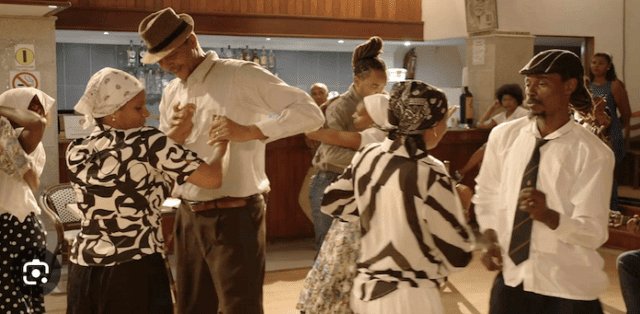
In his new film, Nôs Dança (a world premiere earlier this week in Doclisboa’s Heartbeat section) Rui Lopes da Silva accompanies his friend, dancer and choreographer António Tavares, on an epic journey across the Cape Verde islands. They travel by boat, bus and sometimes by foot in search of communities where locals still remember old dances like the ‘Lundum’, the ‘Batuko’ and ‘Funanna.’
There are obvious reasons why these dances are now under threat. The younger people no longer cherish them or have the patience to learn the intricate moves that some require. Thanks to the massive Cape Verdean diaspora, many from the country have taken the secrets of these dances abroad with them. Nonetheless, as Tavares roams through Cape Verde, he finds old-timers who still remember the old routines.
Da Silva lives in Portugal but his mother is from Cape Verde. “The idea of the film began at a New Year’s party at the house of a friend. During that night, we danced all the styles of dance of Cape Verde,” the director remembers.
After the party, be began to think in earnest about a documentary which would preserve the memory of the dances that gave them so much pleasure.
Tavares is a childhood friend whom the director has known for many years and who also has roots in Cape Verde. Da Silva told him his intention was to “rescue” some styles of Cape Verdean dance that might otherwise disappear.
On one level, it was a race against time. In the months since Da Silva and Tavares travelled to Cape Verde to make the film, two of their elderly interviewees have passed away. Others have fallen ill. The director is happy he managed to reach them, and to give them a platform, late in their lives. “It is my interest to interview them,” he says, making it clear that he didn’t want to speak to historians or sociologists. His subjects are the people who’ve grown up with the dances and know them at first hand.
The filming took around a month and involved constant travel. “My idea was to travel by boat,” the director notes. He acknowledges that he “shot a lot of hours…”
The film was produced by Isabel Machado, João Paradela and Joana Ferreira. It was made through companies C.R.I.M. and Éden Produções. Having shown the film at Doclisboa and in a festival in Sao Paulo, Da Silva would like to tweak it and add one dance routine which was cut out for length reasons. This was a sequence he filmed in a very remote village which he and Tavares were able to reach only after a two-hour journey by foot.
As the documentary shows, in Cape Verde, there are dances for every mood and every occasion., Some are wild and sensuous. Others are formal and sombre. They have different histories too. Some arrived in Cape Verde with slaves from Africa. Some were created in Cape Verde itself. The filmmakers record them all.
Ask the director why he is so obsessed with these dances and he answers that they take him back into his own past. “In my youth, I have danced all these dances – and I love to dance!”
No, the director isn’t as accomplished a dancer as his friend Tavares, who is the face (and sometimes the feet) of the film. “It was better to do it with Tony [in front of the camera] because he is a professional dancer. It’s like he was my eyes, looking for the dancers.”
Early on, the director hoped to attend some of the big popular parties held in communities across Cape Verde and to shoot the old dances there. As it happened, many of these parties didn’t happen because of the pandemic. Instead, he encouraged the communities to perform their dances specially for him. “I had to adapt,” he says with understatement of the resourcefulness he needed to show.
Throughout the documentary, there are sequences of kids wearing elaborate masks who turn up in front of Tavares but then seem to vanish into thin air. These children, da Silva explains, stand for “continuation, the future of the dances and of the culture for Cape Verde.” The director made these masks himself. They were constructed from old plastic containers, jars and lids.
Da Silva hopes his film will have two lives: one bringing the Cape Verde dances alive to a general audience and the other as a historical document. He and Tavares have elicited first-hand testimony from their interviewees about the story behind the dances that is bound to be of value to historians and anthropologists.
“It’s a film I think is important to show in schools. We have Cape Verdeans in Portugal who don’t have [a sense of] identity and what it means to be Cape Verdean,” the director reflects. Young viewers from the Cape Verde diaspora who saw the film in Doclisboa told the director that they don’t know their own culture – or the dances that their parents and ancestors used to perform. Nôs Dança therefore gave them an insight into their own family lives.
Having finished the doc, Da Silva is now looking to make his first fictional feature, Casa De Lata. This will again be set in Cape Verde. “My universe is always Cape Verde,” he declares of the land that continues to fire his creative imagination.





